<?xml version="1.0" encoding="utf-8"?><feed xmlns="http://www.w3.org/2005/Atom" ><generator uri="https://jekyllrb.com/" version="4.4.1">Jekyll</generator><link href="https://rcanand.com/feed.xml" rel="self" type="application/atom+xml" /><link href="https://rcanand.com/" rel="alternate" type="text/html" /><updated>2026-11-07T18:05:04+00:00</updated><id>https://rcanand.com/feed.xml</id><title type="html">Anand Ramanathan (RC)</title><subtitle>RC&apos;s personal site. AI, Software, Product, Autodidact. Interests include AI/AGI, pure math, theoretical physics, mindfulness, reading, movies and shows, games.</subtitle><author><name>Anand Ramanathan</name></author><entry><title type="html">Google at current market price by minimax-m3.1-flash</title><link href="https://rcanand.com/blog/goog-buy/" rel="alternate" type="text/html" title="Google at current market price by minimax-m3.1-flash" /><published>2026-10-30T00:00:00+00:00</published><updated>2026-10-30T00:00:00+00:00</updated><id>https://rcanand.com/blog/goog-buy</id><content type="html" xml:base="https://rcanand.com/blog/goog-buy/"><![CDATA[<blockquote>
  <p>This is for informational purposes only, not to be considered financial or investment advice - AI generated response about US stock market securities - please check responses.</p>
</blockquote>

<h2 id="bottom-line">Bottom line</h2>

<p>At <strong>~$282</strong> (GOOGL, intraday Oct 30, 2026, ~11:45 ET; previous close $283.82), Alphabet is a <strong>“yes, but scale it and give it time” buy</strong> — not a “back up the truck” buy. The stock has just had its worst day ever (‑12.6% on Oct 29, ~$500B of market value erased), the multiple is no longer demanding (~18.6x 2027 EPS excluding investment gains, per Carlson; 20.5x forward GAAP; ~18x EV/EBITDA), and the legal worst case has been avoided. But the thing you are actually buying is an unresolved question: <strong>does search monetization survive the AI transition while Alphabet spends $300B+ a year?</strong> That is not a one-quarter question, so the entry price matters less than position sizing and time horizon.</p>

<hr />

<h2 id="what-actually-happened-q3-2026-reported-oct-28">What actually happened (Q3 2026, reported Oct 28)</h2>

<table>
  <thead>
    <tr>
      <th>Metric</th>
      <th>Q3 2026</th>
      <th>Consensus</th>
      <th>Verdict</th>
    </tr>
  </thead>
  <tbody>
    <tr>
      <td>Revenue</td>
      <td>$127.58B (+25% y/y)</td>
      <td>$128.22B</td>
      <td>Miss</td>
    </tr>
    <tr>
      <td>Adj. EPS</td>
      <td>$2.67 (‑7% y/y)</td>
      <td>$3.02</td>
      <td>Miss</td>
    </tr>
    <tr>
      <td>Operating income</td>
      <td>$40.58B (31.8% margin)</td>
      <td>$43.19B</td>
      <td>Miss</td>
    </tr>
    <tr>
      <td>Free cash flow</td>
      <td><strong>‑$9.07B</strong></td>
      <td>+$2.70B</td>
      <td>Big miss</td>
    </tr>
    <tr>
      <td>Capex</td>
      <td>$51.36B</td>
      <td>$55.09B</td>
      <td>Under-spent</td>
    </tr>
    <tr>
      <td>Cloud revenue</td>
      <td>$30.71B (+103%)</td>
      <td>$28.7B</td>
      <td>Beat</td>
    </tr>
    <tr>
      <td>Search revenue</td>
      <td>$63.35B (+12%, vs +17% in Q2)</td>
      <td>$64.96B</td>
      <td>Miss</td>
    </tr>
  </tbody>
</table>

<p>First top-and-bottom-line miss in ~4 years. Notes that matter: the FCF hole was cushioned by a <strong>$5.2B EU fine payment</strong> and a TPU inventory build (so “true” burn was ~‑$4B); <strong>search growth decelerated for the second straight quarter</strong> and AI Mode monetizes less per query than classic search; <strong>Cloud segment operating income tripled to $11.1B</strong> with a <strong>$561B backlog</strong> (~$308B to be recognized within 24 months); Gemini app hit <strong>1B users</strong>.</p>

<h2 id="where-the-price-sits">Where the price sits</h2>

<ul>
  <li>‑30.8% from the May 2026 high of $408.61; 52-week low $270.70 (set Nov 2025).</li>
  <li><strong>YTD 2026: ~‑11%</strong> vs S&amp;P 500 <strong>+13%</strong>, MSFT <strong>+10%</strong>, AMZN <strong>+6%</strong> — Alphabet is the clear laggard of the AI cohort.</li>
  <li>Trailing GAAP P/E 14.8x “lowest since 2012” — <strong>this is optical</strong>. TTM net income of $235.7B includes ~$129B of investment gains (SpaceX/Anthropic marks; Q2 alone was +$99B, Q3 was ‑$8.7B). On core earnings it’s ~26x trailing, ~18.6x 2027E, ~15.5x 2028E (ex-marks).</li>
  <li>Cash $265B, debt $125.1B (vs $21.6B a year ago), <strong>purchase commitments $924B</strong> + $152B pre-commencement leases. TTM FCF $19.7B, ‑73% y/y (FCF margin 4.2%). Citi expects Alphabet, Meta and Amazon all in <strong>negative FCF in 2027 and 2028</strong> on $801B of combined 2027 capex.</li>
  <li>Management is selling stock into the crash: <strong>~$27B left of a $40B ATM program</strong> (which is partly why CNBC’s Investing Club passed). Analyst consensus is still “Strong Buy” (58 analysts), avg PT $408; BofA cut $430→$380 and reiterated Buy.</li>
</ul>

<h2 id="the-bull-case-why-this-is-buyable-here">The bull case (why this is buyable here)</h2>

<ol>
  <li><strong>Multiple reset without business collapse.</strong> Revenue +25%, operating margin expanded 1.3pp to 31.8%, Cloud doubling, Gemini at 1B users — yet ~18x EV/EBITDA and ~18–19x forward earnings for a business with $500B revenue, 32% operating margins, 44% ROE, 24% ROIC and net cash.</li>
  <li><strong>Cloud is inflecting.</strong> $30.7B revenue (+103%), tripled segment operating income, $561B backlog, 18 product lines each &gt;$1B. Citi now models <strong>$62B of TPU revenue in 2027</strong> — Google selling AI silicon externally, not just consuming it.</li>
  <li><strong>Antitrust risk is mostly behind.</strong> The Sept 2025 remedy kept Chrome and Android, banned exclusive defaults, required data sharing. Google appealed Oct 2, 2026 and DOJ cross-appealed (seeking Chrome divestiture) — a tail risk, not the base case.</li>
  <li><strong>The AI-cannibalization scare may be overdone.</strong> Queries grew at the fastest rate in 5 years; management attributes the revenue gap mainly to FX, EU de-minimis changes hitting APAC advertisers, and World Cup comps. BofA sees a search-growth uptick as early as Q1 as AI Overview ads roll out internationally.</li>
  <li><strong>Sentiment is washed out.</strong> Worst single-day market-cap loss in company history, lowest P/E in 14 years, and a sector-wide AI-capex de-rating (Amazon/Intel spooked the tape again this morning; Nasdaq futures ‑2%).</li>
</ol>

<h2 id="the-bear-case-why-you-shouldnt-buy-the-whole-position">The bear case (why you shouldn’t buy the whole position)</h2>

<ol>
  <li><strong>The cash flow statement, not the P/E, is the binding constraint.</strong> FCF was negative for a second straight quarter and is consensus-negative into 2027–28. Capex goes from $195–205B (2026) to <strong>&gt;$300B (2027)</strong>.</li>
  <li><strong>That spending is being financed with dilution and debt</strong>, plus $924B of purchase commitments already locked in. If AI demand disappoints, you own the debt and the depreciation.</li>
  <li><strong>Earnings optics are about to get worse.</strong> Consensus FY2027 EPS ($15.14) is <em>below</em> FY2026 ($16.55) precisely because the equity-mark gains don’t repeat. D&amp;A is compounding fast ($28.5B TTM vs $21.1B FY2025).</li>
  <li><strong>Competitive evidence is genuinely mixed.</strong> Total ad revenue +10.5% vs Meta +26%. Gene Munster (Deepwater) called management’s explanations “excuses.” AI Mode revenue per query is <em>lower</em> than classic search — that’s the bear’s single most important data point.</li>
  <li><strong>The company is selling stock into the weakness</strong>, which is a poor signal for near-term management confidence.</li>
</ol>

<h2 id="how-id-frame-the-decision">How I’d frame the decision</h2>

<ul>
  <li><strong>Buy</strong> if: you have a 3‑5 year horizon, you already own MSFT/AMZN/META and want the cheapest quality name in the cohort, and you can tolerate 20–30% drawdowns (a further derating to 15x 2027 EPS ≈ $215 is entirely possible if search growth slips into single digits).</li>
  <li><strong>Wait / size small and stage in</strong> if: you need the money inside 12 months, you’re already heavily exposed to AI-capex names, or you can’t stomach earnings-driven multiple swings. A reasonable approach: 1/3 now, 1/3 after the Q4 print (early Feb 2027) confirms the 2027 capex number, 1/3 on evidence that AI Mode monetization converges toward classic search.</li>
  <li><strong>Specific tripwires to watch:</strong> Q4 search growth (needs to hold ≥12%) and the FX/ad-commentary bridge; whether AI Overview ads in the US lift revenue per query; the 2027 capex guide at the Q4 call; FCF and the ATM issuance pace; Cloud backlog conversion ($561B → revenue); and how large a 2027 guide would have to be to break the thesis (Citi’s $308B is already the base case; $350B+ would be a red flag).</li>
</ul>

<p><strong>My conclusion:</strong> at $282 the risk/reward is attractive relative to the rest of the AI cohort and to Alphabet’s own history — the market is pricing permanent search impairment plus permanent cash burn. I think that combination is over-discounted. But this is a <em>show-me</em> stock where the next two quarters of search monetization data matter more than today’s entry, and where position sizing should reflect a genuinely unresolved technology transition, not a dip.</p>

<h2 id="if-in-the-us-means-youre-buying-from-outside-the-us">If “in the US” means you’re buying from outside the US</h2>

<ul>
  <li><strong>Ticker:</strong> GOOGL (Class A, voting) and GOOG (Class C, non-voting) are economically near-identical; same dividend, same economics.</li>
  <li><strong>Dividend withholding:</strong> the $0.88/yr dividend (0.31% yield) is negligible either way, but US withholding is 30% unless your country’s treaty rate applies — file a <strong>W‑8BEN</strong> with the broker.</li>
  <li><strong>US estate tax (the real trap):</strong> a non-resident, non-citizen individual gets only a <strong>$60,000 unified credit</strong> against US-situs assets, so holding more than roughly $60–80k of GOOGL directly can expose the excess to US estate tax at up to 40% on death. Many non-US investors use an Irish-domiciled UCITS ETF (CSPX/CNDX) or a local wrapper instead. Check this with a tax adviser in your jurisdiction before sizing.</li>
  <li><strong>Also:</strong> FX exposure (USD vs your currency) and, depending on where you live, local reporting rules on foreign holdings (e.g., Indian LRS limits and TCS on remittances). If you’re a US taxpayer, none of this applies — GOOGL is a US C-corp, dividends are qualified, and there’s no withholding.</li>
</ul>

<h2 id="business-impact-and-revenue-drivers">Business impact and revenue drivers</h2>

<p>Alphabet is three businesses sharing one AI cost base, and the investment case depends on knowing which one you own: an ad-funded search franchise that is 96% of operating profit, a cloud business that just doubled, and a portfolio of options (Waymo, Gemini subscriptions, commerce protocols) that the market currently assigns no value.</p>

<table>
  <thead>
    <tr>
      <th>Segment</th>
      <th>Q3’26 revenue</th>
      <th>% of total</th>
      <th>y/y</th>
      <th>Op. income</th>
      <th>Margin</th>
    </tr>
  </thead>
  <tbody>
    <tr>
      <td>Google Services</td>
      <td>$96.30B</td>
      <td>75%</td>
      <td>+11%</td>
      <td>$39.2B</td>
      <td>40.7%</td>
    </tr>
    <tr>
      <td>— Search &amp; other ads</td>
      <td>$63.35B</td>
      <td>50%</td>
      <td>+12%</td>
      <td>—</td>
      <td>—</td>
    </tr>
    <tr>
      <td>— YouTube ads</td>
      <td>$11.21B</td>
      <td>9%</td>
      <td>+9%</td>
      <td>—</td>
      <td>—</td>
    </tr>
    <tr>
      <td>— Google Network</td>
      <td>$7.5B</td>
      <td>6%</td>
      <td>+1%</td>
      <td>—</td>
      <td>—</td>
    </tr>
    <tr>
      <td>— Subscriptions, platforms &amp; devices</td>
      <td>$14.3B</td>
      <td>11%</td>
      <td>+11%</td>
      <td>—</td>
      <td>—</td>
    </tr>
    <tr>
      <td>Google Cloud</td>
      <td>$30.71B</td>
      <td>24%</td>
      <td><strong>+103%</strong></td>
      <td>$11.12B</td>
      <td>36.2% (vs 23.7% a year ago)</td>
    </tr>
    <tr>
      <td>Other Bets</td>
      <td>$0.372B</td>
      <td>0.3%</td>
      <td>—</td>
      <td>‑$2.0B</td>
      <td>—</td>
    </tr>
    <tr>
      <td>Alphabet-level activities</td>
      <td>—</td>
      <td>—</td>
      <td>—</td>
      <td>‑$7.7B</td>
      <td>shared AI R&amp;D</td>
    </tr>
    <tr>
      <td><strong>Total</strong></td>
      <td><strong>$127.58B</strong></td>
      <td> </td>
      <td><strong>+25%</strong></td>
      <td><strong>$40.58B</strong></td>
      <td><strong>31.8%</strong></td>
    </tr>
  </tbody>
</table>

<p>Advertising is $82.01B — 64% of revenue — at very high incremental margins, and traffic acquisition costs of $16.4B grew <em>more slowly</em> than ads (+10% vs +11%), a small but real sign of mix shifting toward owned properties (YouTube, Android, Chrome). The 13th consecutive quarter of double-digit revenue growth puts Alphabet at a half-trillion-dollar run rate.</p>

<h3 id="search-this-is-a-monetization-problem-not-a-demand-problem">Search: this is a monetization problem, not a demand problem</h3>

<p>The bear case says AI is eating search. The usage data does not support that. Year-over-year query growth is the <strong>highest in five years</strong>. AI Mode queries run ~3x longer than traditional searches; one in five AI Mode searches globally uses voice, images or documents; visual search crossed 50B queries a month. Schindler’s most important sentence was that <strong>the majority of AI Mode queries are incremental</strong> — new demand, not cannibalized classic search — and they skew to upper-funnel, commercial intent. Sponsored click-through rates in AI Mode are already roughly equal to organic product-list CTR.</p>

<p>What broke in Q3 was revenue <em>per</em> query. Search grew 12%, down from 17% in Q2, and management decomposed the deceleration into four parts: <strong>FX was the single largest driver</strong> (headwinds concentrated in Search and YouTube ads), the EU’s removal of the de-minimis exemption hurt APAC retail advertisers, media spend normalized after a World Cup-boosted June, and <strong>AI Mode monetizes less than classic search</strong>. Ads in AI Overviews and AI Mode are only now scaling internationally, alongside US multi-turn ads.</p>

<p>The offsetting pull is ad quality. Gemini generated <strong>1.5 billion campaign assets in Q3, up more than 7x year over year</strong>; Discover ads delivered 18% incremental advertiser value; Telstra saw a 52% conversion lift and 36% lower cost per order through AI Max. Better models raise advertiser ROI, which is a pricing-power argument for the auction independent of query volume.</p>

<p>Q4 is guided to look worse on the same lines: a slightly larger FX headwind, and roughly two points of growth lapping as the Q3’25 search acceleration rolls off.</p>

<h3 id="subscriptions-and-youtube-the-hedge-against-ad-cyclicality">Subscriptions and YouTube: the hedge against ad cyclicality</h3>

<p>$14.3B (+11%), and subscriptions are now growing faster than ads. YouTube Music and Premium passed <strong>150 million subscribers</strong> (including trials), Premium Lite is a deliberate price-ladder for volume, and <strong>Google One AI plans are Alphabet’s fastest-growing subscription product</strong>. YouTube ads grew 9% to $11.21B, with living room now accounting for over a third of YouTube ad revenue, 20M+ videos uploaded daily, 1.3M+ channels on YouTube Shopping and Amazon joining the platform. Consumer AI at Google does not have to be monetized through ads — it can be sold into existing subscriptions at $20–$250 per month tiers, through a Gemini app that crossed 1 billion monthly active users (up from 950M in August), the fastest-growing product in the company’s history. <strong>Gemini app revenue is not disclosed anywhere</strong>, which makes it the largest unpriced line in the story.</p>

<h3 id="google-cloud-the-part-of-the-business-that-genuinely-changed">Google Cloud: the part of the business that genuinely changed</h3>

<p>$30.71B (+103%), operating income tripled to $11.12B, margin 36.2%, and a <strong>$561B backlog</strong> — up from $514B last quarter — with roughly 55% (~$308B) scheduled for recognition within 24 months. That is about two quarters of revenue already contracted.</p>

<p>Inside it: GCP is the vast majority of revenue, and management said growth excluding TPU system sales was “again very, very strong” (Kurian declined to quantify it — the number investors want and won’t get). The TPU platform has become a real revenue line: 8t for training at 2.7x better training performance and 8i for inference at 80% better price-performance; more than 100 significant TPU customers; delivery partnerships with <strong>Crux AI and Oracle</strong> into third-party data centers; <strong>Apple scaling pretraining on Google TPUs</strong>; frontier labs (Mirendil, Physical Intelligence); Citadel Securities and Jump Trading. Gemini Enterprise sits on top of it: ~90% of the Fortune 100 use it, customers who used it in Q3’25 <strong>quadrupled their spend</strong> year over year, more than 100 million seats have been sold for knowledge work, and 2,600 customers have consumed at least 100B tokens. The AI flywheel is multi-line — using Gemini drives compute, storage for agent memory, database for context, and cybersecurity.</p>

<p>Two caveats: TPU system sales are hardware-flavored (lower margin, working-capital heavy, NVIDIA-competitive) and they flatter the optics; and Cloud margin faces guided near-term headwinds from third-party bridging capacity that came online only at the end of Q3.</p>

<h3 id="the-model-layer-gemini-4-argon-and-gemini-4-carbon">The model layer: Gemini 4 Argon and Gemini 4 Carbon</h3>

<p>Two frontier releases in four weeks is the cadence of a company that believes it is winning — and it is the most important new variable in the business, because model capability is the upstream input to every revenue line above.</p>

<p><strong>Gemini 4 Argon</strong> (announced Sept 30, 2026) was built for long-horizon software engineering, enterprise knowledge work and cyber defense: 1M-token context, up to 1M output tokens, introductory pricing of <strong>$2/$10 per million input/output tokens</strong> with cached input at 95% off — half the price of Claude Opus 5.5. It posted the highest or tied score in 13 of 18 categories on Google’s own benchmark table, ranked #1 on LMArena as of October 15 (1524), #1 of 45 on IOI, and #3 of 27 on the independent Vals Index (69.24%). It is not, however, the best at everything: it trails Claude Opus 5.5 on Terminal-Bench 4.0 (57.4% vs 66.4%) and GPT-6 Astra on FrontierSWE v2 (55% vs 65.5%). Access was deliberately gated to trusted cyber defenders through the Fairwind program.</p>

<p><strong>Gemini 4 Carbon</strong>, launched hours before the Q3 print, is Google’s most capable model: <strong>#1 on the Artificial Analysis Intelligence Index v5 with 59, one point ahead of Claude Opus 5.5</strong>; new state of the art in cybersecurity with 88.2% on SEC-bench Pro, 71% on CWE-bench and 54.8% on ExploitGym; more than double Argon’s success rate at generating vulnerability-free code; Google’s Chrome team reported it producing high-quality security patches more than 10x better than an unnamed rival; and a 89-point WebDev Arena gain to 1,768. It launches at the same $2/$10 introductory price with the same 95% cached-input discount.</p>

<p>Why this matters commercially, and where it does not yet show up in the numbers:</p>

<table>
  <thead>
    <tr>
      <th>Model capability</th>
      <th>Revenue vector</th>
      <th>Evidence today</th>
      <th>Still unproven</th>
    </tr>
  </thead>
  <tbody>
    <tr>
      <td>Long-horizon agentic capability</td>
      <td>Gemini Enterprise seats, attached compute/storage/database/security</td>
      <td>&gt;100M seats sold; ~90% of Fortune 100; Q3’25 users quadrupled spend</td>
      <td>Seats are sold, not yet disclosed as revenue; churn unknown</td>
    </tr>
    <tr>
      <td>Developer demand</td>
      <td>API tokens → Cloud consumption; TPU system sales</td>
      <td>~32B tokens/min (+40% q/q, &gt;4x y/y); &gt;100 significant TPU customers</td>
      <td>Ex-TPU Cloud growth not quantified</td>
    </tr>
    <tr>
      <td>Consumer reach</td>
      <td>Google One AI plans, YouTube Premium, Gemini app monetization</td>
      <td>1B Gemini app MAU; YouTube subs 150M+; Google One fastest-growing subscription</td>
      <td>Gemini app revenue undisclosed; conversion rate unknown</td>
    </tr>
    <tr>
      <td>Inference efficiency (3.8 Flash at $0.75/$3.75 per million tokens)</td>
      <td>Cost per AI Mode query → Search gross margin</td>
      <td>Query growth accelerating while Flash class gets smarter</td>
      <td>Cost per query never disclosed</td>
    </tr>
    <tr>
      <td>Ad creative and ranking</td>
      <td>CPC/pricing power</td>
      <td>1.5B campaign assets in Q3 (+7x); 18% incremental advertiser value</td>
      <td>Effect on cost-per-click not disclosed</td>
    </tr>
    <tr>
      <td>Long-horizon agents</td>
      <td>New ad surface: UCP, Universal Cart, Agent Payments Protocol</td>
      <td>Hundreds of thousands of brands onboard; Nike, Chewy, Tapestry live</td>
      <td>Whether agents bid in the auction or bypass it</td>
    </tr>
    <tr>
      <td>Internal productivity</td>
      <td>Offsets R&amp;D +36% and headcount +7.7%</td>
      <td>Teams using Argon shipped 35% more code with 30% fewer errors</td>
      <td>Not quantified in dollars</td>
    </tr>
  </tbody>
</table>

<p>Three caveats on the model story. First, <strong>leadership has decayed into a commodity</strong>: GPT-6 Astra, GPT-6.1 Sol, Claude Opus 5.5/Sonnet 5.5/Fable 5.1, Meta’s Muse and Spark, DeepSeek’s V4.1-Flash — a frontier advantage measured in points on an index is a marketing asset with a shelf life of weeks, so durable value has to accrue to distribution and ads, not to API margin. Second, <strong>the cost of serving is about to step up</strong>: introductory pricing on Argon, Carbon and Flash expires between November 30 and December 31, 2026, and Carbon’s measured time-to-first-token of roughly 100 seconds is slow for interactive consumer use — which is exactly why Pichai said Google is building distilled versions of Carbon to run at 1-billion-user scale. Third, <strong>Carbon was access-gated on day one</strong>, so the second model of the quarter contributed essentially nothing to Q3 revenue; it is a Q4’26/2027 story.</p>

<p>Org matters here too. In August 2026, Demis Hassabis moved to Chair of Google DeepMind and Alphabet Chief Scientist (keeping Isomorphic Labs), Koray Kavukcuoglu rose to SVP Google DeepMind, and <strong>Jeff Dean left after 27 years</strong> to found Discovery Loop with Sanjay Ghemawat, Oriol Vinyals and Quoc Le — with Google as founding investor and cloud partner. Losing a quarter of the leadership bench that built Google’s search and ML infrastructure is a genuine risk to a model lead that only shows up as slowed cadence or missed launches. Offsetting it: Gemma has passed 900M downloads, Google’s Cyber model is already live and selling, and the release cadence since August (Argon, then Carbon) has not visibly slipped.</p>

<h3 id="the-cost-side-is-where-the-cash-goes">The cost side is where the cash goes</h3>

<table>
  <thead>
    <tr>
      <th>Cost line</th>
      <th>Q3’26</th>
      <th>y/y</th>
    </tr>
  </thead>
  <tbody>
    <tr>
      <td>Cost of revenue</td>
      <td>$51.4B</td>
      <td>+24%</td>
    </tr>
    <tr>
      <td>— Traffic acquisition cost</td>
      <td>$16.4B</td>
      <td>+10% (ads +11%)</td>
    </tr>
    <tr>
      <td>— Other cost of revenue</td>
      <td>$35.1B</td>
      <td>+32% (TPU hardware, depreciation, content, energy)</td>
    </tr>
    <tr>
      <td>R&amp;D</td>
      <td>—</td>
      <td><strong>+36%</strong> (AI talent + depreciation)</td>
    </tr>
    <tr>
      <td>Sales &amp; marketing</td>
      <td>—</td>
      <td>+22% (Gemini)</td>
    </tr>
    <tr>
      <td>G&amp;A</td>
      <td>—</td>
      <td>‑17%</td>
    </tr>
    <tr>
      <td>Stock-based comp (TTM)</td>
      <td>$30.4B</td>
      <td>~6.5% of revenue</td>
    </tr>
    <tr>
      <td>D&amp;A (TTM)</td>
      <td>$28.5B</td>
      <td>vs $21.1B FY25</td>
    </tr>
    <tr>
      <td>Headcount</td>
      <td>204,757</td>
      <td>+7.7% y/y</td>
    </tr>
  </tbody>
</table>

<p>Rough arithmetic on my part: a $200B/yr capex run at a blended life of roughly eight years adds about $25B of annual depreciation as it rolls on, which would push D&amp;A from ~$28B TTM toward $50B+ by 2028–29 — 8–9% of revenue against 6.1% today. That alone can absorb most of the operating leverage from 25% revenue growth, which is why consolidated margin compresses even in a strong growth year. Sixty-five percent of technical infrastructure is servers and networking on six-year lives; 35% is data centers on seven-to-40-year lives.</p>

<h3 id="two-items-hiding-behind-the-earnings">Two items hiding behind the earnings</h3>

<p><strong>The equity portfolio is a mark-to-market lottery bolted to EPS.</strong> Cash and marketable securities are $265.1B, including <strong>$90.4B of marketable equity securities</strong>; the SpaceX stake alone swung +$99B of “revenue” in Q2 and <strong>‑$8.7B in Q3</strong>. Until those marks are stripped out, any P/E on this company is noise.</p>

<p><strong>The commitments are the real leverage.</strong> $125.1B of long-term debt (from $21.6B a year earlier), <strong>$924B of future purchase commitments</strong> and $152B of pre-commencement leases. Inventory rose to $13.3B from $2.4B at year-end 2025 — TPU systems built against signed contracts, so contract-backed rather than speculative, but cash that leaves before revenue arrives. The mitigating arithmetic: Alphabet’s pre-AI ROIC was above 30% against a ~10.5% cost of capital, so even a mediocre return on $300B a year of AI spend clears the hurdle that would sink a lower-return business.</p>

<h3 id="what-to-watch-each-quarter">What to watch each quarter</h3>

<table>
  <thead>
    <tr>
      <th>Metric</th>
      <th>Latest</th>
      <th>Thesis-changing threshold</th>
    </tr>
  </thead>
  <tbody>
    <tr>
      <td>Search revenue growth</td>
      <td>+12%</td>
      <td>Below 10% while query growth holds = monetization structurally impaired</td>
    </tr>
    <tr>
      <td>AI Mode monetization</td>
      <td>Lower per query; ads expanding globally</td>
      <td>Sponsored CTR parity with organic in more markets</td>
    </tr>
    <tr>
      <td>Query growth</td>
      <td>5-year high</td>
      <td>Negative = demand thesis broken</td>
    </tr>
    <tr>
      <td>Cloud revenue ex-TPU</td>
      <td>“Very strong” (undisclosed)</td>
      <td>Slowing = TPU systems were carrying the number</td>
    </tr>
    <tr>
      <td>Cloud backlog</td>
      <td>$561B (+9% q/q)</td>
      <td>Backlog growing slower than revenue = forward book deteriorating</td>
    </tr>
    <tr>
      <td>Cloud margin</td>
      <td>36.2%</td>
      <td>Structural drift below low-30s as hardware mix rises</td>
    </tr>
    <tr>
      <td>Inventory</td>
      <td>$13.3B</td>
      <td>Build without revenue catch-up, or writedowns</td>
    </tr>
    <tr>
      <td>TAC / ad revenue</td>
      <td>~20.0%</td>
      <td>Rising = giving economics to partners</td>
    </tr>
    <tr>
      <td>Subscriptions, platforms &amp; devices</td>
      <td>$14.3B, +11%</td>
      <td>The Google One AI plan line to watch, not ads</td>
    </tr>
    <tr>
      <td>Gemini app / paid conversion</td>
      <td>1B MAU, revenue undisclosed</td>
      <td>Any disclosure of Gemini app or AI-plan revenue</td>
    </tr>
    <tr>
      <td>Model cadence</td>
      <td>Argon (Sept 30), Carbon (Oct 28)</td>
      <td>Post-promo pricing; access beyond Fairwind; further senior departures</td>
    </tr>
    <tr>
      <td>D&amp;A</td>
      <td>$28.5B TTM</td>
      <td>The silent margin killer</td>
    </tr>
    <tr>
      <td>Other Bets</td>
      <td>$372M revenue, ‑$2.0B loss</td>
      <td>Waymo: 300M+ autonomous miles, 15 US cities, San Antonio/San Diego/Tampa live, Canada/Germany/Singapore/Spain next</td>
    </tr>
  </tbody>
</table>

<h3 id="what-the-business-says-about-the-thesis">What the business says about the thesis</h3>

<p>The operating business is stronger than the quarter’s optics: revenue at a half-trillion run rate, Cloud doubling with $561B contracted, subscriptions outgrowing ads, Gemini at a billion users, and query demand at a five-year high. What broke the stock was not demand — it was search monetization growing slower than queries, a cash flow statement that turned negative because the buildout is funded with debt, contracts and equity issuance, and an earnings line polluted by a SpaceX mark.</p>

<p>The models are the hinge. Argon and Carbon put Google at or near the frontier of intelligence, and frontier capability is what converts a $30B Cloud business into a compounding one, a 1-billion-user Gemini funnel into a subscription business, and AI Mode from a monetization drag into a defensible surface. But the market will now demand the proof in a currency it hasn’t seen yet: Cloud revenue ex-TPU, Gemini app revenue, AI-plan subscriptions, and revenue per AI Mode query. Carbon launched two hours before the print with access restricted to a handful of cyber defenders, so the model story and the revenue story are running about two quarters apart — and it is that gap, not the benchmarks, that determines whether Alphabet is cheap at ~20x forward earnings excluding investment marks.</p>

<p><em>Prices and figures as of Oct 30, 2026 (~11:45 ET). Consensus, targets and capex estimates are the Street’s, not facts. This is analysis, not investment advice.</em></p>]]></content><author><name>Anand Ramanathan</name></author><category term="finance" /><category term="ai-generated" /><category term="investment" /><category term="minimax-m3-1-flash" /><summary type="html"><![CDATA[A friend asked - Is google a buy at current market price - I asked minimax-m3.1-flash]]></summary></entry><entry><title type="html">401k options for person in their 20s when quitting job in the USA</title><link href="https://rcanand.com/blog/401k-options/" rel="alternate" type="text/html" title="401k options for person in their 20s when quitting job in the USA" /><published>2026-08-05T00:00:00+00:00</published><updated>2026-08-05T00:00:00+00:00</updated><id>https://rcanand.com/blog/401k-options</id><content type="html" xml:base="https://rcanand.com/blog/401k-options/"><![CDATA[<blockquote>
  <p>This is for informational purposes only, not to be considered financial advice - AI generated response about 401k options - please check responses.</p>
</blockquote>

<p>Here’s a research-backed rundown of the four main options (plus a few extras) for a 20-something quitting a job in the USA, with citations.</p>

<h2 id="first-three-quick-checks-before-choosing">First, three quick checks before choosing</h2>

<ul>
  <li><strong>Vesting</strong>: If you haven’t worked long enough to be vested, part or all of the employer match is forfeited when you quit (employee contributions are always 100% yours). Check your plan’s vesting schedule before making any decision.</li>
  <li><strong>Your plan’s quality</strong>: Fee levels, fund lineup, and admin fees vary wildly between plans. This matters more than any other factor.</li>
  <li><strong>Outstanding 401(k) loan</strong>: If you have one, leaving usually triggers repayment, typically by your tax-filing deadline (including extensions); an unpaid balance becomes a taxable distribution, possibly plus the 10% penalty. See <a href="https://smartasset.com/retirement/how-to-repay-401k-loan-after-leaving-job">SmartAsset’s guide</a> and the <a href="https://www.caryfixedincome.com/blog/401k-loan-rules-after-leaving-your-job/">IRS overview of 401(k) loan rules after termination</a>.</li>
</ul>

<p>The standard framework of four options is confirmed by Fidelity (“Generally, you have 4 options… keep it with your previous employer, roll it into an IRA, roll it into a new employer’s plan, or cash it out”) — <a href="https://www.fidelity.com/learning-center/smart-money/what-happens-to-your-401k-when-you-leave-a-job">Fidelity: What happens to your 401(k) when you leave a job</a>. Also see <a href="https://investor.vanguard.com/investor-resources-education/article/what-happens-401k-when-you-quit">Vanguard’s version</a>.</p>

<hr />

<h2 id="option-1-leave-it-in-the-old-employers-401k">Option 1: Leave it in the old employer’s 401(k)</h2>

<p><strong>Pros</strong></p>
<ul>
  <li>Tax-deferred growth continues with zero action needed.</li>
  <li>Strongest creditor/bankruptcy protection. ERISA-qualified 401(k)s are federally shielded from creditors and lawsuits with no dollar limit, even outside bankruptcy — <a href="https://www.napa-net.org/news/2025/1/case-of-the-week-creditor-protection-and-retirement-assets/">NAPA: Creditor protection and retirement assets</a>, <a href="https://www.irafinancial.com/blog/ira-asset-and-creditor-protection/">IRA Financial</a>.</li>
  <li>If your plan has institutional-class funds, fees can be lower than what you’d get in a retail IRA (more on this below).</li>
  <li>Keeps open the “Rule of 55” option: if you leave this employer’s plan in place, you can withdraw penalty-free after separating from service in the year you turn 55 (and later). IRAs do NOT offer this — <a href="https://www.fidelity.com/learning-center/personal-finance/what-is-rule-of-55">Fidelity: What is the Rule of 55</a>, <a href="https://www.schwab.com/learn/story/retiring-early-5-key-points-about-rule-55">Schwab: Rule of 55</a>. (Pennies today, but a real flexibility perk decades from now.)</li>
</ul>

<p><strong>Cons</strong></p>
<ul>
  <li>You’re stuck with the old plan’s fund lineup and continue paying its admin fees; if the plan is mediocre, your money is worse off than it needs to be.</li>
  <li>You lose contact with the plan and can end up as a “forgotten” account; that’s how accounts get automated to default IRAs or cashed out eventually (below).</li>
  <li>If your balance is small, the plan may cash you out anyway (see forced distributions below).</li>
</ul>

<hr />

<h2 id="option-2-roll-it-into-your-new-employers-401k">Option 2: Roll it into your NEW employer’s 401(k)</h2>

<p><strong>Pros</strong></p>
<ul>
  <li>Keeps the money in one place, keeps all ERISA protections at the unlimited federal level (rolling to another employer’s ERISA plan preserves full protection — <a href="https://www.mesirow.com/wealth-knowledge-center/retirement-accounts-provide-protection-against-creditors">Mesirow</a>).</li>
  <li>Many 401(k)s allow <strong>plan loans</strong>; you lose loan access with an IRA.</li>
  <li>Retail investors often pay more in an IRA than they did in a 401(k): a <a href="https://www.pew.org/en/research-and-analysis/issue-briefs/2022/06/small-differences-in-mutual-fund-fees-can-cut-billions-from-americans-retirement-savings">Pew study</a> found median retail share-class expenses run meaningfully higher than institutional shares, and <a href="https://www.cnbc.com/2022/06/30/rollover-iras-cost-consumers-45point5-billion-in-fees-earnings-study.html">CNBC’s coverage</a> put the aggregate cost of rollover fee creep at ＄45.5 billion. If the new plan has good index funds, this is a strong choice.</li>
</ul>

<p><strong>Cons</strong></p>
<ul>
  <li>Depends entirely on the new employer’s plan quality: fund choices, fees, and rules you don’t control (<a href="https://www.schwab.com/ira/rollover-ira/rollover-options">Schwab’s rollover decision guide</a>).</li>
  <li>Creates a “dot-connecting” chore every time you change jobs.</li>
  <li>If your new plan doesn’t accept rollovers, this option is off the table.</li>
</ul>

<hr />

<h2 id="option-3-roll-it-into-a-rollover-ira-most-common-recommendation">Option 3: Roll it into a rollover IRA (most common recommendation)</h2>

<p>A direct rollover (custodian-to-custodian) from the 401(k) to an IRA at a low-cost firm (Fidelity, Schwab, Vanguard) keeps the money tax-deferred and never touches your income or the 10% penalty. Cited core mechanism: <a href="https://www.irs.gov/taxtopics/tc413">IRS Topic 413 - Rollovers from retirement plans</a>.</p>

<p><strong>Pros</strong></p>
<ul>
  <li><strong>Investment freedom</strong>: nearly any stock, bond, ETF, or fund, versus a limited menu.</li>
  <li>Consolidation: one account, one statement, one set of fees.</li>
  <li>No requirement to keep the old plan’s structure; you can rebalance and tax-manage freely.</li>
  <li>For <strong>Roth 401(k) money</strong>: rolling to a Roth IRA is tax-free at rollover and eliminates required minimum distributions (RMDs) eventually — traditional IRAs do have RMDs, but that’s a retirement-age issue, not a today-issue (<a href="https://www.fidelity.com/learning-center/personal-finance/retirement/rollover-401k-to-roth-ira">Fidelity: 401(k)-to-Roth-IRA rollover</a>).</li>
</ul>

<p><strong>Cons and traps</strong></p>
<ul>
  <li><strong>Fee creep is real</strong>: as covered above, IRA retail share classes cost more on average (<a href="https://www.pew.org/en/research-and-analysis/issue-briefs/2022/06/small-differences-in-mutual-fund-fees-can-cut-billions-from-americans-retirement-savings">Pew</a>); counter it by choosing low-cost index funds/ETFs deliberately.</li>
  <li><strong>The “parked in cash” trap</strong>: <a href="https://www.aarp.org/money/retirement/401k-ira-rollover-mistakes/">AARP reported</a> more than 1 in 4 investors who rolled a 401(k) into a Vanguard IRA in 2022 still sat in cash a year later. An uninvested rollover grows at 0%.</li>
  <li><strong>Weaker creditor protection</strong>: outside bankruptcy, a rollover IRA loses ERISA’s unlimited shield and protection is governed by state law; in bankruptcy, IRAs are protected but capped (currently over ＄1.5 million, inflation-adjusted) rather than unlimited — <a href="https://www.napa-net.org/news/2025/1/case-of-the-week-creditor-protection-and-retirement-assets/">NAPA case of the week</a>, <a href="https://www.irafinancial.com/blog/ira-asset-and-creditor-protection/">IRA Financial: IRA asset and creditor protection</a>.</li>
  <li><strong>Backdoor Roth wrinkle</strong>: a Traditional/rollover IRA balance complicates the backdoor Roth IRA strategy via the pro-rata rule when your income later exceeds Roth contribution limits — <a href="https://www.whitecoatinvestor.com/backdoor-roth-ira-tutorial/">White Coat Investor: Backdoor Roth tutorial</a> and <a href="https://www.schwab.com/learn/story/backdoor-roth-is-it-right-you">Schwab’s explanation of pro-rata</a>. In your 20s this is genuinely worth knowing before you roll.</li>
  <li><strong>Do it as a direct rollover</strong>: if the 401(k) pays you directly (indirect rollover), the plan must withhold 20% federal tax, and you must complete the rollover within 60 days — missing the window makes the amount taxable and possibly penalized (<a href="https://www.fidelity.com/learning-center/trading-investing/60-day-rollover-rule">Fidelity: 60-day rollover rule</a>, <a href="https://www.fidelity.com/learning-center/personal-finance/401k-rollover-mistakes">Fidelity: 401(k) rollover mistakes</a>). Have the check made payable to the new custodian FBO (for benefit of) you.</li>
</ul>

<hr />

<h2 id="option-4-cash-it-out-withdrawal">Option 4: Cash it out (withdrawal)</h2>

<p><strong>The mechanics</strong> — you owe:</p>
<ol>
  <li><strong>Ordinary income tax</strong> on the full amount (at your marginal rate, federal + state).</li>
  <li>A <strong>10% additional early-withdrawal penalty</strong> if you’re under 59½ (<a href="https://www.irs.gov/taxtopics/tc558">IRS Topic 558</a>, <a href="https://www.irs.gov/retirement-plans/plan-participant-employee/retirement-topics-exceptions-to-tax-on-early-distributions">IRS: Exceptions to tax on early distributions</a>).</li>
  <li><strong>20% mandatory federal withholding</strong> if paid directly to you, even if you intend to roll it over later (<a href="https://www.irs.gov/taxtopics/tc413">IRS Topic 413</a>).</li>
</ol>

<p><strong>The math that matters for a 20-something.</strong> A <a href="https://www.myubiquity.com/resources/how-much-will-i-get-if-i-cash-out-my-401-k-early">worked example from myUbiquity</a>: a ＄10,000 early withdrawal taxed at 22% federal + 10% penalty + 8% state nets roughly ＄5,700 in hand — while the same ＄10,000 left invested could grow to roughly ＄68,000 over 25 years at 8%. For someone in their early 20s the horizon is 40+ years, so the compounding loss is even bigger. <a href="https://turbotax.intuit.com/tax-tips/retirement/an-early-withdrawal-from-your-401k-understanding-the-consequences/L0M8yJMYS">TurboTax’s summary</a> and <a href="https://investor.vanguard.com/investor-resources-education/article/what-happens-401k-when-you-quit">Vanguard</a> make the same point: it “can result in a substantial loss of your retirement savings.”</p>

<p><strong>When exceptions apply (mostly edge cases for this scenario):</strong> death/disability, separation from service after age 55, qualified medical expenses over 7.5% of AGI, QDRO, IRS levy, and substantially equal periodic payments (72(t)). Note that familiar exceptions like first-home purchase or education costs exist for <strong>IRAs only, not 401(k)s</strong> (<a href="https://www.irs.gov/retirement-plans/plan-participant-employee/retirement-topics-exceptions-to-tax-on-early-distributions">IRS exceptions list</a>). SECURE 2.0 added new penalty exceptions — up to ＄1,000 of “emergency personal expenses,” domestic-abuse withdrawals up to ＄10,000, terminal illness, and disasters — but only for plans that adopt them, and TVM (these don’t change the basic math) — <a href="https://bradfordtaxinstitute.com/Content/SECURE-2-0-Adds-New-Escapes-from-the-10-Percent-Early-Withdrawal-Penalty.aspx">Bradford Tax Institute overview</a>.</p>

<p><strong>Bottom line on cashing out</strong>: treat it as a last resort. If you genuinely need the money (e.g., to avoid credit-card debt at 25%+ APR), it can be rational, but you’re permanently donating ~40-60% of the balance to taxes and penalties and losing decades of growth. Rollovers are tax-free; a cash-out is not.</p>

<hr />

<h2 id="other-options-and-special-situations">Other options and special situations</h2>

<ul>
  <li><strong>Roth conversion</strong>: you can roll pretax 401(k) money into a Roth IRA, paying income tax now (no 10% penalty on the conversion itself) for tax-free growth later. In your early 20s with a low current income, partial conversions can be smart — but it’s a distinct tax decision, not a default. See <a href="https://www.fidelity.com/learning-center/personal-finance/retirement/rollover-401k-to-roth-ira">Fidelity</a> and <a href="https://irahelp.com/deciphering-the-rules-for-roth-401k-to-roth-ira-rollovers/">IRAHelp on Roth 401(k) rollovers</a> (two five-year holding periods to be aware of).</li>
  <li><strong>Company stock / NUA</strong>: if your 401(k) holds significantly appreciated employer stock, distributing the shares in kind and electing net unrealized appreciation (NUA) lets the appreciation be taxed at long-term capital gains rates on eventual sale instead of ordinary income — <a href="https://www.fidelity.com/learning-center/personal-finance/retirement/company-stock">Fidelity’s NUA explainer</a>. Niche, but relevant if your employer matches in stock.</li>
  <li><strong>Forced distribution ahead of you</strong>: SECURE 2.0 raised the threshold at which plans may cash out leaving employees from ＄5,000 to <strong>＄7,000</strong> (with a mandatory rollover-to-IRA for balances over ＄1,000 rather than an outright check). Under ＄1,000, plans can still force a full cash-out to you (<a href="https://www.milliman.com/en/insight/client-action-bulletin-secure-2-mandatory-cash-out-limit">Milliman: SECURE 2.0 mandatory cash-out limit</a>). If your balance is small, the plan may act before you do — so decide rather than ignore it.</li>
</ul>

<hr />

<h2 id="bottom-line-for-a-20-something">Bottom line for a 20-something</h2>

<ol>
  <li><strong>Never cash out unless truly desperate</strong> — the penalty + tax + lost compounding math is brutal at your age.</li>
  <li><strong>Best default</strong>: roll into a <strong>low-cost rollover IRA</strong> with index funds at a major custodian, using a <strong>direct rollover</strong> to avoid the 20% withholding/60-day trap. Do it quickly and actually invest it (the cash-trap stat above).</li>
  <li><strong>Better alternative in some cases</strong>: if your <strong>new employer’s 401(k) has good low-cost index funds</strong>, rolling there keeps unlimited ERISA creditor protection and loan access — arguably the best of both worlds.</li>
  <li><strong>Keep in the old plan</strong> if the plan is excellent (institutional pricing, good funds) and you don’t mind the contact/maintenance issue.</li>
  <li>Think ahead about the <strong>backdoor Roth / pro-rata rule</strong> before parking pretax money in a Traditional IRA if you expect high income later.</li>
</ol>

<p>I’m not a financial advisor, and your specific plan documents (fees, vesting, loan terms, fund lineup) should drive the final call — read your Summary Plan Description before acting.</p>]]></content><author><name>Anand Ramanathan</name></author><category term="finance" /><category term="retirement" /><category term="ira" /><category term="tax" /><category term="career" /><category term="ai-generated" /><summary type="html"><![CDATA[Comparing options for what to do with their 401k for a person in the 20s in the USA when quitting their job - AI generated, as is, check for mistakes.]]></summary></entry><entry><title type="html">A new fair metric for comparing LLMs by intelligence and cost</title><link href="https://rcanand.com/blog/fair-value-metric-llm/" rel="alternate" type="text/html" title="A new fair metric for comparing LLMs by intelligence and cost" /><published>2026-07-17T00:00:00+00:00</published><updated>2026-07-17T00:00:00+00:00</updated><id>https://rcanand.com/blog/fair-value-metric-llm</id><content type="html" xml:base="https://rcanand.com/blog/fair-value-metric-llm/"><![CDATA[<p>How do you compare two models when one is slightly smarter but costs ten times more? Raw benchmark scores ignore price entirely, and naive score-per-dollar ratios let cheap, weak models dominate the rankings. I wanted a single number that answers a simple question: <strong>for what this model costs, how much intelligence am I actually getting?</strong></p>

<p>This post describes a new “fair value” metric that combines intelligence and pricing into one score, in a way that stays calibrated as the market moves. The metric was developed in conjunction with Kimi K3, and it is live in my free web tool <a href="https://ollamadash.up.railway.app/home/">ollamadash</a>, where you can see it visualized as a radar chart and rank models by it. Here is a <a href="https://ollamadash.up.railway.app/home/?compare=eyJ2IjoxLCJlIjoxLCJtIjoxLCJzIjpbImNsYXVkZS1mYWJsZS01IiwiZ3BwdC01LTYtc29sIiwia2ltaS1rMyIsImNsYXVkZS1vcHVzLTQtOCIsImdwdC01LTYtdGVycmEiLCJncm9rLTQtNSIsImNsYXVkZS1zb25uZXQtNSIsImdsbS01LTIiLCJnZW1pbmktMy01LWZsYXNoIiwibWluaW1heC1tMyIsImRlZXBzZWVrLXY0LXBybyIsIm1pbW8tdjItNS1wcm8iLCJraW1pLWsyLTctY29kZSIsIm5leC1uMi1wcm8iLCJpbmtsaW5nIiwiZGVlcHNlZWstdjQtZmxhc2giLCJncm9rLWJ1aWxkLTAtMS0wNi0xNiIsIm52aWRpYS1uZW1vdHJvbi0zLXVsdHJhLTU1MGItYTU1YiIsIm1pbW8tdjItNS0wNDI0IiwicXdlbjMtNi0yN2IiXSwiaCI6W10sImIiOlsiYXJ0aWZpY2lhbF9hbmFseXNpc19tYXRoX2luZGV4IiwiYWltZV8yNSIsImFpbWUiLCJtYXRoXzUwMCJdfQ==">shareable view of a subset of top models ranked by value</a>.</p>

<h2 id="the-inputs">The inputs</h2>

<p>The metric needs exactly two things per model:</p>

<ul>
  <li><strong>A score on a 0-100 scale.</strong> The primary intelligence metric is the <a href="https://artificialanalysis.ai/">Artificial Analysis Intelligence Index</a>, but any benchmark works - in ollamadash the same formula is applied per benchmark axis (coding, math, agentic tasks, and so on).</li>
  <li><strong>A price in USD per million tokens.</strong> We take <code class="language-plaintext highlighter-rouge">max(input_price, output_price)</code> as the single representative price. Cached-token discounts and other pricing nuances are ignored - the point is a fair, simple comparison, not a billing simulation.</li>
</ul>

<p>Models with missing or <span>$</span>0 prices are excluded from the computation entirely. A <span>$</span>0 price in the data always means “we don’t know the price”, not “this model is free”, and treating it as free would corrupt the fit for everyone else.</p>

<h2 id="the-formula">The formula</h2>

<p><strong>Step 1 - price-adjusted raw value:</strong></p>

<div class="language-plaintext highlighter-rouge"><div class="highlight"><pre class="highlight"><code>raw = score - λ · log10(price / P_ref)
</code></pre></div></div>

<ul>
  <li><code class="language-plaintext highlighter-rouge">P_ref</code> is a reference price of <strong><span>$</span>0.05/M</strong>, the point of zero penalty. A model priced at <span>$</span>0.05/M keeps its full score; one at <span>$</span>0.50/M loses λ points; one at <span>$</span>5.00/M loses 2λ.</li>
  <li><code class="language-plaintext highlighter-rouge">λ</code> (lambda) is <strong>fitted from the dataset, not picked by hand</strong>. It is the slope of an ordinary least-squares regression of score on log10(price) across all models with a valid score and a positive price, rounded to two decimals and recomputed whenever the underlying data refreshes.</li>
</ul>

<p>λ has a nice interpretation: it is the market’s going exchange rate - how many points of intelligence a 10x higher price buys you on average. In the 2026-07-17 snapshot, λ ≈ 10.14 for the intelligence index (other benchmarks range from about 7 to 18). Fitting λ from the data is what keeps the metric fair over time: if intelligence gets cheaper across the board, the slope flattens and the price penalty softens automatically. A hand-picked λ would silently drift out of date.</p>

<p><strong>Step 2 - min-max scaling to 0-100:</strong></p>

<div class="language-plaintext highlighter-rouge"><div class="highlight"><pre class="highlight"><code>value = 100 · (raw - min) / (max - min)
</code></pre></div></div>

<p>where <code class="language-plaintext highlighter-rouge">min</code> and <code class="language-plaintext highlighter-rouge">max</code> are taken over the same set of priced models, per benchmark. After scaling, 100 is the best value in the dataset and 0 is the worst. (The reference price <code class="language-plaintext highlighter-rouge">P_ref</code> has no effect on the scaled result - it shifts all raw values by the same constant, which min-max scaling absorbs - it just keeps the raw numbers interpretable.)</p>

<p>Because λ is fitted from the same data the metric is scored on, the scaled value is essentially a normalized <strong>“beats the market” residual</strong>: how far a model sits above (or below) the intelligence-for-price trend line of the whole field.</p>

<h2 id="why-not-just-score--price">Why not just score / price?</h2>

<p>A plain ratio measures cheapness, not value. Prices in the dataset span about four orders of magnitude while useful scores span a factor of about two, so the ratio is dominated by the denominator - cheap, mediocre models float to the top. Raising the score to a power does not fix this either: the exponent required to balance the ranges is so large it makes the metric absurdly sensitive to tiny score differences. The logarithmic price penalty compresses price onto the same scale as the score, so neither variable dominates by range alone.</p>

<h2 id="worked-examples">Worked examples</h2>

<p>Using the 2026-07-17 snapshot for the intelligence benchmark (λ = 10.14, min = -24.22, max = 32.72):</p>

<table>
  <thead>
    <tr>
      <th>model</th>
      <th>intelligence</th>
      <th>price</th>
      <th>raw</th>
      <th>scaled value</th>
    </tr>
  </thead>
  <tbody>
    <tr>
      <td>Grok 4.5 (high)</td>
      <td>53.8</td>
      <td><span>$</span>6.00</td>
      <td>53.8 - 10.14·log10(120) = 32.72</td>
      <td>100.00</td>
    </tr>
    <tr>
      <td>DeepSeek V4 Flash (max effort)</td>
      <td>40.3</td>
      <td><span>$</span>0.28</td>
      <td>40.3 - 10.14·log10(5.6) = 32.71</td>
      <td>99.99</td>
    </tr>
    <tr>
      <td>Kimi K3</td>
      <td>57.1</td>
      <td><span>$</span>15.00</td>
      <td>57.1 - 10.14·log10(300) = 31.98</td>
      <td>98.71</td>
    </tr>
    <tr>
      <td>Claude Fable 5</td>
      <td>59.9</td>
      <td><span>$</span>50.00</td>
      <td>59.9 - 10.14·log10(1000) = 29.48</td>
      <td>94.31</td>
    </tr>
    <tr>
      <td>GPT-4</td>
      <td>7.0</td>
      <td><span>$</span>60.00</td>
      <td>7.0 - 10.14·log10(1200) = -24.22</td>
      <td>0.00</td>
    </tr>
  </tbody>
</table>

<p>Two things worth noticing. First, the top of the table is a photo finish between a premium model (Grok 4.5) and a budget model (DeepSeek V4 Flash) - the metric is genuinely neutral about <em>how</em> you get your value. Second, GPT-4 anchors the bottom: once state of the art, now both weak and expensive relative to the market, so it defines the zero point.</p>

<h2 id="see-it-live-in-ollamadash">See it live in ollamadash</h2>

<p>The metric powers the Compare view in <a href="https://ollamadash.up.railway.app/home/">ollamadash</a>, my free dashboard for exploring and comparing LLMs across providers. In value mode, every axis of the radar chart shows the value-adjusted score for that benchmark instead of the raw score, and each model in the legend carries its overall value score:</p>

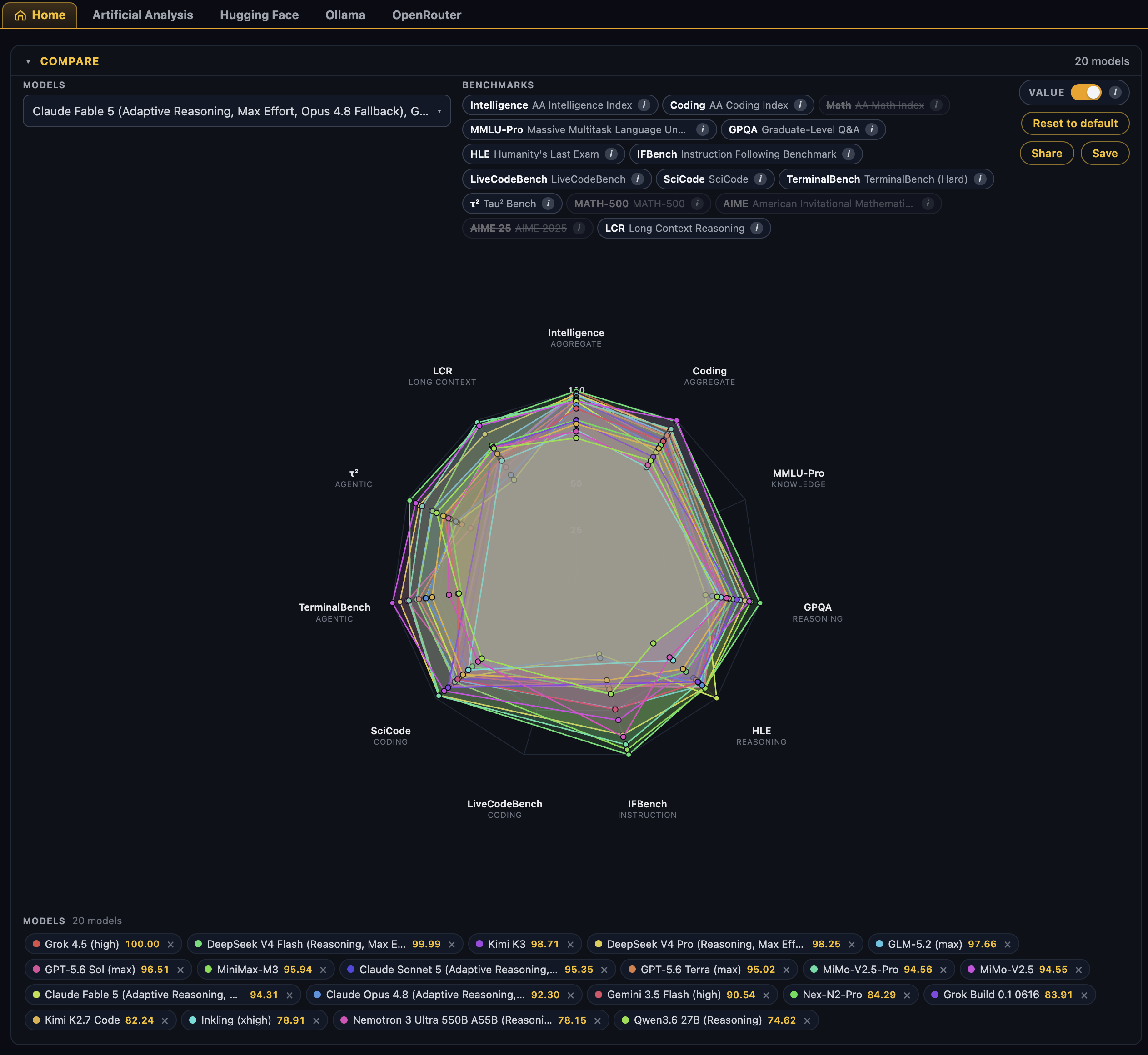
<p><img src="/assets/images/ollamadash_value_radar.png" alt="Compare radar chart in value mode - 20 models ranked by the fair value metric" /></p>

<p>A detail that is easy to miss: <strong>the order of models in the legend below the compare area is the ranking by value</strong>. Grok 4.5 at 100.00 first, DeepSeek V4 Flash at 99.99 second, and so on down the list. Flip the <strong>VALUE</strong> toggle off (top right of the compare area) and the exact same set of models re-sorts to a ranking by raw intelligence - a quick way to see who is winning on capability versus who is winning on capability-per-dollar.</p>

<p>Hovering a legend entry shows the full breakdown: the scaled value score plus the raw computation, something like <code class="language-plaintext highlighter-rouge">raw 31.98 = 57.1 - 10.14·log10($15.00 / $0.05)</code>, so the number is never a black box.</p>

<h2 id="try-it-yourself">Try it yourself</h2>

<p>The best way to get a feel for the metric is to poke at it:</p>

<ul>
  <li>Open the <a href="https://ollamadash.up.railway.app/home/?compare=eyJ2IjoxLCJlIjoxLCJtIjoxLCJzIjpbImNsYXVkZS1mYWJsZS01IiwiZ3B0LTUtNi1zb2wiLCJraW1pLWszIiwiY2xhdWRlLW9wdXMtNC04IiwiZ3B0LTUtNi10ZXJyYSIsImdyb2stNC01IiwiY2xhdWRlLXNvbm5ldC01IiwiZ2xtLTUtMiIsImdlbWluaS0zLTUtZmxhc2giLCJtaW5pbWF4LW0zIiwiZGVlcHNlZWstdjQtcHJvIiwibWltby12Mi01LXBybyIsImtpbWktazItNy1jb2RlIiwibmV4LW4yLXBybyIsImlua2xpbmciLCJkZWVwc2Vlay12NC1mbGFzaCIsImdyb2stYnVpbGQtMC0xLTA2LTE2IiwibnZpZGlhLW5lbW90cm9uLTMtdWx0cmEtNTUwYi1hNTViIiwibWltby12Mi01LTA0MjQiLCJxd2VuMy02LTI3YiJdLCJoIjpbXSwiYiI6WyJhcnRpZmljaWFsX2FuYWx5c2lzX21hdGhfaW5kZXgiLCJhaW1lXzI1IiwiYWltZSIsIm1hdGhfNTAwIl19">compare view</a> and toggle VALUE on and off to see the ranking flip between value and pure intelligence.</li>
  <li>Swap models in and out of the comparison - pick your daily drivers and see where they actually land on the value curve.</li>
  <li>Change the benchmark axes. λ is fitted per benchmark, so a model that is great value on coding can be mediocre value on math - the radar makes that visible immediately.</li>
  <li>Share your setup with the Save/Share buttons - the full comparison state is encoded in the URL, like the link in this post.</li>
</ul>

<p>The implementation lives in the ollamadash source (<code class="language-plaintext highlighter-rouge">app.js</code> for the live version, mirrored in Python in the test suite), and the exact spec is in <code class="language-plaintext highlighter-rouge">metric.md</code> in that repo. If you have ideas for improving the metric - different anchors, robust regression for λ, per-task weightings - I would love to hear them.</p>]]></content><author><name>Anand Ramanathan</name></author><category term="ai" /><category term="metrics" /><category term="ollamadash" /><category term="ai-generated" /><summary type="html"><![CDATA[A new way to measure LLM value as a combination of intelligence and price - fitted to the market, resistant to cheap-model dominance, and visualized live in ollamadash.]]></summary></entry><entry><title type="html">Mac Power User Finder customizations Cheatsheet</title><link href="https://rcanand.com/blog/mac-finder-poweruser-cheatsheet/" rel="alternate" type="text/html" title="Mac Power User Finder customizations Cheatsheet" /><published>2026-06-30T00:00:00+00:00</published><updated>2026-06-30T00:00:00+00:00</updated><id>https://rcanand.com/blog/mac-finder-poweruser-cheatsheet</id><content type="html" xml:base="https://rcanand.com/blog/mac-finder-poweruser-cheatsheet/"><![CDATA[<p>This is a list of AI generated power user tricks to customize Mac Finder.</p>

<p>❗ AI generated - can be risky. Be careful to verify each one and using only after assuring that it is safe and is what you want.
❗ Not all steps apply to everyone - I picked a few and applied them for myself. Others may find other things they like, so keeping most of the AI generated tricks here.</p>

<h1 id="macos-finder-power-user-cheatsheet">macOS Finder Power User Cheatsheet</h1>

<blockquote>
  <p>Commands marked <code class="language-plaintext highlighter-rouge">killall Finder</code> require a Finder restart to take effect.
⚠️ Some legacy <code class="language-plaintext highlighter-rouge">defaults write</code> keys may be silent no-ops on macOS 26 Tahoe — always verify with <code class="language-plaintext highlighter-rouge">defaults read com.apple.finder</code>.</p>
</blockquote>

<hr />

<h2 id="ranked-by-power-user-utility">Ranked by Power User Utility</h2>

<hr />

<h3 id="1-show-hidden-files-dotfiles">1. Show Hidden Files (dotfiles)</h3>
<div class="language-bash highlighter-rouge"><div class="highlight"><pre class="highlight"><code>defaults write com.apple.finder AppleShowAllFiles <span class="nt">-bool</span> <span class="nb">true</span><span class="p">;</span> killall Finder
</code></pre></div></div>
<p>Toggle on the fly: <strong><code class="language-plaintext highlighter-rouge">Cmd + Shift + .</code></strong> — no restart needed. This is the one toggle you’ll use constantly.</p>

<hr />

<h3 id="2-always-show-all-file-extensions">2. Always Show All File Extensions</h3>
<div class="language-bash highlighter-rouge"><div class="highlight"><pre class="highlight"><code>defaults write NSGlobalDomain AppleShowAllExtensions <span class="nt">-bool</span> <span class="nb">true</span><span class="p">;</span> killall Finder
</code></pre></div></div>
<p>Domain is <code class="language-plaintext highlighter-rouge">NSGlobalDomain</code>, not <code class="language-plaintext highlighter-rouge">com.apple.finder</code>. Affects all apps.</p>

<hr />

<h3 id="3-show-full-posix-path-in-window-title">3. Show Full POSIX Path in Window Title</h3>
<div class="language-bash highlighter-rouge"><div class="highlight"><pre class="highlight"><code>defaults write com.apple.finder _FXShowPosixPathInTitle <span class="nt">-bool</span> <span class="nb">true</span><span class="p">;</span> killall Finder
</code></pre></div></div>
<p>Title bar shows <code class="language-plaintext highlighter-rouge">/Users/you/projects/app/src</code> instead of just <code class="language-plaintext highlighter-rouge">src</code>.</p>

<hr />

<h3 id="4-show-path-bar-bottom-breadcrumb">4. Show Path Bar (Bottom Breadcrumb)</h3>
<div class="language-bash highlighter-rouge"><div class="highlight"><pre class="highlight"><code>defaults write com.apple.finder ShowPathbar <span class="nt">-bool</span> <span class="nb">true</span> <span class="o">&amp;&amp;</span> killall cfprefsd <span class="o">&amp;&amp;</span> <span class="nb">sleep </span>1 <span class="o">&amp;&amp;</span> killall Finder
</code></pre></div></div>
<p>Toggle: <strong><code class="language-plaintext highlighter-rouge">Cmd + Option + P</code></strong>. Right-click any segment in the path bar to jump there, open in Terminal, or copy path.</p>

<hr />

<h3 id="5-show-status-bar-item-count--disk-space">5. Show Status Bar (Item Count + Disk Space)</h3>
<div class="language-bash highlighter-rouge"><div class="highlight"><pre class="highlight"><code>defaults write com.apple.finder ShowStatusBar <span class="nt">-bool</span> <span class="nb">true</span><span class="p">;</span> killall Finder
</code></pre></div></div>
<p>Toggle: <strong><code class="language-plaintext highlighter-rouge">Cmd + /</code></strong></p>

<hr />

<h3 id="6-search-current-folder-by-default-not-this-mac">6. Search Current Folder by Default (Not “This Mac”)</h3>
<div class="language-bash highlighter-rouge"><div class="highlight"><pre class="highlight"><code>defaults write com.apple.finder FXDefaultSearchScope <span class="nt">-string</span> <span class="s2">"SCcf"</span><span class="p">;</span> killall Finder
</code></pre></div></div>
<p><code class="language-plaintext highlighter-rouge">SCcf</code> = current folder. <code class="language-plaintext highlighter-rouge">SCev</code> = This Mac (Apple’s default). Or set via GUI: <strong>Finder → Settings → Advanced → “When performing a search” → Search the Current Folder</strong>.</p>

<hr />

<h3 id="7-set-default-view-mode-list--column--icon--gallery">7. Set Default View Mode (List / Column / Icon / Gallery)</h3>
<div class="language-bash highlighter-rouge"><div class="highlight"><pre class="highlight"><code>defaults write com.apple.finder FXPreferredViewStyle <span class="nt">-string</span> <span class="s2">"Nlsv"</span><span class="p">;</span> killall Finder
</code></pre></div></div>
<p>View codes: <code class="language-plaintext highlighter-rouge">Nlsv</code> = List, <code class="language-plaintext highlighter-rouge">clmv</code> = Column, <code class="language-plaintext highlighter-rouge">icnv</code> = Icon, <code class="language-plaintext highlighter-rouge">glyv</code> = Gallery.</p>
<blockquote>
  <p>⚠️ This sets the <em>default for new windows</em>. Existing folders remember their own view via <code class="language-plaintext highlighter-rouge">.DS_Store</code>. To force globally, see #19 (nuke <code class="language-plaintext highlighter-rouge">.DS_Store</code> files).</p>
</blockquote>

<hr />

<h3 id="8-keep-folders-on-top-when-sorting-by-name">8. Keep Folders on Top When Sorting by Name</h3>
<div class="language-bash highlighter-rouge"><div class="highlight"><pre class="highlight"><code>defaults write com.apple.finder _FXSortFoldersFirst <span class="nt">-bool</span> <span class="nb">true</span><span class="p">;</span> killall Finder
</code></pre></div></div>
<p>Or GUI: <strong>Finder → Settings → Advanced → “Keep folders on top: In windows when sorting by name”</strong>. Also has a separate checkbox for Desktop.</p>

<hr />

<h3 id="9-copy-file-path-to-clipboard-native--no-automator-needed">9. Copy File Path to Clipboard (Native — No Automator Needed)</h3>
<p><strong><code class="language-plaintext highlighter-rouge">Cmd + Option + C</code></strong> — copies POSIX path of selected item(s).
Or: <strong>hold Option + right-click</strong> → “Copy [filename] as Pathname”.
Or: drag file/folder from Finder into Terminal (auto-escaped path).</p>

<hr />

<h3 id="10-go-to-any-path-including-hidden-folders">10. Go to Any Path (Including Hidden Folders)</h3>
<p><strong><code class="language-plaintext highlighter-rouge">Cmd + Shift + G</code></strong> — type any POSIX path: <code class="language-plaintext highlighter-rouge">~/.ssh</code>, <code class="language-plaintext highlighter-rouge">/usr/local/bin</code>, <code class="language-plaintext highlighter-rouge">~/Library/Caches</code>. Supports tab-completion.</p>

<hr />

<h3 id="11-reveal-library-folder">11. Reveal ~/Library Folder</h3>
<div class="language-bash highlighter-rouge"><div class="highlight"><pre class="highlight"><code>chflags nohidden ~/Library
</code></pre></div></div>
<p>No <code class="language-plaintext highlighter-rouge">killall</code> needed. Also accessible via <strong>Go → Go to Folder (<code class="language-plaintext highlighter-rouge">Cmd+Shift+G</code>) → <code class="language-plaintext highlighter-rouge">~/Library</code></strong>.</p>

<hr />

<h3 id="12-reveal-volumes-folder">12. Reveal /Volumes Folder</h3>
<div class="language-bash highlighter-rouge"><div class="highlight"><pre class="highlight"><code><span class="nb">sudo </span>chflags nohidden /Volumes
</code></pre></div></div>

<hr />

<h3 id="13-disable-ds_store-on-network-volumes">13. Disable .DS_Store on Network Volumes</h3>
<div class="language-bash highlighter-rouge"><div class="highlight"><pre class="highlight"><code>defaults write com.apple.desktopservices DSDontWriteNetworkStores <span class="nt">-bool</span> <span class="nb">true</span>
</code></pre></div></div>

<hr />

<h3 id="14-disable-ds_store-on-usb-volumes-new--verified">14. Disable .DS_Store on USB Volumes <em>(new — verified)</em></h3>
<div class="language-bash highlighter-rouge"><div class="highlight"><pre class="highlight"><code>defaults write com.apple.desktopservices DSDontWriteUSBStores <span class="nt">-bool</span> <span class="nb">true</span>
</code></pre></div></div>
<p>This key exists and is confirmed in multiple dotfile repos (Mathias Bynens, nickytonline).</p>

<hr />

<h3 id="15-disable-extension-change-warning">15. Disable Extension Change Warning</h3>
<div class="language-bash highlighter-rouge"><div class="highlight"><pre class="highlight"><code>defaults write com.apple.finder FXEnableExtensionChangeWarning <span class="nt">-bool</span> <span class="nb">false</span><span class="p">;</span> killall Finder
</code></pre></div></div>
<p>Stops the “Are you sure you want to change the extension?” dialog.</p>

<hr />

<h3 id="16-disable-empty-trash-warning">16. Disable Empty Trash Warning</h3>
<div class="language-bash highlighter-rouge"><div class="highlight"><pre class="highlight"><code>defaults write com.apple.finder WarnOnEmptyTrash <span class="nt">-bool</span> <span class="nb">false</span><span class="p">;</span> killall Finder
</code></pre></div></div>
<p>Also: <strong><code class="language-plaintext highlighter-rouge">Cmd + Option + Shift + Delete</code></strong> empties trash with no confirmation dialog (one-time, no setting change).</p>

<hr />

<h3 id="17-allow-quitting-finder-via-cmdq">17. Allow Quitting Finder via Cmd+Q</h3>
<div class="language-bash highlighter-rouge"><div class="highlight"><pre class="highlight"><code>defaults write com.apple.finder QuitMenuItem <span class="nt">-bool</span> <span class="nb">true</span><span class="p">;</span> killall Finder
</code></pre></div></div>
<p>Adds “Quit Finder” to the Finder menu. Quitting hides desktop icons until Finder relaunches.</p>

<hr />

<h3 id="18-disable-all-finder-animations-snappier-navigation">18. Disable All Finder Animations (Snappier Navigation)</h3>
<div class="language-bash highlighter-rouge"><div class="highlight"><pre class="highlight"><code>defaults write com.apple.finder DisableAllAnimations <span class="nt">-bool</span> <span class="nb">true</span><span class="p">;</span> killall Finder
</code></pre></div></div>
<p>Disables window open/close animations, Get Info animations, etc.</p>

<hr />

<h3 id="19-force-all-folders-to-use-your-default-view-nuke-ds_store">19. Force ALL Folders to Use Your Default View (Nuke .DS_Store)</h3>
<div class="language-bash highlighter-rouge"><div class="highlight"><pre class="highlight"><code><span class="c"># Step 1: Set your desired view options in Finder → Cmd+J → "Use as Defaults"</span>
<span class="c"># Step 2: Delete all .DS_Store files so every folder falls back to defaults:</span>
find ~ <span class="nt">-name</span> .DS_Store <span class="nt">-delete</span> 2&gt;/dev/null
<span class="c"># and/or target specific folders/volumes</span>
<span class="c"># find ~/Projects ~/Documents ~/Desktop -name .DS_Store -delete 2&gt;/dev/null</span>
killall Finder
</code></pre></div></div>
<blockquote>
  <p>⚠️ Aggressive — wipes per-folder view memories everywhere. Every folder will now use your default view style. On macOS 15 Sequoia+, the “Use as Defaults” button propagates more reliably than older versions, so this nuke may be less necessary.
⚠️ Also: changes the modified time on all folders that had .DS_Store in it, so use ONLY if ok with that.
⚠️ Dont use / instead of ~ : Using / will require sudo, will wipe out everything but can take a very long time, depending on your external volumes, etc.</p>
</blockquote>

<hr />

<h3 id="20-column-auto-resize-to-fit-filenames-new--verified-macos-261">20. Column Auto-Resize to Fit Filenames <em>(new — verified macOS 26.1+)</em></h3>
<p><strong>macOS 26.1 Tahoe+:</strong> View → Show View Options (in Column View) → check <strong>“Resize columns to fit filenames”</strong>. This is a universal setting for all column view windows.</p>

<p><strong>macOS 13 Ventura – 15 Sequoia (hidden setting):</strong></p>
<div class="language-bash highlighter-rouge"><div class="highlight"><pre class="highlight"><code>defaults write com.apple.finder _FXEnableColumnAutoSizing <span class="nt">-bool</span> YES<span class="p">;</span> killall Finder
</code></pre></div></div>
<blockquote>
  <p>⚠️ Known limitation: only resizes based on <em>currently visible</em> filenames, not the longest in the entire folder. Doesn’t dynamically resize when scrolling.</p>
</blockquote>

<hr />

<h3 id="21-expand-all-get-info-panes-by-default">21. Expand All “Get Info” Panes by Default</h3>
<div class="language-bash highlighter-rouge"><div class="highlight"><pre class="highlight"><code>defaults write com.apple.finder FXInfoPanesExpanded <span class="nt">-dict</span> <span class="se">\</span>
    General <span class="nt">-bool</span> <span class="nb">true</span> <span class="se">\</span>
    OpenWith <span class="nt">-bool</span> <span class="nb">true</span> <span class="se">\</span>
    Privileges <span class="nt">-bool</span> <span class="nb">true</span><span class="p">;</span> killall Finder
</code></pre></div></div>
<p>Get Info window opens with General, Open With, and Sharing &amp; Permissions sections all expanded.</p>

<hr />

<h3 id="22-auto-open-finder-window-when-volume-is-mounted">22. Auto-Open Finder Window When Volume Is Mounted</h3>
<div class="language-bash highlighter-rouge"><div class="highlight"><pre class="highlight"><code>defaults write com.apple.frameworks.diskimages auto-open-ro-root <span class="nt">-bool</span> <span class="nb">true
</span>defaults write com.apple.frameworks.diskimages auto-open-rw-root <span class="nt">-bool</span> <span class="nb">true
</span>defaults write com.apple.finder OpenWindowForNewRemovableDisk <span class="nt">-bool</span> <span class="nb">true</span><span class="p">;</span> killall Finder
</code></pre></div></div>

<hr />

<h3 id="23-set-new-finder-window-target-home-folder-example">23. Set New Finder Window Target (Home Folder Example)</h3>
<div class="language-bash highlighter-rouge"><div class="highlight"><pre class="highlight"><code>defaults write com.apple.finder NewWindowTarget <span class="nt">-string</span> <span class="s2">"PfLo"</span>
defaults write com.apple.finder NewWindowTargetPath <span class="nt">-string</span> <span class="s2">"file://</span><span class="k">${</span><span class="nv">HOME</span><span class="k">}</span><span class="s2">/"</span>
killall Finder
</code></pre></div></div>
<p><code class="language-plaintext highlighter-rouge">PfDe</code> = Desktop. <code class="language-plaintext highlighter-rouge">PfLo</code> = custom path (use with <code class="language-plaintext highlighter-rouge">NewWindowTargetPath</code>). Or set via GUI: <strong>Finder → Settings → General → “New Finder windows show”</strong>.</p>

<hr />

<h3 id="24-show-desktop-items-drives-servers-media">24. Show Desktop Items (Drives, Servers, Media)</h3>
<div class="language-bash highlighter-rouge"><div class="highlight"><pre class="highlight"><code>defaults write com.apple.finder ShowHardDrivesOnDesktop <span class="nt">-bool</span> <span class="nb">true
</span>defaults write com.apple.finder ShowExternalHardDrivesOnDesktop <span class="nt">-bool</span> <span class="nb">true
</span>defaults write com.apple.finder ShowMountedServersOnDesktop <span class="nt">-bool</span> <span class="nb">true
</span>defaults write com.apple.finder ShowRemovableMediaOnDesktop <span class="nt">-bool</span> <span class="nb">true
</span>killall Finder
</code></pre></div></div>
<p>Or GUI: <strong>Finder → Settings → General → “Show these items on the desktop”</strong>.</p>

<hr />

<h3 id="25-expand-saveopen-dialogs-by-default">25. Expand Save/Open Dialogs by Default</h3>
<div class="language-bash highlighter-rouge"><div class="highlight"><pre class="highlight"><code>defaults write NSGlobalDomain NSNavPanelExpandedStateForSaveMode <span class="nt">-bool</span> <span class="nb">true
</span>defaults write NSGlobalDomain NSNavPanelExpandedStateForOpenMode <span class="nt">-bool</span> <span class="nb">true
</span>defaults write NSGlobalDomain PMPrintingExpandedStateForPrint <span class="nt">-bool</span> <span class="nb">true
</span>defaults write NSGlobalDomain PMPrintingExpandedStateForPrint2 <span class="nt">-bool</span> <span class="nb">true</span>
</code></pre></div></div>
<p>All save/open/print dialogs open in expanded (full) view.</p>

<hr />

<h3 id="26-enable-spring-loaded-folders">26. Enable Spring-Loaded Folders</h3>
<div class="language-bash highlighter-rouge"><div class="highlight"><pre class="highlight"><code>defaults write com.apple.finder SpringloadingEnabled <span class="nt">-bool</span> <span class="nb">true</span><span class="p">;</span> killall Finder
</code></pre></div></div>
<p>Drag a file onto a folder, hover, and the folder springs open. Also set delay via GUI: <strong>Finder → Settings → General → Spring-loading delay</strong>.</p>

<hr />

<h3 id="27-disable-window-zoom-animation">27. Disable Window Zoom Animation</h3>
<div class="language-bash highlighter-rouge"><div class="highlight"><pre class="highlight"><code>defaults write com.apple.finder AnimateWindowZoom <span class="nt">-bool</span> <span class="nb">false</span><span class="p">;</span> killall Finder
</code></pre></div></div>

<hr />

<h3 id="28-show-alternating-row-stripes-in-list-view">28. Show Alternating Row Stripes in List View</h3>
<div class="language-bash highlighter-rouge"><div class="highlight"><pre class="highlight"><code>defaults write com.apple.finder FXListViewStripes <span class="nt">-boolean</span> <span class="nb">true</span><span class="p">;</span> killall Finder
</code></pre></div></div>

<hr />

<h3 id="29-control-which-columns-show-in-search-results">29. Control Which Columns Show in Search Results</h3>
<div class="language-bash highlighter-rouge"><div class="highlight"><pre class="highlight"><code>defaults write com.apple.finder SearchViewSettings.ListViewSettings.columns.version.visible <span class="nt">-boolean</span> <span class="nb">true
</span>defaults write com.apple.finder SearchViewSettings.ListViewSettings.columns.size.visible <span class="nt">-boolean</span> <span class="nb">true
</span>defaults write com.apple.finder SearchViewSettings.ListViewSettings.columns.comments.visible <span class="nt">-boolean</span> <span class="nb">true
</span>killall Finder
</code></pre></div></div>

<hr />

<h3 id="30-sidebar-icon-size-small--medium--large">30. Sidebar Icon Size (Small / Medium / Large)</h3>
<div class="language-bash highlighter-rouge"><div class="highlight"><pre class="highlight"><code>defaults write NSGlobalDomain NSTableViewDefaultSizeMode <span class="nt">-int</span> 1  <span class="c"># Small</span>
<span class="c"># -int 2 = Medium (default)</span>
<span class="c"># -int 3 = Large</span>
killall Finder
</code></pre></div></div>

<hr />

<h3 id="31-set-list-view-column-order-width--visibility-via-applescript">31. Set List View Column Order, Width &amp; Visibility via AppleScript</h3>
<p>AppleScript can control columns, widths, sort direction, and visibility — but <strong>only for the currently open window</strong>. To apply to many folders, you must script a loop (see #32).</p>

<div class="language-applescript highlighter-rouge"><div class="highlight"><pre class="highlight"><code><span class="k">tell</span><span class="w"> </span><span class="nb">application</span><span class="w"> </span><span class="s2">"Finder"</span><span class="w">
    </span><span class="nb">activate</span><span class="w">
    </span><span class="k">tell</span><span class="w"> </span><span class="nv">list</span><span class="w"> </span><span class="na">view</span><span class="w"> </span><span class="nv">options</span><span class="w"> </span><span class="k">of</span><span class="w"> </span><span class="nb">the</span><span class="w"> </span><span class="nb">front</span><span class="w"> </span><span class="nv">Finder</span><span class="w"> </span><span class="na">window</span><span class="w">
        </span><span class="k">set</span><span class="w"> </span><span class="na">properties</span><span class="w"> </span><span class="k">to</span><span class="w"> </span><span class="p">{</span><span class="nv">calculates</span><span class="w"> </span><span class="nv">folder</span><span class="w"> </span><span class="nv">sizes</span><span class="p">:</span><span class="nb">true</span><span class="p">,</span><span class="w"> </span><span class="nv">shows</span><span class="w"> </span><span class="nv">icon</span><span class="w"> </span><span class="nv">preview</span><span class="p">:</span><span class="nb">false</span><span class="p">,</span><span class="w"> </span><span class="se">¬
</span><span class="w">            </span><span class="nv">icon</span><span class="w"> </span><span class="na">size</span><span class="p">:</span><span class="nv">small</span><span class="w"> </span><span class="nv">icon</span><span class="p">,</span><span class="w"> </span><span class="nb">text</span><span class="w"> </span><span class="na">size</span><span class="p">:</span><span class="mi">12</span><span class="p">,</span><span class="w"> </span><span class="nv">uses</span><span class="w"> </span><span class="nv">relative</span><span class="w"> </span><span class="nv">dates</span><span class="p">:</span><span class="nb">true</span><span class="p">,</span><span class="w"> </span><span class="na">sort column</span><span class="p">:</span><span class="na">name</span><span class="w"> </span><span class="nv">column</span><span class="p">}</span><span class="w">
        
        </span><span class="k">tell</span><span class="w"> </span><span class="nv">column</span><span class="w"> </span><span class="na">name</span><span class="w"> </span><span class="nv">column</span><span class="w">
            </span><span class="k">set</span><span class="w"> </span><span class="na">properties</span><span class="w"> </span><span class="k">to</span><span class="w"> </span><span class="p">{</span><span class="na">index</span><span class="p">:</span><span class="mi">1</span><span class="p">,</span><span class="w"> </span><span class="nv">sort</span><span class="w"> </span><span class="nv">direction</span><span class="p">:</span><span class="nv">normal</span><span class="p">,</span><span class="w"> </span><span class="na">width</span><span class="p">:</span><span class="mi">280</span><span class="p">}</span><span class="w">
        </span><span class="k">end</span><span class="w"> </span><span class="k">tell</span><span class="w">
        </span><span class="k">tell</span><span class="w"> </span><span class="nv">column</span><span class="w"> </span><span class="na">size</span><span class="w"> </span><span class="nv">column</span><span class="w">
            </span><span class="k">set</span><span class="w"> </span><span class="na">properties</span><span class="w"> </span><span class="k">to</span><span class="w"> </span><span class="p">{</span><span class="na">index</span><span class="p">:</span><span class="mi">2</span><span class="p">,</span><span class="w"> </span><span class="nv">sort</span><span class="w"> </span><span class="nv">direction</span><span class="p">:</span><span class="nv">normal</span><span class="p">,</span><span class="w"> </span><span class="na">width</span><span class="p">:</span><span class="mi">72</span><span class="p">,</span><span class="w"> </span><span class="na">visible</span><span class="p">:</span><span class="nb">true</span><span class="p">}</span><span class="w">
        </span><span class="k">end</span><span class="w"> </span><span class="k">tell</span><span class="w">
        </span><span class="k">tell</span><span class="w"> </span><span class="nv">column</span><span class="w"> </span><span class="nv">modification</span><span class="w"> </span><span class="nv">date</span><span class="w"> </span><span class="nv">column</span><span class="w">
            </span><span class="k">set</span><span class="w"> </span><span class="na">properties</span><span class="w"> </span><span class="k">to</span><span class="w"> </span><span class="p">{</span><span class="na">index</span><span class="p">:</span><span class="mi">3</span><span class="p">,</span><span class="w"> </span><span class="nv">sort</span><span class="w"> </span><span class="nv">direction</span><span class="p">:</span><span class="nv">normal</span><span class="p">,</span><span class="w"> </span><span class="na">width</span><span class="p">:</span><span class="mi">120</span><span class="p">,</span><span class="w"> </span><span class="na">visible</span><span class="p">:</span><span class="nb">true</span><span class="p">}</span><span class="w">
        </span><span class="k">end</span><span class="w"> </span><span class="k">tell</span><span class="w">
        </span><span class="k">tell</span><span class="w"> </span><span class="nv">column</span><span class="w"> </span><span class="nv">creation</span><span class="w"> </span><span class="nv">date</span><span class="w"> </span><span class="nv">column</span><span class="w">
            </span><span class="k">set</span><span class="w"> </span><span class="na">properties</span><span class="w"> </span><span class="k">to</span><span class="w"> </span><span class="p">{</span><span class="na">index</span><span class="p">:</span><span class="mi">4</span><span class="p">,</span><span class="w"> </span><span class="nv">sort</span><span class="w"> </span><span class="nv">direction</span><span class="p">:</span><span class="nv">normal</span><span class="p">,</span><span class="w"> </span><span class="na">width</span><span class="p">:</span><span class="mi">120</span><span class="p">,</span><span class="w"> </span><span class="na">visible</span><span class="p">:</span><span class="nb">true</span><span class="p">}</span><span class="w">
        </span><span class="k">end</span><span class="w"> </span><span class="k">tell</span><span class="w">
        </span><span class="k">tell</span><span class="w"> </span><span class="nv">column</span><span class="w"> </span><span class="nv">kind</span><span class="w"> </span><span class="nv">column</span><span class="w">
            </span><span class="k">set</span><span class="w"> </span><span class="na">properties</span><span class="w"> </span><span class="k">to</span><span class="w"> </span><span class="p">{</span><span class="na">index</span><span class="p">:</span><span class="mi">5</span><span class="p">,</span><span class="w"> </span><span class="nv">sort</span><span class="w"> </span><span class="nv">direction</span><span class="p">:</span><span class="nv">normal</span><span class="p">,</span><span class="w"> </span><span class="na">width</span><span class="p">:</span><span class="mi">120</span><span class="p">,</span><span class="w"> </span><span class="na">visible</span><span class="p">:</span><span class="nb">true</span><span class="p">}</span><span class="w">
        </span><span class="k">end</span><span class="w"> </span><span class="k">tell</span><span class="w">
        </span><span class="k">tell</span><span class="w"> </span><span class="nv">column</span><span class="w"> </span><span class="na">label</span><span class="w"> </span><span class="nv">column</span><span class="w">
            </span><span class="k">set</span><span class="w"> </span><span class="na">properties</span><span class="w"> </span><span class="k">to</span><span class="w"> </span><span class="p">{</span><span class="na">index</span><span class="p">:</span><span class="mi">6</span><span class="p">,</span><span class="w"> </span><span class="nv">sort</span><span class="w"> </span><span class="nv">direction</span><span class="p">:</span><span class="nv">normal</span><span class="p">,</span><span class="w"> </span><span class="na">width</span><span class="p">:</span><span class="mi">72</span><span class="p">,</span><span class="w"> </span><span class="na">visible</span><span class="p">:</span><span class="nb">false</span><span class="p">}</span><span class="w">
        </span><span class="k">end</span><span class="w"> </span><span class="k">tell</span><span class="w">
        </span><span class="k">tell</span><span class="w"> </span><span class="nv">column</span><span class="w"> </span><span class="nb">version</span><span class="w"> </span><span class="nv">column</span><span class="w">
            </span><span class="k">set</span><span class="w"> </span><span class="na">properties</span><span class="w"> </span><span class="k">to</span><span class="w"> </span><span class="p">{</span><span class="na">index</span><span class="p">:</span><span class="mi">7</span><span class="p">,</span><span class="w"> </span><span class="nv">sort</span><span class="w"> </span><span class="nv">direction</span><span class="p">:</span><span class="nv">normal</span><span class="p">,</span><span class="w"> </span><span class="na">width</span><span class="p">:</span><span class="mi">72</span><span class="p">,</span><span class="w"> </span><span class="na">visible</span><span class="p">:</span><span class="nb">false</span><span class="p">}</span><span class="w">
        </span><span class="k">end</span><span class="w"> </span><span class="k">tell</span><span class="w">
        </span><span class="k">tell</span><span class="w"> </span><span class="nv">column</span><span class="w"> </span><span class="nv">comment</span><span class="w"> </span><span class="nv">column</span><span class="w">
            </span><span class="k">set</span><span class="w"> </span><span class="na">properties</span><span class="w"> </span><span class="k">to</span><span class="w"> </span><span class="p">{</span><span class="na">index</span><span class="p">:</span><span class="mi">8</span><span class="p">,</span><span class="w"> </span><span class="nv">sort</span><span class="w"> </span><span class="nv">direction</span><span class="p">:</span><span class="nv">normal</span><span class="p">,</span><span class="w"> </span><span class="na">width</span><span class="p">:</span><span class="mi">240</span><span class="p">,</span><span class="w"> </span><span class="na">visible</span><span class="p">:</span><span class="nb">false</span><span class="p">}</span><span class="w">
        </span><span class="k">end</span><span class="w"> </span><span class="k">tell</span><span class="w">
    </span><span class="k">end</span><span class="w"> </span><span class="k">tell</span><span class="w">
    </span><span class="k">tell</span><span class="w"> </span><span class="nb">the</span><span class="w"> </span><span class="nb">front</span><span class="w"> </span><span class="nv">Finder</span><span class="w"> </span><span class="na">window</span><span class="w">
        </span><span class="k">set</span><span class="w"> </span><span class="nv">current</span><span class="w"> </span><span class="na">view</span><span class="w"> </span><span class="k">to</span><span class="w"> </span><span class="nv">list</span><span class="w"> </span><span class="na">view</span><span class="w">
    </span><span class="k">end</span><span class="w"> </span><span class="k">tell</span><span class="w">
</span><span class="k">end</span><span class="w"> </span><span class="k">tell</span><span class="w">
</span></code></pre></div></div>
<blockquote>
  <p>⚠️ Changing <code class="language-plaintext highlighter-rouge">index</code> (column order) works but may require navigating away and back to see the change render. Column <code class="language-plaintext highlighter-rouge">width</code> must be between minimum and maximum values enforced by Finder. Some columns like “Date Added” and “Date Last Opened” are not accessible via AppleScript’s list view options — use System Events UI scripting for those.</p>
</blockquote>

<hr />

<h3 id="32-apply-list-view-settings-recursively-to-all-subfolders-applescript">32. Apply List View Settings Recursively to All Subfolders (AppleScript)</h3>
<p>Save as <code class="language-plaintext highlighter-rouge">apply-list-view.applescript</code>, adjust column settings in <code class="language-plaintext highlighter-rouge">resetFinderWindow()</code>, then run from Script Editor with the target folder open in Finder:</p>

<div class="language-applescript highlighter-rouge"><div class="highlight"><pre class="highlight"><code><span class="k">set</span><span class="w"> </span><span class="nv">shortDelay</span><span class="w"> </span><span class="k">to</span><span class="w"> </span><span class="mf">0.2</span><span class="w">
</span><span class="k">set</span><span class="w"> </span><span class="nv">mediumDelay</span><span class="w"> </span><span class="k">to</span><span class="w"> </span><span class="mf">0.5</span><span class="w">

</span><span class="k">tell</span><span class="w"> </span><span class="nb">application</span><span class="w"> </span><span class="s2">"Finder"</span><span class="w">
    </span><span class="k">set</span><span class="w"> </span><span class="nv">targetFolder</span><span class="w"> </span><span class="k">to</span><span class="w"> </span><span class="na">target</span><span class="w"> </span><span class="k">of</span><span class="w"> </span><span class="nb">front</span><span class="w"> </span><span class="nv">Finder</span><span class="w"> </span><span class="na">window</span><span class="w">
    </span><span class="k">try</span><span class="w">
        </span><span class="k">set</span><span class="w"> </span><span class="nv">theSubfolders</span><span class="w"> </span><span class="k">to</span><span class="w"> </span><span class="nb">every</span><span class="w"> </span><span class="nv">folder</span><span class="w"> </span><span class="k">of</span><span class="w"> </span><span class="nb">the</span><span class="w"> </span><span class="nv">entire</span><span class="w"> </span><span class="na">contents</span><span class="w"> </span><span class="k">of</span><span class="w"> </span><span class="nv">targetFolder</span><span class="w">
        </span><span class="k">if</span><span class="w"> </span><span class="na">class</span><span class="w"> </span><span class="k">of</span><span class="w"> </span><span class="nv">theSubfolders</span><span class="w"> </span><span class="ow">is not</span><span class="w"> </span><span class="nv">list</span><span class="w"> </span><span class="k">then</span><span class="w"> </span><span class="k">set</span><span class="w"> </span><span class="nv">theSubfolders</span><span class="w"> </span><span class="k">to</span><span class="w"> </span><span class="nv">theSubfolders</span><span class="w"> </span><span class="k">as</span><span class="w"> </span><span class="nv">list</span><span class="w">
    </span><span class="nb">on</span><span class="w"> </span><span class="k">error</span><span class="w">
        </span><span class="k">set</span><span class="w"> </span><span class="nv">theSubfolders</span><span class="w"> </span><span class="k">to</span><span class="w"> </span><span class="p">{}</span><span class="w">
    </span><span class="k">end</span><span class="w"> </span><span class="k">try</span><span class="w">
</span><span class="k">end</span><span class="w"> </span><span class="k">tell</span><span class="w">

</span><span class="k">set</span><span class="w"> </span><span class="nv">theFolders</span><span class="w"> </span><span class="k">to</span><span class="w"> </span><span class="p">(</span><span class="nv">targetFolder</span><span class="w"> </span><span class="k">as</span><span class="w"> </span><span class="nv">list</span><span class="p">)</span><span class="w"> </span><span class="o">&amp;</span><span class="w"> </span><span class="nv">theSubfolders</span><span class="w">
</span><span class="k">set</span><span class="w"> </span><span class="nv">progress</span><span class="w"> </span><span class="nv">total</span><span class="w"> </span><span class="nv">steps</span><span class="w"> </span><span class="k">to</span><span class="w"> </span><span class="p">(</span><span class="nb">count</span><span class="w"> </span><span class="k">of</span><span class="w"> </span><span class="nv">theFolders</span><span class="p">)</span><span class="w">
</span><span class="k">set</span><span class="w"> </span><span class="nv">progress</span><span class="w"> </span><span class="nv">completed</span><span class="w"> </span><span class="nv">steps</span><span class="w"> </span><span class="k">to</span><span class="w"> </span><span class="mi">0</span><span class="w">

</span><span class="k">repeat</span><span class="w"> </span><span class="nv">with</span><span class="w"> </span><span class="nv">aFolder</span><span class="w"> </span><span class="k">in</span><span class="w"> </span><span class="nv">theFolders</span><span class="w">
    </span><span class="k">tell</span><span class="w"> </span><span class="nb">application</span><span class="w"> </span><span class="s2">"Finder"</span><span class="w"> </span><span class="k">to</span><span class="w"> </span><span class="k">set</span><span class="w"> </span><span class="nb">the</span><span class="w"> </span><span class="na">target</span><span class="w"> </span><span class="k">of</span><span class="w"> </span><span class="nv">Finder</span><span class="w"> </span><span class="na">window</span><span class="w"> </span><span class="mi">1</span><span class="w"> </span><span class="k">to</span><span class="w"> </span><span class="nv">aFolder</span><span class="w">
    </span><span class="nv">resetFinderWindow</span><span class="p">()</span><span class="w">
    </span><span class="k">set</span><span class="w"> </span><span class="nv">progress</span><span class="w"> </span><span class="nv">completed</span><span class="w"> </span><span class="nv">steps</span><span class="w"> </span><span class="k">to</span><span class="w"> </span><span class="p">(</span><span class="nv">progress</span><span class="w"> </span><span class="nv">completed</span><span class="w"> </span><span class="nv">steps</span><span class="p">)</span><span class="w"> </span><span class="o">+</span><span class="w"> </span><span class="mi">1</span><span class="w">
</span><span class="k">end</span><span class="w"> </span><span class="k">repeat</span><span class="w">

</span><span class="k">on</span> <span class="nv">resetFinderWindow</span><span class="p">()</span><span class="w">
    </span><span class="k">tell</span><span class="w"> </span><span class="nb">application</span><span class="w"> </span><span class="s2">"Finder"</span><span class="w">
        </span><span class="k">tell</span><span class="w"> </span><span class="nb">front</span><span class="w"> </span><span class="nv">Finder</span><span class="w"> </span><span class="na">window</span><span class="w">
            </span><span class="k">set</span><span class="w"> </span><span class="nv">current</span><span class="w"> </span><span class="na">view</span><span class="w"> </span><span class="k">to</span><span class="w"> </span><span class="nv">list</span><span class="w"> </span><span class="na">view</span><span class="w">
        </span><span class="k">end</span><span class="w"> </span><span class="k">tell</span><span class="w">
        </span><span class="k">tell</span><span class="w"> </span><span class="nb">application</span><span class="w"> </span><span class="s2">"System Events"</span><span class="w"> </span><span class="k">to</span><span class="w"> </span><span class="k">tell</span><span class="w"> </span><span class="nv">process</span><span class="w"> </span><span class="s2">"Finder"</span><span class="w">
            </span><span class="nb">delay</span><span class="w"> </span><span class="nv">shortDelay</span><span class="w">
            </span><span class="k">tell</span><span class="w"> </span><span class="na">menu</span><span class="w"> </span><span class="nb">item</span><span class="w"> </span><span class="s2">"Show View Options"</span><span class="w"> </span><span class="k">of</span><span class="w"> </span><span class="na">menu</span><span class="w"> </span><span class="k">of</span><span class="w"> </span><span class="na">menu</span><span class="w"> </span><span class="nv">bar</span><span class="w"> </span><span class="nb">item</span><span class="w"> </span><span class="s2">"View"</span><span class="w"> </span><span class="k">of</span><span class="w"> </span><span class="na">menu</span><span class="w"> </span><span class="nv">bar</span><span class="w"> </span><span class="mi">1</span><span class="w"> </span><span class="k">to</span><span class="w"> </span><span class="k">if</span><span class="w"> </span><span class="nb">exists</span><span class="w"> </span><span class="k">then</span><span class="w"> </span><span class="nv">click</span><span class="w">
            </span><span class="nb">delay</span><span class="w"> </span><span class="nv">mediumDelay</span><span class="w">
            </span><span class="k">repeat</span><span class="w"> </span><span class="nv">with</span><span class="w"> </span><span class="nv">boxName</span><span class="w"> </span><span class="k">in</span><span class="w"> </span><span class="p">{</span><span class="s2">"Date Modified"</span><span class="p">,</span><span class="w"> </span><span class="s2">"Date Created"</span><span class="p">,</span><span class="w"> </span><span class="s2">"Date Last Opened"</span><span class="p">,</span><span class="w"> </span><span class="s2">"Date Added"</span><span class="p">,</span><span class="w"> </span><span class="s2">"Size"</span><span class="p">,</span><span class="w"> </span><span class="s2">"Kind"</span><span class="p">,</span><span class="w"> </span><span class="s2">"Version"</span><span class="p">,</span><span class="w"> </span><span class="s2">"Comments"</span><span class="p">,</span><span class="w"> </span><span class="s2">"Tags"</span><span class="p">}</span><span class="w">
                </span><span class="k">if</span><span class="w"> </span><span class="nv">boxName</span><span class="w"> </span><span class="ow">is in</span><span class="w"> </span><span class="p">{</span><span class="s2">"Date Modified"</span><span class="p">,</span><span class="w"> </span><span class="s2">"Date Created"</span><span class="p">,</span><span class="w"> </span><span class="s2">"Size"</span><span class="p">,</span><span class="w"> </span><span class="s2">"Kind"</span><span class="p">}</span><span class="w"> </span><span class="k">then</span><span class="w">
                    </span><span class="k">tell</span><span class="w"> </span><span class="nv">checkbox</span><span class="w"> </span><span class="nv">boxName</span><span class="w"> </span><span class="k">of</span><span class="w"> </span><span class="nv">group</span><span class="w"> </span><span class="mi">1</span><span class="w"> </span><span class="k">of</span><span class="w"> </span><span class="na">window</span><span class="w"> </span><span class="mi">1</span><span class="w"> </span><span class="k">to</span><span class="w"> </span><span class="k">if</span><span class="w"> </span><span class="nv">value</span><span class="w"> </span><span class="ow">is</span><span class="w"> </span><span class="mi">0</span><span class="w"> </span><span class="k">then</span><span class="w"> </span><span class="nv">click</span><span class="w">
                </span><span class="k">else</span><span class="w">
                    </span><span class="k">tell</span><span class="w"> </span><span class="nv">checkbox</span><span class="w"> </span><span class="nv">boxName</span><span class="w"> </span><span class="k">of</span><span class="w"> </span><span class="nv">group</span><span class="w"> </span><span class="mi">1</span><span class="w"> </span><span class="k">of</span><span class="w"> </span><span class="na">window</span><span class="w"> </span><span class="mi">1</span><span class="w"> </span><span class="k">to</span><span class="w"> </span><span class="k">if</span><span class="w"> </span><span class="nv">value</span><span class="w"> </span><span class="ow">is</span><span class="w"> </span><span class="mi">1</span><span class="w"> </span><span class="k">then</span><span class="w"> </span><span class="nv">click</span><span class="w">
                </span><span class="k">end</span><span class="w"> </span><span class="k">if</span><span class="w">
            </span><span class="k">end</span><span class="w"> </span><span class="k">repeat</span><span class="w">
            </span><span class="nb">delay</span><span class="w"> </span><span class="nv">mediumDelay</span><span class="w">
            </span><span class="k">tell</span><span class="w"> </span><span class="na">menu</span><span class="w"> </span><span class="nb">item</span><span class="w"> </span><span class="s2">"Hide View Options"</span><span class="w"> </span><span class="k">of</span><span class="w"> </span><span class="na">menu</span><span class="w"> </span><span class="k">of</span><span class="w"> </span><span class="na">menu</span><span class="w"> </span><span class="nv">bar</span><span class="w"> </span><span class="nb">item</span><span class="w"> </span><span class="s2">"View"</span><span class="w"> </span><span class="k">of</span><span class="w"> </span><span class="na">menu</span><span class="w"> </span><span class="nv">bar</span><span class="w"> </span><span class="mi">1</span><span class="w"> </span><span class="k">to</span><span class="w"> </span><span class="k">if</span><span class="w"> </span><span class="nb">exists</span><span class="w"> </span><span class="k">then</span><span class="w"> </span><span class="nv">click</span><span class="w">
            </span><span class="nb">delay</span><span class="w"> </span><span class="nv">mediumDelay</span><span class="w">
        </span><span class="k">end</span><span class="w"> </span><span class="k">tell</span><span class="w">
        </span><span class="k">tell</span><span class="w"> </span><span class="nb">front</span><span class="w"> </span><span class="nv">Finder</span><span class="w"> </span><span class="na">window</span><span class="w">
            </span><span class="k">set</span><span class="w"> </span><span class="nv">options</span><span class="w"> </span><span class="k">to</span><span class="w"> </span><span class="k">its</span><span class="w"> </span><span class="nv">list</span><span class="w"> </span><span class="na">view</span><span class="w"> </span><span class="nv">options</span><span class="w">
        </span><span class="k">end</span><span class="w"> </span><span class="k">tell</span><span class="w">
        </span><span class="k">tell</span><span class="w"> </span><span class="nv">options</span><span class="w">
            </span><span class="k">set</span><span class="w"> </span><span class="na">properties</span><span class="w"> </span><span class="k">of</span><span class="w"> </span><span class="nv">column</span><span class="w"> </span><span class="na">name</span><span class="w"> </span><span class="nv">column</span><span class="w"> </span><span class="k">to</span><span class="w"> </span><span class="p">{</span><span class="na">index</span><span class="p">:</span><span class="mi">1</span><span class="p">,</span><span class="w"> </span><span class="na">width</span><span class="p">:</span><span class="mi">280</span><span class="p">}</span><span class="w">
            </span><span class="k">set</span><span class="w"> </span><span class="na">properties</span><span class="w"> </span><span class="k">of</span><span class="w"> </span><span class="nv">column</span><span class="w"> </span><span class="na">size</span><span class="w"> </span><span class="nv">column</span><span class="w"> </span><span class="k">to</span><span class="w"> </span><span class="p">{</span><span class="na">index</span><span class="p">:</span><span class="mi">2</span><span class="p">,</span><span class="w"> </span><span class="na">width</span><span class="p">:</span><span class="mi">72</span><span class="p">}</span><span class="w">
            </span><span class="k">set</span><span class="w"> </span><span class="na">properties</span><span class="w"> </span><span class="k">of</span><span class="w"> </span><span class="nv">column</span><span class="w"> </span><span class="nv">modification</span><span class="w"> </span><span class="nv">date</span><span class="w"> </span><span class="nv">column</span><span class="w"> </span><span class="k">to</span><span class="w"> </span><span class="p">{</span><span class="na">index</span><span class="p">:</span><span class="mi">3</span><span class="p">,</span><span class="w"> </span><span class="na">width</span><span class="p">:</span><span class="mi">120</span><span class="p">}</span><span class="w">
            </span><span class="k">set</span><span class="w"> </span><span class="na">properties</span><span class="w"> </span><span class="k">of</span><span class="w"> </span><span class="nv">column</span><span class="w"> </span><span class="nv">creation</span><span class="w"> </span><span class="nv">date</span><span class="w"> </span><span class="nv">column</span><span class="w"> </span><span class="k">to</span><span class="w"> </span><span class="p">{</span><span class="na">index</span><span class="p">:</span><span class="mi">4</span><span class="p">,</span><span class="w"> </span><span class="na">width</span><span class="p">:</span><span class="mi">120</span><span class="p">}</span><span class="w">
            </span><span class="k">set</span><span class="w"> </span><span class="na">properties</span><span class="w"> </span><span class="k">of</span><span class="w"> </span><span class="nv">column</span><span class="w"> </span><span class="nv">kind</span><span class="w"> </span><span class="nv">column</span><span class="w"> </span><span class="k">to</span><span class="w"> </span><span class="p">{</span><span class="na">index</span><span class="p">:</span><span class="mi">5</span><span class="p">,</span><span class="w"> </span><span class="na">width</span><span class="p">:</span><span class="mi">120</span><span class="p">}</span><span class="w">
            </span><span class="k">set</span><span class="w"> </span><span class="na">properties</span><span class="w"> </span><span class="k">of</span><span class="w"> </span><span class="nv">column</span><span class="w"> </span><span class="na">label</span><span class="w"> </span><span class="nv">column</span><span class="w"> </span><span class="k">to</span><span class="w"> </span><span class="p">{</span><span class="na">index</span><span class="p">:</span><span class="mi">6</span><span class="p">,</span><span class="w"> </span><span class="na">width</span><span class="p">:</span><span class="mi">0</span><span class="p">}</span><span class="w">
            </span><span class="k">set</span><span class="w"> </span><span class="na">properties</span><span class="w"> </span><span class="k">of</span><span class="w"> </span><span class="nv">column</span><span class="w"> </span><span class="nb">version</span><span class="w"> </span><span class="nv">column</span><span class="w"> </span><span class="k">to</span><span class="w"> </span><span class="p">{</span><span class="na">index</span><span class="p">:</span><span class="mi">7</span><span class="p">,</span><span class="w"> </span><span class="na">width</span><span class="p">:</span><span class="mi">0</span><span class="p">}</span><span class="w">
            </span><span class="k">set</span><span class="w"> </span><span class="na">properties</span><span class="w"> </span><span class="k">of</span><span class="w"> </span><span class="nv">column</span><span class="w"> </span><span class="nv">comment</span><span class="w"> </span><span class="nv">column</span><span class="w"> </span><span class="k">to</span><span class="w"> </span><span class="p">{</span><span class="na">index</span><span class="p">:</span><span class="mi">8</span><span class="p">,</span><span class="w"> </span><span class="na">width</span><span class="p">:</span><span class="mi">0</span><span class="p">}</span><span class="w">
        </span><span class="k">end</span><span class="w"> </span><span class="k">tell</span><span class="w">
    </span><span class="k">end</span><span class="w"> </span><span class="k">tell</span><span class="w">
</span><span class="k">end</span><span class="w"> </span><span class="nv">resetFinderWindow</span><span class="w">
</span></code></pre></div></div>
<blockquote>
  <p>⚠️ Slow for large directory trees — Finder must open each folder. Best run on specific project directories, not your entire home folder.</p>
</blockquote>

<hr />

<h3 id="33-create-smart-folders-with-raw-mdfind-queries">33. Create Smart Folders with Raw mdfind Queries</h3>
<p>Smart Folders are <code class="language-plaintext highlighter-rouge">.savedSearch</code> plist files in <code class="language-plaintext highlighter-rouge">~/Library/Saved Searches/</code>. The Finder GUI supports a “Raw Query” criteria that lets you embed <code class="language-plaintext highlighter-rouge">mdfind</code>-style Spotlight Query Language:</p>

<ol>
  <li><strong>Finder → File → New Smart Folder</strong> (<code class="language-plaintext highlighter-rouge">Cmd + Option + N</code>)</li>
  <li>Click <strong><code class="language-plaintext highlighter-rouge">+</code></strong> to add criteria, then click the first dropdown → <strong>Other…</strong></li>
  <li>Search for <strong>“Raw query”</strong> and select it</li>
  <li>Enter any <code class="language-plaintext highlighter-rouge">mdfind</code>-compatible query, e.g.:
    <ul>
      <li><code class="language-plaintext highlighter-rouge">kMDItemFSCreationDate &gt; $time.now(-300)</code> — files created in last 5 min</li>
      <li><code class="language-plaintext highlighter-rouge">kMDItemContentType == "com.adobe.pdf" &amp;&amp; kMDItemFSSize &gt; 1000000</code> — PDFs &gt; 1MB</li>
      <li><code class="language-plaintext highlighter-rouge">kMDItemUserTags == "Red"</code> — files tagged Red</li>
    </ul>
  </li>
  <li>Click <strong>Save</strong>, name it, check “Add to Sidebar”</li>
</ol>

<blockquote>
  <p>⚠️ Hold <strong>Option (⌥)</strong> while criteria are visible to change <code class="language-plaintext highlighter-rouge">+</code> into <code class="language-plaintext highlighter-rouge">…</code>, which lets you add “Any of the following are true” (OR logic) groups.
⚠️ There is <strong>no undo</strong> in Smart Folder editing — changes apply immediately. Duplicate <code class="language-plaintext highlighter-rouge">.savedSearch</code> files before modifying complex ones.</p>
</blockquote>

<hr />

<h3 id="34-mdfind--spotlight-search-from-the-shell">34. mdfind — Spotlight Search from the Shell</h3>
<div class="language-bash highlighter-rouge"><div class="highlight"><pre class="highlight"><code><span class="c"># Basic content search</span>
mdfind <span class="s2">"search term"</span>

<span class="c"># Filename-only search</span>
mdfind <span class="nt">-name</span> <span class="s2">"config"</span>

<span class="c"># Search within specific directory</span>
mdfind <span class="nt">-onlyin</span> ~/Projects <span class="s2">"kMDItemContentType == 'com.adobe.pdf'"</span>

<span class="c"># Live-updating results (ctrl-C to stop)</span>
mdfind <span class="nt">-live</span> <span class="s2">"kMDItemFSCreationDate &gt; </span><span class="nv">$time</span><span class="s2">.now(-60)"</span>

<span class="c"># Count only</span>
mdfind <span class="nt">-count</span> <span class="s2">"kMDItemUserTags == 'Red'"</span>

<span class="c"># Files modified in last 3 days in home folder</span>
mdfind <span class="nt">-onlyin</span> ~ <span class="s1">'kMDItemFSContentChangeDate &gt;= $time.today(-3)'</span>

<span class="c"># All folders with "doc" in name</span>
mdfind <span class="s1">'kind:folder'</span> <span class="nt">-name</span> doc

<span class="c"># Tagged Red AND is a folder</span>
mdfind <span class="s1">'kMDItemUserTags == "Red" &amp;&amp; kMDItemContentType == "public.folder"'</span>

<span class="c"># All images</span>
mdfind <span class="s1">'kMDItemContentType == "public.image"'</span>
</code></pre></div></div>
<p>Key attributes: <code class="language-plaintext highlighter-rouge">kMDItemDisplayName</code>, <code class="language-plaintext highlighter-rouge">kMDItemFSName</code>, <code class="language-plaintext highlighter-rouge">kMDItemFSSize</code>, <code class="language-plaintext highlighter-rouge">kMDItemFSCreationDate</code>, <code class="language-plaintext highlighter-rouge">kMDItemFSContentChangeDate</code>, <code class="language-plaintext highlighter-rouge">kMDItemContentType</code>, <code class="language-plaintext highlighter-rouge">kMDItemKind</code>, <code class="language-plaintext highlighter-rouge">kMDItemUserTags</code>, <code class="language-plaintext highlighter-rouge">kMDItemTextContent</code>
Modifiers: <code class="language-plaintext highlighter-rouge">c</code> = case-insensitive, <code class="language-plaintext highlighter-rouge">d</code> = diacritic-insensitive, <code class="language-plaintext highlighter-rouge">w</code> = word-based. Example: <code class="language-plaintext highlighter-rouge">kMDItemDisplayName ==[c] "steve"</code>
Use <code class="language-plaintext highlighter-rouge">mdls /path/to/file</code> to see all available metadata attributes for a specific file.</p>

<hr />

<h3 id="35-create-copy-full-path-quick-action-automator">35. Create “Copy Full Path” Quick Action (Automator)</h3>
<ol>
  <li><strong>Automator → New → Quick Action</strong></li>
  <li>Set “Workflow receives current: <strong>files or folders</strong> in <strong>Finder.app</strong>”</li>
  <li>Add <strong>“Run Shell Script”</strong> action. Set shell to <code class="language-plaintext highlighter-rouge">/bin/zsh</code>, pass input “as arguments”:
    <div class="language-bash highlighter-rouge"><div class="highlight"><pre class="highlight"><code><span class="nb">printf</span> <span class="s1">'%s\n'</span> <span class="s2">"</span><span class="nv">$@</span><span class="s2">"</span> | pbcopy
</code></pre></div>    </div>
  </li>
  <li>Save as “Copy Full Path”</li>
  <li>Right-click any file in Finder → <strong>Quick Actions → Copy Full Path</strong></li>
</ol>

<hr />

<h3 id="36-create-open-in-terminal-quick-action-automator">36. Create “Open in Terminal” Quick Action (Automator)</h3>
<ol>
  <li><strong>Automator → New → Quick Action</strong></li>
  <li>Set “Workflow receives current: <strong>folders</strong> in <strong>Finder.app</strong>”</li>
  <li>Add <strong>“Run AppleScript”</strong> action:
    <div class="language-applescript highlighter-rouge"><div class="highlight"><pre class="highlight"><code><span class="k">on</span> <span class="nb">run</span><span class="w"> </span><span class="p">{</span><span class="nv">input</span><span class="p">,</span><span class="w"> </span><span class="nv">parameters</span><span class="p">}</span><span class="w">
    </span><span class="k">repeat</span><span class="w"> </span><span class="nv">with</span><span class="w"> </span><span class="nv">theItem</span><span class="w"> </span><span class="k">in</span><span class="w"> </span><span class="nv">input</span><span class="w">
        </span><span class="k">set</span><span class="w"> </span><span class="nv">thePath</span><span class="w"> </span><span class="k">to</span><span class="w"> </span><span class="nv">POSIX</span><span class="w"> </span><span class="na">path</span><span class="w"> </span><span class="k">of</span><span class="w"> </span><span class="nv">theItem</span><span class="w">
        </span><span class="k">tell</span><span class="w"> </span><span class="nb">application</span><span class="w"> </span><span class="s2">"Terminal"</span><span class="w">
            </span><span class="nb">activate</span><span class="w">
            </span><span class="nv">do</span><span class="w"> </span><span class="nv">script</span><span class="w"> </span><span class="s2">"cd "</span><span class="w"> </span><span class="o">&amp;</span><span class="w"> </span><span class="nb">quoted form</span><span class="w"> </span><span class="k">of</span><span class="w"> </span><span class="nv">thePath</span><span class="w">
        </span><span class="k">end</span><span class="w"> </span><span class="k">tell</span><span class="w">
    </span><span class="k">end</span><span class="w"> </span><span class="k">repeat</span><span class="w">
    </span><span class="nb">return</span><span class="w"> </span><span class="nv">input</span><span class="w">
</span><span class="k">end</span><span class="w"> </span><span class="nb">run</span><span class="w">
</span></code></pre></div>    </div>
  </li>
  <li>Save as “Open in Terminal”</li>
  <li>Assign keyboard shortcut: <strong>System Settings → Keyboard → Keyboard Shortcuts → Services → Files and Folders → Open in Terminal</strong></li>
</ol>

<hr />

<h3 id="37-shortcuts-app-quick-actions-alternative-to-automator">37. Shortcuts App Quick Actions (Alternative to Automator)</h3>
<p>The Shortcuts app (macOS 12+) can also create Quick Actions:</p>
<ol>
  <li>Open <strong>Shortcuts</strong> → create new shortcut</li>
  <li>Click <strong>Details (ⓘ)</strong> → check <strong>“Use as Quick Action”</strong> → check <strong>Finder</strong></li>
  <li>Build workflow with drag-and-drop actions</li>
  <li>Enable in <strong>System Settings → Privacy &amp; Security → Extensions → Finder</strong></li>
</ol>

<blockquote>
  <p>⚠️ Some users report Shortcuts-based Quick Actions don’t always appear in Finder’s right-click menu, while Automator-based ones reliably do. For Finder-specific actions, Automator is currently more reliable.</p>
</blockquote>

<hr />

<h3 id="38-custom-keyboard-shortcuts-for-any-finder-menu-item">38. Custom Keyboard Shortcuts for Any Finder Menu Item</h3>
<p><strong>System Settings → Keyboard → Keyboard Shortcuts → App Shortcuts → +</strong></p>
<ul>
  <li>App: <strong>Finder</strong></li>
  <li>Menu Title: exact name as it appears in the menu (e.g., “New Smart Folder”, “Go to Folder”, “Compress”)</li>
  <li>Assign any available key combo</li>
</ul>

<hr />

<h3 id="39-custom-finder-toolbar">39. Custom Finder Toolbar</h3>
<p><strong>Finder → View → Customize Toolbar</strong> (<code class="language-plaintext highlighter-rouge">Cmd + Option + ;</code>):</p>
<ul>
  <li>Add: <strong>Path</strong> (breadcrumb dropdown), <strong>New Folder</strong>, <strong>Delete</strong>, <strong>Connect</strong>, <strong>Get Info</strong>, <strong>Quick Look</strong></li>
  <li>Drag-reorder, remove defaults you don’t use</li>
</ul>

<hr />

<h3 id="40-open-folders-in-tabs-instead-of-new-windows">40. Open Folders in Tabs Instead of New Windows</h3>
<p><strong>Finder → Settings → General → “Open folders in tabs instead of new windows”</strong> ✓</p>
<ul>
  <li><code class="language-plaintext highlighter-rouge">Cmd + T</code> — new tab</li>
  <li><code class="language-plaintext highlighter-rouge">Cmd + Shift + T</code> — new tab with same folder</li>
  <li><code class="language-plaintext highlighter-rouge">Cmd + W</code> — close tab</li>
  <li><code class="language-plaintext highlighter-rouge">Window → Merge All Windows</code> — combine multiple windows into tabs</li>
</ul>

<hr />

<h3 id="41-key-keyboard-shortcuts-reference">41. Key Keyboard Shortcuts Reference</h3>

<table>
  <thead>
    <tr>
      <th>Shortcut</th>
      <th>Action</th>
    </tr>
  </thead>
  <tbody>
    <tr>
      <td><code class="language-plaintext highlighter-rouge">Cmd + Shift + .</code></td>
      <td>Toggle hidden files</td>
    </tr>
    <tr>
      <td><code class="language-plaintext highlighter-rouge">Cmd + Option + C</code></td>
      <td>Copy path to clipboard</td>
    </tr>
    <tr>
      <td><code class="language-plaintext highlighter-rouge">Cmd + Shift + G</code></td>
      <td>Go to folder (type any path)</td>
    </tr>
    <tr>
      <td><code class="language-plaintext highlighter-rouge">Cmd + Option + N</code></td>
      <td>New Smart Folder</td>
    </tr>
    <tr>
      <td><code class="language-plaintext highlighter-rouge">Cmd + Option + P</code></td>
      <td>Toggle path bar</td>
    </tr>
    <tr>
      <td><code class="language-plaintext highlighter-rouge">Cmd + /</code></td>
      <td>Toggle status bar</td>
    </tr>
    <tr>
      <td><code class="language-plaintext highlighter-rouge">Cmd + Shift + P</code></td>
      <td>Toggle preview pane</td>
    </tr>
    <tr>
      <td><code class="language-plaintext highlighter-rouge">Cmd + J</code></td>
      <td>Show View Options</td>
    </tr>
    <tr>
      <td><code class="language-plaintext highlighter-rouge">Cmd + 1/2/3/4</code></td>
      <td>Icon / List / Column / Gallery view</td>
    </tr>
    <tr>
      <td><code class="language-plaintext highlighter-rouge">Cmd + Option + I</code></td>
      <td>Inspector (persistent Get Info — updates as selection changes)</td>
    </tr>
    <tr>
      <td><code class="language-plaintext highlighter-rouge">Cmd + Option + Y</code></td>
      <td>Quick Look slideshow</td>
    </tr>
    <tr>
      <td><code class="language-plaintext highlighter-rouge">Space</code></td>
      <td>Quick Look preview</td>
    </tr>
    <tr>
      <td><code class="language-plaintext highlighter-rouge">Cmd + Option + V</code></td>
      <td>Move (instead of copy) — “cut and paste”</td>
    </tr>
    <tr>
      <td><code class="language-plaintext highlighter-rouge">Cmd + Shift + N</code></td>
      <td>New folder</td>
    </tr>
    <tr>
      <td><code class="language-plaintext highlighter-rouge">Cmd + Option + Shift + N</code></td>
      <td>New folder with selection</td>
    </tr>
    <tr>
      <td><code class="language-plaintext highlighter-rouge">Cmd + Delete</code></td>
      <td>Move to Trash</td>
    </tr>
    <tr>
      <td><code class="language-plaintext highlighter-rouge">Cmd + Shift + Delete</code></td>
      <td>Empty Trash</td>
    </tr>
    <tr>
      <td><code class="language-plaintext highlighter-rouge">Cmd + Option + Shift + Delete</code></td>
      <td>Empty Trash (no confirmation)</td>
    </tr>
    <tr>
      <td><code class="language-plaintext highlighter-rouge">Cmd + Up</code></td>
      <td>Go to parent folder</td>
    </tr>
    <tr>
      <td><code class="language-plaintext highlighter-rouge">Cmd + Ctrl + Up</code></td>
      <td>Open parent in new window/tab</td>
    </tr>
    <tr>
      <td><code class="language-plaintext highlighter-rouge">Cmd + Down</code></td>
      <td>Open selected item</td>
    </tr>
    <tr>
      <td><code class="language-plaintext highlighter-rouge">Cmd + [</code> / <code class="language-plaintext highlighter-rouge">Cmd + ]</code></td>
      <td>Back / Forward</td>
    </tr>
    <tr>
      <td><code class="language-plaintext highlighter-rouge">Cmd + click window title</code></td>
      <td>Breadcrumb dropdown of enclosing folders</td>
    </tr>
    <tr>
      <td><code class="language-plaintext highlighter-rouge">Return</code></td>
      <td>Rename selected file</td>
    </tr>
    <tr>
      <td><code class="language-plaintext highlighter-rouge">Cmd + D</code></td>
      <td>Duplicate</td>
    </tr>
    <tr>
      <td><code class="language-plaintext highlighter-rouge">Cmd + Ctrl + A</code></td>
      <td>Make alias</td>
    </tr>
    <tr>
      <td><code class="language-plaintext highlighter-rouge">Cmd + Shift + C/D/H/O/U/I/K</code></td>
      <td>Computer / Desktop / Home / Documents / Utilities / iCloud / Network</td>
    </tr>
    <tr>
      <td><code class="language-plaintext highlighter-rouge">Cmd + Option + L</code></td>
      <td>Downloads folder</td>
    </tr>
    <tr>
      <td><code class="language-plaintext highlighter-rouge">Cmd + Shift + R</code></td>
      <td>AirDrop window</td>
    </tr>
    <tr>
      <td><code class="language-plaintext highlighter-rouge">Cmd + T</code></td>
      <td>New tab</td>
    </tr>
    <tr>
      <td><code class="language-plaintext highlighter-rouge">Cmd + Option + T</code></td>
      <td>Toggle toolbar</td>
    </tr>
    <tr>
      <td><code class="language-plaintext highlighter-rouge">Cmd + Option + S</code></td>
      <td>Toggle sidebar</td>
    </tr>
    <tr>
      <td><code class="language-plaintext highlighter-rouge">Cmd + Option + D</code></td>
      <td>Toggle Dock</td>
    </tr>
  </tbody>
</table>

<hr />

<h3 id="42-reset-all-finder-settings-to-defaults">42. Reset All Finder Settings to Defaults</h3>
<div class="language-bash highlighter-rouge"><div class="highlight"><pre class="highlight"><code>defaults delete com.apple.finder
killall Finder
</code></pre></div></div>
<p>Nuclear option — wipes every customization. Finder restarts with factory defaults.</p>

<hr />

<h3 id="43-verify-current-settings">43. Verify Current Settings</h3>
<div class="language-bash highlighter-rouge"><div class="highlight"><pre class="highlight"><code><span class="c"># Read all Finder preferences</span>
defaults <span class="nb">read </span>com.apple.finder

<span class="c"># Read a specific key</span>
defaults <span class="nb">read </span>com.apple.finder FXPreferredViewStyle

<span class="c"># Read global domain settings</span>
defaults <span class="nb">read </span>NSGlobalDomain AppleShowAllExtensions
</code></pre></div></div>

<hr />

<h3 id="44-verify-which-defaults-keys-actually-exist">44. Verify Which defaults Keys Actually Exist</h3>
<div class="language-bash highlighter-rouge"><div class="highlight"><pre class="highlight"><code><span class="c"># Full plist as XML</span>
defaults <span class="nb">read </span>com.apple.finder <span class="o">&gt;</span> ~/finder_prefs.txt

<span class="c"># Or convert plist to XML directly</span>
plutil <span class="nt">-convert</span> xml1 <span class="nt">-o</span> - ~/Library/Preferences/com.apple.finder.plist
</code></pre></div></div>
<p>Only keys you’ve modified appear in the plist. Keys that are no-ops won’t show up after <code class="language-plaintext highlighter-rouge">killall Finder</code> if macOS ignored them.</p>

<hr />

<h3 id="45-macos-26-tahoe-column-view-bug-warning">45. macOS 26 Tahoe Column View Bug Warning</h3>
<p>If you’re on macOS 26 Tahoe and use <strong>Column View</strong> with scroll bars set to “Always Show”:</p>
<ul>
  <li>The horizontal scroll bar covers the column resize handles at the bottom of each column</li>
  <li>macOS 26.3 partially fixed this (shortened vertical scrollers) but the horizontal bar still overlaps filenames</li>
  <li>Workaround: set scroll bars to “When scrolling” in System Settings → Accessibility → Display → Scroll bars</li>
  <li>Or: hide path bar + status bar (the bug doesn’t occur without them)</li>
</ul>

<hr />]]></content><author><name>Anand Ramanathan</name></author><category term="mac" /><category term="finder" /><category term="poweruser" /><category term="cheatsheet" /><category term="ai-generated" /><summary type="html"><![CDATA[Mac Finder is grossly underconfigured by default for power users. These are some (AI generated) tweaks to customize it. Warning: Some are verified, others are not, so review each one carefully before using.]]></summary></entry><entry><title type="html">Model analysis summary</title><link href="https://rcanand.com/blog/model-analysis-summary/" rel="alternate" type="text/html" title="Model analysis summary" /><published>2026-06-29T00:00:00+00:00</published><updated>2026-06-29T00:00:00+00:00</updated><id>https://rcanand.com/blog/model-analysis-summary</id><content type="html" xml:base="https://rcanand.com/blog/model-analysis-summary/"><![CDATA[<h1 id="model-analysis-summary">Model analysis summary</h1>

<h2 id="what-this-set-of-posts-is-about">What this set of posts is about</h2>

<p>Modern LLMs are distributed through several systems - the <strong>Ollama</strong> library, <strong>OpenRouter</strong>’s catalog, and <strong>Artificial Analysis</strong>’s benchmark data - and each model is identified by a string like <code class="language-plaintext highlighter-rouge">gemma4:26b-a4b-it-qat</code> or <code class="language-plaintext highlighter-rouge">qwen/qwen3.7-max-20260520</code>. These IDs are dense: every segment (<code class="language-plaintext highlighter-rouge">gemma4</code>, <code class="language-plaintext highlighter-rouge">26b</code>, <code class="language-plaintext highlighter-rouge">a4b</code>, <code class="language-plaintext highlighter-rouge">it</code>, <code class="language-plaintext highlighter-rouge">qat</code>, <code class="language-plaintext highlighter-rouge">nvfp4</code>, <code class="language-plaintext highlighter-rouge">mlx</code>, <code class="language-plaintext highlighter-rouge">q4_K_M</code>, <code class="language-plaintext highlighter-rouge">mtp</code>, <code class="language-plaintext highlighter-rouge">yarn</code>, …) is a <em>stem</em> that encodes a real architectural or packaging choice - parameter size, quantization scheme, numeric precision, runtime/container, training technique, capability tier, context window, vendor codename, or a release date. Read literally, an ID tells you not just <em>which</em> model it is but <em>how it was built, how it’s stored, and what hardware it wants to run on</em>.</p>

<p>This set of posts decodes those stems end-to-end and then ranks them. Concretely it answers, for every stem you’ll encounter across the three systems: <strong>what does it mean</strong>, <strong>what does it do to quality / decode speed (TPS) / first-token latency (TTFT) / size</strong>, <strong>which platforms can run it natively vs emulated</strong>, and <strong>which stems can be combined on a single model and which are mutually exclusive</strong>. The unifying mental model that makes all of this tractable is the three orthogonal axes above - one numeric encoding (Axis A), one runtime (Axis B), any number of build-time techniques (Axis C) - so “can I combine X and Y?” reduces to “are X and Y on different axes?”.</p>
<h2 id="tldr">TLDR</h2>

<p><strong>The organizing insight</strong> - every architectural/quant stem belongs to one of three orthogonal axes, which makes combinability mechanical:</p>
<ul>
  <li><strong>Axis A - numeric encoding</strong> (pick one per tensor group): all the GGUF <code class="language-plaintext highlighter-rouge">Q*</code> levels, <code class="language-plaintext highlighter-rouge">F16</code>/<code class="language-plaintext highlighter-rouge">BF16</code>/<code class="language-plaintext highlighter-rouge">FP8</code>/<code class="language-plaintext highlighter-rouge">INT*</code>, <code class="language-plaintext highlighter-rouge">NVFP4</code>/<code class="language-plaintext highlighter-rouge">MXFP4</code>/<code class="language-plaintext highlighter-rouge">MXFP8</code></li>
  <li><strong>Axis B - runtime/container</strong> (pick one): <code class="language-plaintext highlighter-rouge">MLX</code> (Mac-only) vs GGUF/llama.cpp (everywhere) vs vendor GPU stacks</li>
  <li><strong>Axis C - build-time technique</strong> (stack any number): <code class="language-plaintext highlighter-rouge">QAT</code>, <code class="language-plaintext highlighter-rouge">MTP</code>, MoE/<code class="language-plaintext highlighter-rouge">A22B</code>, <code class="language-plaintext highlighter-rouge">distill</code>, <code class="language-plaintext highlighter-rouge">DPO</code>, <code class="language-plaintext highlighter-rouge">LASER</code>, <code class="language-plaintext highlighter-rouge">YaRN</code>, MatFormer <code class="language-plaintext highlighter-rouge">E2B</code>/<code class="language-plaintext highlighter-rouge">E4B</code>, abliteration</li>
</ul>

<p><strong>Independent rankings</strong> for quality, TPS, TTFT, and disk/RAM size - each given separately because <strong>TTFT and TPS rank differently</strong> (prefill is compute-bound, decode is memory-bandwidth-bound, so quantization buys TPS not TTFT). Per-platform reality table for Mac / Linux / WSL2 / CPU, including which formats are native vs emulated.</p>

<p><strong>Combination matrix</strong> with a worked answer to your exact examples:</p>
<ul>
  <li><em>QAT + Q4_K_M</em> → ✅ yes (orthogonal; this is literally what a Gemma QAT GGUF is)</li>
  <li><em>NVFP4 + QAT + MLX on Ollama</em> → partly: NVFP4+QAT ✅, but on a Mac via MLX you get NVFP4’s size/bandwidth benefit only, <strong>not</strong> Blackwell’s 4x compute speedup (Apple has no FP4 tensor cores) - the full win needs a Blackwell NVIDIA GPU on Linux/WSL</li>
  <li><em>NVFP4 + Q4_K_M</em> → ❌ both Axis A, pick one</li>
</ul>

<p><strong>Section 10</strong> of the analysis enumerates the seven factors that flip the rankings (GPU generation, TTFT-vs-TPS objective, context length, task sensitivity, MoE memory, CPU-vs-GPU, Linux-vs-WSL).</p>

<hr />

<h2 id="how-to-read-these-posts">How to read these posts</h2>

<p>The posts are layered, each one building on the last. Read top-down:</p>

<ol>
  <li><strong>This summary</strong> - <a href="/blog/model-analysis-summary/">Model analysis summary</a> - the 5-minute orientation: the three-axis model, the independent quality/TPS/TTFT/size rankings, the combination matrix in one line, and the factors that flip the rankings. Start here.</li>
  <li><strong><a href="/blog/model-glossary-analysis/">Model-ID stem analysis</a></strong> - the full analysis report. Formalizes the three axes, explains <em>why</em> TTFT and TPS rank differently (prefill is compute-bound, decode is memory-bandwidth-bound), gives the per-platform reality table (Mac / Linux / WSL2 / CPU, native vs emulated), ranks each axis on quality / TPS / TTFT / size, provides per-stem reference cards, the full combination matrix, and worked answers to “can I combine QAT + Q4_K_M? NVFP4 + QAT + MLX on Ollama? NVFP4 + Q4_K_M?”.</li>
  <li><strong><a href="/blog/model-glossary/">Model-ID glossary</a></strong> - the reference: decodes <em>every</em> meaningful stem found across the Ollama, OpenRouter, and Artificial Analysis identifiers, grouped by what kind of thing it encodes (families, parameter/MoE notation, the GGUF quant block, NVFP4/MXFP formats, MLX/GGUF runtimes, training techniques, capability suffixes, context windows, version/date conventions, vendor codenames, scraping artifacts). Use this as a dictionary - jump to a stem when an ID doesn’t parse.</li>
  <li><strong><a href="/blog/model-glossary-research-notes/">Model-ID glossary research notes</a></strong> - the verified-source backing for the glossary: for each stem family (GGUF quants, NVFP4, MX formats, MLX, QAT, MTP, MoE notation, YaRN, distillation, MatFormer, DPO, LASER, reasoning models, abliteration, modality suffixes, date conventions, safety models) a concise summary plus the primary sources.</li>
  <li><strong>The runs</strong> - the raw extraction and analysis that produced the inventory. These are the working artifacts; read them only if you want to audit how a count or claim was derived, or re-run the extraction yourself.
    <ul>
      <li><a href="/blog/model-glossary-run-01/">Run 01 - Core ID inventory</a>: counts of tags, families, quants, variants, sizes, providers, creators across all three datasets.</li>
      <li><a href="/blog/model-glossary-run-02/">Run 02 - Unified stem frequency table</a>: every identifier tokenized, ranked by frequency, plus the special/architectural token counts (<code class="language-plaintext highlighter-rouge">Q4_K_M</code>, <code class="language-plaintext highlighter-rouge">NVFP4</code>, <code class="language-plaintext highlighter-rouge">A22B</code>, …).</li>
      <li><a href="/blog/model-glossary-run-03/">Run 03 - Advanced quant/format/training stems</a>: the Ollama tags carrying NVFP4 / MXFP8 / FP8 / QAT / MTP / MLX / INT4 / INT8.</li>
      <li><a href="/blog/model-glossary-run-04/">Run 04 - Codename context resolution</a>: obscure codename tokens (<code class="language-plaintext highlighter-rouge">rnj</code>, <code class="language-plaintext highlighter-rouge">hy3</code>, <code class="language-plaintext highlighter-rouge">jt</code>, <code class="language-plaintext highlighter-rouge">laguna</code>, <code class="language-plaintext highlighter-rouge">ling</code>, …) matched back to their identifier contexts.</li>
      <li><a href="/blog/model-glossary-run-05-perf-notes/">Run 05 - Performance &amp; combination research notes</a>: verified findings and sources on the quant ladder, MLX vs llama.cpp, NVFP4/MXFP4/FP8, QAT, and TTFT-vs-TPS fundamentals.</li>
      <li><a href="/blog/model-glossary-run-06-combination-matrix/">Run 06 - Combination matrix</a>: the generated axis classification and cross-stem stack/exclude table.</li>
      <li><a href="/blog/model-glossary-run-07-verification/">Run 07 - v2 verification</a>: re-researched sources for the four claims the analysis initially hedged (Ollama’s MLX backend, FP4 in llama.cpp, Apple Silicon FP4/FP8 hardware, MLX long-context decode).</li>
    </ul>
  </li>
</ol>

<p>If you only have a few minutes, read this summary and skim the per-stem reference cards in the analysis. If you’re trying to <em>choose a model tag</em>, jump to the analysis’s combination matrix and worked examples. If a stem in an ID is opaque, look it up in the glossary and trace its sources in the research notes or the relevant run.</p>]]></content><author><name>Anand Ramanathan</name></author><category term="ai" /><category term="llm" /><category term="quantization" /><category term="ai-generated" /><summary type="html"><![CDATA[A deep dive into the different parts of the model ids - parameters, quantization, but also architectural stems like MXFP8, NVFP4, MLX, etc. - what they mean and how they interact with each other. Semi-raw analysis from claude code.]]></summary></entry><entry><title type="html">Model-ID stem analysis - quality / speed / size rankings and combinability</title><link href="https://rcanand.com/blog/model-glossary-analysis/" rel="alternate" type="text/html" title="Model-ID stem analysis - quality / speed / size rankings and combinability" /><published>2026-06-29T00:00:00+00:00</published><updated>2026-06-29T00:00:00+00:00</updated><id>https://rcanand.com/blog/model-glossary-analysis</id><content type="html" xml:base="https://rcanand.com/blog/model-glossary-analysis/"><![CDATA[<h1 id="model-id-stem-analysis-quality--speed--size-rankings-and-combinability">Model-ID Stem Analysis: quality / speed / size rankings and combinability</h1>

<p>A companion to <a href="/blog/model-glossary/">Model-ID glossary</a>. This report analyzes the
<strong>architectural and quantization stems</strong> (<code class="language-plaintext highlighter-rouge">Q4_K_M</code>, <code class="language-plaintext highlighter-rouge">Q8_0</code>, <code class="language-plaintext highlighter-rouge">NVFP4</code>, <code class="language-plaintext highlighter-rouge">MXFP8</code>, <code class="language-plaintext highlighter-rouge">BF16</code>, <code class="language-plaintext highlighter-rouge">FP8</code>,
<code class="language-plaintext highlighter-rouge">MLX</code>, <code class="language-plaintext highlighter-rouge">QAT</code>, <code class="language-plaintext highlighter-rouge">MTP</code>, MoE active-params, <code class="language-plaintext highlighter-rouge">distill</code>, <code class="language-plaintext highlighter-rouge">YaRN</code>, <code class="language-plaintext highlighter-rouge">LASER</code>, MatFormer, etc.) and ranks them on:</p>

<ul>
  <li><strong>Quality</strong> - generation quality, instruction following, reasoning/math/code fidelity.</li>
  <li><strong>Speed</strong> - <strong>TTFT</strong> (time to first token = prefill latency) and <strong>TPS</strong> (tokens/sec = decode
throughput). These two move <em>differently</em>, which is why some rankings split.</li>
  <li><strong>Size</strong> - on disk and in RAM/VRAM.</li>
  <li>across <strong>Mac (Apple Silicon)</strong>, <strong>Linux (NVIDIA)</strong>, and <strong>WSL2 (NVIDIA)</strong>.</li>
</ul>

<p>Plus a <strong>combination matrix</strong>: which stems stack and which are mutually exclusive (e.g. <em>can I
have QAT with Q4_K_M? NVFP4 with QAT and MLX on Ollama?</em>).</p>

<blockquote>
  <p>Figures below are drawn from published 2026 benchmarks (linked inline and in the
<a href="[[#bibliography](/blog/tag/bibliography/)](/blog/tag/bibliography/)">Bibliography</a>). Absolute throughput and the exact ordering depend on the model,
context length, batch size, GPU generation, and runtime version; where the order flips, the
governing factor is called out.</p>
</blockquote>

<hr />

<h2 id="contents">Contents</h2>

<ul>
  <li><a href="[[#model-id-stem-analysis-quality--speed--size-rankings-and-combinability](/blog/tag/model-id-stem-analysis-quality--speed--size-rankings-and-combinability/)](/blog/tag/model-id-stem-analysis-quality--speed--size-rankings-and-combinability/)">Model-ID Stem Analysis: quality / speed / size rankings and combinability</a>
    <ul>
      <li><a href="[[#contents](/blog/tag/contents/)](/blog/tag/contents/)">Contents</a></li>
      <li><a href="#1-the-one-idea-that-makes-this-tractable-three-orthogonal-axes">1. The one idea that makes this tractable: three orthogonal axes</a></li>
      <li><a href="#2-why-ttft-and-tps-rank-differently">2. Why TTFT and TPS rank differently</a></li>
      <li><a href="#3-platform-reality-what-can-even-run-where">3. Platform reality: what can even run where</a></li>
      <li><a href="#4-axis-a---numeric-encodings-ranked">4. Axis A - numeric encodings ranked</a>
        <ul>
          <li><a href="#41-quality-best--worst">4.1 Quality (best → worst)</a></li>
          <li><a href="#42-tps--decode-throughput-fastest--slowest">4.2 TPS / decode throughput (fastest → slowest)</a></li>
          <li><a href="#43-ttft-best--worst">4.3 TTFT (best → worst)</a></li>
          <li><a href="#44-size-on-disk-and-in-ram-smallest--largest">4.4 Size on disk and in RAM (smallest → largest)</a></li>
        </ul>
      </li>
      <li><a href="#5-axis-b---runtime--container-mlx-vs-gguf">5. Axis B - runtime / container: MLX vs GGUF</a></li>
      <li><a href="#6-axis-c---build-time-techniques-ranked">6. Axis C - build-time techniques ranked</a></li>
      <li><a href="#7-per-stem-reference-cards">7. Per-stem reference cards</a>
        <ul>
          <li><a href="[[#numeric-encodings-axis-a](/blog/tag/numeric-encodings-axis-a/)](/blog/tag/numeric-encodings-axis-a/)">Numeric encodings (Axis A)</a></li>
          <li><a href="[[#runtime-axis-b](/blog/tag/runtime-axis-b/)](/blog/tag/runtime-axis-b/)">Runtime (Axis B)</a></li>
          <li><a href="[[#build-time-techniques-axis-c](/blog/tag/build-time-techniques-axis-c/)](/blog/tag/build-time-techniques-axis-c/)">Build-time techniques (Axis C)</a></li>
        </ul>
      </li>
      <li><a href="#8-combination-matrix-what-stacks-and-what-is-mutually-exclusive">8. Combination matrix: what stacks and what is mutually exclusive</a></li>
      <li><a href="#9-worked-answers-to-the-example-questions">9. Worked answers to the example questions</a></li>
      <li><a href="#10-where-the-ranking-depends-on-other-factors">10. Where the ranking depends on other factors</a></li>
      <li><a href="[[#verification-pass-v2](/blog/tag/verification-pass-v2/)](/blog/tag/verification-pass-v2/)">Verification pass (v2)</a>
        <ul>
          <li><a href="[[#sources-added-in-this-verification-pass](/blog/tag/sources-added-in-this-verification-pass/)](/blog/tag/sources-added-in-this-verification-pass/)">Sources added in this verification pass</a></li>
        </ul>
      </li>
      <li><a href="[[#bibliography](/blog/tag/bibliography/)](/blog/tag/bibliography/)">Bibliography</a>
        <ul>
          <li><a href="[[#gguf-quant-performance--quality](/blog/tag/gguf-quant-performance--quality/)](/blog/tag/gguf-quant-performance--quality/)">GGUF quant performance \&amp; quality</a></li>
          <li><a href="[[#mlx-vs-llamacpp--apple-silicon](/blog/tag/mlx-vs-llamacpp--apple-silicon/)](/blog/tag/mlx-vs-llamacpp--apple-silicon/)">MLX vs llama.cpp / Apple Silicon</a></li>
          <li><a href="[[#nvfp4--mxfp--fp8--blackwell](/blog/tag/nvfp4--mxfp--fp8--blackwell/)](/blog/tag/nvfp4--mxfp--fp8--blackwell/)">NVFP4 / MXFP / FP8 / Blackwell</a></li>
          <li><a href="[[#qat-and-combination](/blog/tag/qat-and-combination/)](/blog/tag/qat-and-combination/)">QAT and combination</a></li>
          <li><a href="[[#ttft--tps--prefill-decode-fundamentals](/blog/tag/ttft--tps--prefill-decode-fundamentals/)](/blog/tag/ttft--tps--prefill-decode-fundamentals/)">TTFT / TPS / prefill-decode fundamentals</a></li>
          <li><a href="[[#architectural-techniques-moe--mtp--distill--yarn--matformer--laser](/blog/tag/architectural-techniques-moe--mtp--distill--yarn--matformer--laser/)](/blog/tag/architectural-techniques-moe--mtp--distill--yarn--matformer--laser/)">Architectural techniques (MoE / MTP / distill / YaRN / MatFormer / LASER)</a></li>
        </ul>
      </li>
    </ul>
  </li>
</ul>

<hr />

<h2 id="1-the-one-idea-that-makes-this-tractable-three-orthogonal-axes">1. The one idea that makes this tractable: three orthogonal axes</h2>

<p>Every stem in a model tag belongs to exactly one of three independent axes. You pick <strong>one value
from Axis A and one from Axis B, and stack any number from Axis C</strong>:</p>

<table>
  <thead>
    <tr>
      <th>Axis</th>
      <th>What it is</th>
      <th>Pick how many</th>
      <th>Stems</th>
    </tr>
  </thead>
  <tbody>
    <tr>
      <td><strong>A. Numeric encoding</strong></td>
      <td>how the weights are stored (bits + scheme)</td>
      <td><strong>exactly one</strong> per tensor group</td>
      <td><code class="language-plaintext highlighter-rouge">F16</code>/<code class="language-plaintext highlighter-rouge">FP16</code>, <code class="language-plaintext highlighter-rouge">BF16</code>, <code class="language-plaintext highlighter-rouge">FP8</code>, <code class="language-plaintext highlighter-rouge">INT8</code>/<code class="language-plaintext highlighter-rouge">INT4</code>, <code class="language-plaintext highlighter-rouge">Q8_0</code>, <code class="language-plaintext highlighter-rouge">Q6_K</code>, <code class="language-plaintext highlighter-rouge">Q5_K_M</code>/<code class="language-plaintext highlighter-rouge">Q5_K_S</code>/<code class="language-plaintext highlighter-rouge">Q5_0</code>/<code class="language-plaintext highlighter-rouge">Q5_1</code>, <code class="language-plaintext highlighter-rouge">Q4_K_M</code>/<code class="language-plaintext highlighter-rouge">Q4_K_S</code>/<code class="language-plaintext highlighter-rouge">Q4_0</code>/<code class="language-plaintext highlighter-rouge">Q4_1</code>, <code class="language-plaintext highlighter-rouge">Q3_K_L</code>/<code class="language-plaintext highlighter-rouge">Q3_K_M</code>/<code class="language-plaintext highlighter-rouge">Q3_K_S</code>, <code class="language-plaintext highlighter-rouge">Q2_K</code>, <code class="language-plaintext highlighter-rouge">NVFP4</code>, <code class="language-plaintext highlighter-rouge">MXFP4</code>, <code class="language-plaintext highlighter-rouge">MXFP8</code></td>
    </tr>
    <tr>
      <td><strong>B. Runtime / container</strong></td>
      <td>what executes the weights</td>
      <td><strong>exactly one</strong> at run time</td>
      <td><code class="language-plaintext highlighter-rouge">MLX</code> (Apple), GGUF/llama.cpp (cross-platform), vendor GPU stacks (TensorRT/vLLM)</td>
    </tr>
    <tr>
      <td><strong>C. Build-time technique</strong></td>
      <td>how the model was trained/derived</td>
      <td><strong>any number</strong></td>
      <td><code class="language-plaintext highlighter-rouge">QAT</code>, <code class="language-plaintext highlighter-rouge">MTP</code>, MoE/<code class="language-plaintext highlighter-rouge">A22B</code>, <code class="language-plaintext highlighter-rouge">distill</code>, <code class="language-plaintext highlighter-rouge">DPO</code>, <code class="language-plaintext highlighter-rouge">LASER</code>, <code class="language-plaintext highlighter-rouge">YaRN</code>/<code class="language-plaintext highlighter-rouge">gradient</code>, MatFormer (<code class="language-plaintext highlighter-rouge">E2B</code>/<code class="language-plaintext highlighter-rouge">E4B</code>), abliteration/<code class="language-plaintext highlighter-rouge">uncensored</code></td>
    </tr>
  </tbody>
</table>

<p>The single most common confusion - “can I combine <code class="language-plaintext highlighter-rouge">Q4_K_M</code> and <code class="language-plaintext highlighter-rouge">NVFP4</code>?” - dissolves here: both
are <strong>Axis A</strong>, so <strong>no</strong>, you choose one. But <code class="language-plaintext highlighter-rouge">QAT</code> (Axis C) + <code class="language-plaintext highlighter-rouge">Q4_K_M</code> (Axis A) + GGUF (Axis B)?
<strong>Yes</strong> - that is exactly what a Gemma QAT GGUF is.
(<a href="https://blog.google/innovation-and-ai/technology/developers-tools/quantization-aware-training-gemma-4/">Google Gemma 4 QAT</a>,
<a href="https://gingter.org/2026/04/23/ollama-goes-mlx/">Ollama goes MLX</a>)</p>

<hr />

<h2 id="2-why-ttft-and-tps-rank-differently">2. Why TTFT and TPS rank differently</h2>

<ul>
  <li><strong>Prefill</strong> (reading your prompt, producing the first token) is <strong>compute-bound</strong> - big
matrix-matrix multiplies, high arithmetic intensity. It sets <strong>TTFT</strong>.</li>
  <li><strong>Decode</strong> (each subsequent token) is <strong>memory-bandwidth-bound</strong> - matrix-vector ops that
repeatedly stream the weights and a growing KV cache. It sets <strong>TPS</strong>.</li>
</ul>

<p>Consequence: <strong>quantization mainly buys TPS, not TTFT</strong>, because it shrinks bytes moved per token
during the bandwidth-bound decode phase; it does little for the compute-bound prefill. A format
can therefore <em>win on TPS and lose on TTFT</em> (this is exactly the MLX-vs-llama.cpp story below).
(<a href="https://towardsdatascience.com/prefill-is-compute-bound-decode-is-memory-bound-why-your-gpu-shouldnt-do-both/">Towards Data Science - prefill compute-bound, decode memory-bound</a>,
<a href="https://redis.io/blog/prefill-vs-decode/">Redis - Prefill vs Decode</a>,
<a href="https://medium.com/@arjunravi726/why-llm-inference-is-memory-bound-not-compute-bound-ba59c48739e0">Why LLM inference is memory-bound</a>)</p>

<p>Rules of thumb used throughout:</p>
<ul>
  <li><strong>Disk size ≈ bits-per-weight × parameters.</strong> RAM/VRAM ≈ disk + KV cache + runtime overhead.</li>
  <li><strong>Lower bits ⇒ smaller + faster decode (higher TPS), at some quality cost.</strong></li>
  <li><strong>TTFT</strong> is governed far more by <strong>runtime, batching, Flash-Attention, and GPU compute</strong> than by
the weight format.</li>
</ul>

<hr />

<h2 id="3-platform-reality-what-can-even-run-where">3. Platform reality: what can even run where</h2>

<p>Before ranking, note that some Axis-A/Axis-B choices simply don’t exist on some platforms. Native
= dedicated hardware path (fast); emulated = upcast/dequantize in software (works, not fast).</p>

<table>
  <thead>
    <tr>
      <th>Stem</th>
      <th>Mac (Apple Silicon)</th>
      <th>Linux (NVIDIA)</th>
      <th>WSL2 (NVIDIA)</th>
      <th>Pure CPU</th>
    </tr>
  </thead>
  <tbody>
    <tr>
      <td>GGUF <code class="language-plaintext highlighter-rouge">Q2_K…Q8_0</code>, <code class="language-plaintext highlighter-rouge">F16</code></td>
      <td>Native (Metal)</td>
      <td>Native (CUDA)</td>
      <td>Native (CUDA)</td>
      <td>Yes</td>
    </tr>
    <tr>
      <td><code class="language-plaintext highlighter-rouge">BF16</code></td>
      <td>Yes (Metal/CPU)</td>
      <td>Native</td>
      <td>Native</td>
      <td>Yes (slow)</td>
    </tr>
    <tr>
      <td><code class="language-plaintext highlighter-rouge">FP8</code></td>
      <td><strong>Native on M5/A19 GPU Neural Accelerators</strong>; emulated on M1-M4</td>
      <td>Native on <strong>Hopper+</strong></td>
      <td>Native on <strong>Hopper+</strong></td>
      <td>No</td>
    </tr>
    <tr>
      <td><code class="language-plaintext highlighter-rouge">NVFP4</code></td>
      <td>Ollama 0.19 MLX backend; on <strong>M5</strong> the GPU Neural Accelerators accelerate the matmul (native FP8/INT4 paths); no dedicated NVFP4 tensor unit; M1-M4 storage/bandwidth only</td>
      <td><strong>Native only on Blackwell</strong>; emulated on Hopper/Ampere</td>
      <td><strong>Native only on Blackwell</strong></td>
      <td>No</td>
    </tr>
    <tr>
      <td><code class="language-plaintext highlighter-rouge">MXFP4</code> / <code class="language-plaintext highlighter-rouge">MXFP8</code></td>
      <td><strong>M5</strong> GPU Neural Accelerators (native FP8/INT4); M1-M4 emulated</td>
      <td>Native on Blackwell-class; else emulated</td>
      <td>Native on Blackwell-class</td>
      <td>No</td>
    </tr>
    <tr>
      <td><code class="language-plaintext highlighter-rouge">MLX</code> (runtime)</td>
      <td><strong>Apple-silicon only</strong></td>
      <td>N/A</td>
      <td>N/A</td>
      <td>N/A</td>
    </tr>
    <tr>
      <td>GGUF runtime (llama.cpp/Ollama)</td>
      <td>Yes</td>
      <td>Yes</td>
      <td>Yes</td>
      <td>Yes</td>
    </tr>
  </tbody>
</table>

<p>Key platform facts:</p>
<ul>
  <li><strong>MLX is Mac-only.</strong> There is no MLX on Linux or WSL. (<a href="https://github.com/ml-explore/mlx">ml-explore/mlx</a>)</li>
  <li><strong>NVFP4/MXFP4 are Blackwell-native on NVIDIA.</strong> On Hopper/Ampere they are emulated; FP8 needs
Hopper+. NVFP4 is merged in llama.cpp (<code class="language-plaintext highlighter-rouge">GGML_TYPE_NVFP4 = 40</code>, kernels landed late Mar-Apr 2026;
Blackwell tensor-core dispatch in PR #22196); non-Blackwell NVIDIA cards get the memory savings
only. MXFP4 (OCP variant) lives in ik_llama.cpp.
(<a href="https://developer.nvidia.com/blog/introducing-nvfp4-for-efficient-and-accurate-low-precision-inference/">NVIDIA Introducing NVFP4</a>,
<a href="https://www.spheron.network/blog/fp4-quantization-blackwell-gpu-cost/">Spheron FP4 on Blackwell</a>,
<a href="https://github.com/ggml-org/llama.cpp/pull/19769">llama.cpp PR #19769 (NVFP4)</a>,
<a href="https://insiderllm.com/guides/fp4-inference-llamacpp-nvfp4-mxfp4/">InsiderLLM FP4 in llama.cpp</a>)</li>
  <li><strong>On Apple Silicon, low precision is real on M5, emulated before it.</strong> Ollama 0.19 (preview,
released 2026-03-30) rebuilds the Mac stack on Apple’s MLX framework and uses NVFP4 for 4-bit,
while keeping llama.cpp for Linux/Windows. <strong>M5 / M5 Pro / M5 Max (and A19) GPUs add GPU Neural
Accelerators</strong> - matrix units that natively run <strong>FP8 and INT4</strong> - so on M5 the 4-bit path is a
genuine compute win (Ollama measured ~2x: e.g. M5 Max + Qwen3.5-35B-A3B NVFP4, prefill
1,154→1,810 tok/s, decode 58→112 tok/s), not just a bandwidth win. There is still no Apple
equivalent of NVIDIA’s dedicated NVFP4 tensor unit, and on <strong>M1-M4</strong> (no matrix accelerators)
the FP4/FP8 benefit is storage/bandwidth only.
(<a href="https://ollama.com/blog/mlx">Ollama blog - now powered by MLX</a>,
<a href="https://www.macrumors.com/2026/03/31/ollama-now-runs-faster-apple-silicon-macs/">MacRumors - Ollama faster on Macs</a>,
<a href="https://machinelearning.apple.com/research/exploring-llms-mlx-m5">Apple ML Research - LLMs with MLX on M5</a>,
<a href="https://tzakharko.github.io/apple-neural-accelerators-benchmark/">tzakharko - A19/M5 Neural Accelerators benchmark</a>)</li>
  <li><strong>Linux vs WSL2:</strong> with NVIDIA GPU passthrough, WSL2 CUDA compute is near-native; the practical
gaps are slightly higher model-load/disk-I/O latency and occasional driver/VRAM-reporting
quirks. <strong>Compute-bound TTFT and decode TPS are within a few percent of bare Linux</strong>; treat
them as equivalent for ranking, with WSL2 a touch behind on cold-start/load and on very large
models near the VRAM limit.</li>
  <li><strong>Pure CPU</strong> (any OS): only GGUF int/float formats; lower bits help most because CPU memory
bandwidth is the binding constraint. (<a href="https://markaicode.com/benchmarks/tool-cpu-benchmark/">Markaicode CPU benchmark</a>)</li>
</ul>

<hr />

<h2 id="4-axis-a---numeric-encodings-ranked">4. Axis A - numeric encodings ranked</h2>

<p>All else equal (same model, same runtime). “Quality” = closeness to FP16 baseline.</p>

<h3 id="41-quality-best--worst">4.1 Quality (best → worst)</h3>

<div class="language-plaintext highlighter-rouge"><div class="highlight"><pre class="highlight"><code>F16/BF16  ≈  Q8_0  &gt;  Q6_K  &gt;  Q5_K_M &gt; Q5_K_S  &gt;  Q4_K_M &gt; Q4_K_S  &gt;  Q4_0/Q4_1
          &gt;  Q3_K_L &gt; Q3_K_M &gt; Q3_K_S  &gt;  Q2_K
</code></pre></div></div>

<ul>
  <li><code class="language-plaintext highlighter-rouge">Q8_0</code> is effectively lossless; <code class="language-plaintext highlighter-rouge">Q6_K</code> ~+2% over Q4_K_M baseline, <code class="language-plaintext highlighter-rouge">Q5_K_M</code> ~+1.5%, and <code class="language-plaintext highlighter-rouge">Q4_K_M</code>
retains ~92-95% of FP16 quality - the standard “sweet spot.” Below Q4, quality degrades fast,
and <code class="language-plaintext highlighter-rouge">Q2_K</code> is noticeably worse (use only when nothing else fits).
(<a href="https://runaihome.com/blog/quantization-q4-q5-q6-q8-quality-loss-2026/">RunAIHome Q4/Q5/Q6/Q8 quality loss</a>,
<a href="https://willitrunai.com/blog/quantization-guide-gguf-explained">WillItRunAI quant guide</a>)</li>
  <li><strong>k-quant (<code class="language-plaintext highlighter-rouge">_K_</code>) beats legacy (<code class="language-plaintext highlighter-rouge">_0</code>/<code class="language-plaintext highlighter-rouge">_1</code>) at equal bit-width</strong> because of the super-block
scale structure; within a level, <code class="language-plaintext highlighter-rouge">_M</code> &gt; <code class="language-plaintext highlighter-rouge">_S</code> (more tensors kept at higher precision).
<code class="language-plaintext highlighter-rouge">_1</code> ≥ <code class="language-plaintext highlighter-rouge">_0</code> (asymmetric: scale + min). (<a href="https://github.com/ggml-org/llama.cpp/discussions/2094">llama.cpp discussion #2094</a>)</li>
  <li><strong>FP4 family for quality:</strong> <code class="language-plaintext highlighter-rouge">NVFP4</code> &gt; <code class="language-plaintext highlighter-rouge">MXFP4</code> at the same 4 bits (~88% lower quantization error;
block-16 + FP8 scale vs block-32 + power-of-two scale). NVFP4 can match/slightly beat FP8 on
some reasoning tasks <strong>when paired with FP8/BF16 attention</strong> (mixed precision), not as pure FP4.
(<a href="https://www.edge-ai-vision.com/2025/10/nvidia-blackwell-the-impact-of-nvfp4-for-llm-inference/">Edge-AI-Vision NVFP4 impact</a>,
<a href="https://ifactoryapp.com/sap-integration/on-prem-ai/fp4-vs-fp8-vs-fp16-llm-inference">iFactory FP4 vs FP8 vs FP16</a>)</li>
  <li>Rough quality placement of the GPU formats among the GGUF ladder: <code class="language-plaintext highlighter-rouge">BF16 ≈ FP16 &gt; FP8 ≈ Q8_0 &gt;
Q6_K &gt; NVFP4 ≳ Q5_K_M ≳ MXFP8(4-bit-ish use) ≳ Q4_K_M &gt; MXFP4</code>. (NVFP4 lands near a high-quality
4-5 bit GGUF; MXFP4 near a plain 4-bit.)</li>
</ul>

<h3 id="42-tps--decode-throughput-fastest--slowest">4.2 TPS / decode throughput (fastest → slowest)</h3>

<p>On a <strong>Blackwell GPU</strong>, FP4 has dedicated 4x-throughput tensor cores, so:</p>

<div class="language-plaintext highlighter-rouge"><div class="highlight"><pre class="highlight"><code>NVFP4 ≈ MXFP4  &gt;  FP8/MXFP8  &gt;  BF16/F16        (Blackwell: ~4x / ~2x / ~1x stair)
</code></pre></div></div>

<p>On hardware <strong>without an FP4 tensor unit</strong> (non-Blackwell NVIDIA, CPU, and pre-M5 Apple) decode is
purely bandwidth-bound and TPS tracks <strong>fewer bits = faster</strong>:</p>

<div class="language-plaintext highlighter-rouge"><div class="highlight"><pre class="highlight"><code>Q2_K &gt; Q3_K_* &gt; Q4_0/Q4_K_S &gt; Q4_K_M &gt; Q5_K_* &gt; Q6_K &gt; Q8_0 &gt; F16/BF16
</code></pre></div></div>

<p>The fuller picture on <strong>Apple Metal</strong> (correcting a too-broad statement that earlier lumped all
Apple GPUs in as “no FP4 tensor cores, bandwidth-only”): <strong>M5 / A19 GPUs add GPU Neural
Accelerators that execute FP8 and INT4 natively</strong>, so on M5-class Macs low-bit decode gets a real
compute speedup (not just a bandwidth win), and the order above understates how fast 4-bit/8-bit
run there. Apple still has <strong>no dedicated NVFP4 unit</strong> like Blackwell’s, so NVFP4 <em>specifically</em>
leans on those native FP8/INT4 paths plus memory savings; <strong>M1-M4</strong> Macs have no matrix
accelerators at all and remain purely bandwidth-bound as the ladder shows.
(<a href="https://machinelearning.apple.com/research/exploring-llms-mlx-m5">Apple ML Research - LLMs with MLX on M5</a>,
<a href="https://tzakharko.github.io/apple-neural-accelerators-benchmark/">tzakharko - A19/M5 Neural Accelerators benchmark</a>)</p>

<p>Example magnitudes: RTX 4090, Llama-3.2-8B - <code class="language-plaintext highlighter-rouge">Q4_K_M</code> 112 tok/s vs <code class="language-plaintext highlighter-rouge">Q8_0</code> 83 tok/s (+35%); CPU
12-thread - <code class="language-plaintext highlighter-rouge">Q4_K_M</code> 14.2 vs <code class="language-plaintext highlighter-rouge">Q5_K_M</code> 8.5 vs <code class="language-plaintext highlighter-rouge">Q8_0</code> 6.8 tok/s.
(<a href="https://markaicode.com/benchmarks/ollama-quantization-benchmark/">Markaicode Ollama quant benchmark</a>,
<a href="https://dasroot.net/posts/2026/02/gguf-quantization-quality-speed-consumer-gpus/">dasroot GGUF quality vs speed</a>)</p>

<h3 id="43-ttft-best--worst">4.3 TTFT (best → worst)</h3>

<p>Weight format has <strong>second-order</strong> effect on TTFT (prefill is compute-bound). The first-order
levers are GPU compute class and runtime. That said:</p>
<ul>
  <li>On <strong>Blackwell</strong>, <code class="language-plaintext highlighter-rouge">NVFP4</code>/<code class="language-plaintext highlighter-rouge">FP8</code> also give the <strong>best TTFT</strong> because the prefill matmuls run on
the faster low-precision tensor cores. (<a href="https://www.edge-ai-vision.com/2025/10/nvidia-blackwell-the-impact-of-nvfp4-for-llm-inference/">Edge-AI-Vision</a>)</li>
  <li>On <strong>Mac/CPU/non-Blackwell</strong>, TTFT is roughly <strong>format-insensitive</strong>; a lower-bit model is not
meaningfully faster to first token, and can even be marginally slower if it must dequantize.</li>
</ul>

<h3 id="44-size-on-disk-and-in-ram-smallest--largest">4.4 Size on disk and in RAM (smallest → largest)</h3>

<p>Tracks bits-per-weight directly:</p>

<div class="language-plaintext highlighter-rouge"><div class="highlight"><pre class="highlight"><code>Q2_K(~2.6) &lt; Q3_K_S/M/L(~3.4) &lt; NVFP4/MXFP4(~4.0-4.25) &lt; Q4_0/Q4_K_S(~4.3) &lt; Q4_K_M(~4.5)
&lt; Q5_K_*(~5.5) &lt; Q6_K(~6.5) &lt; MXFP8/FP8(~8) ≈ Q8_0(~8.5) &lt; BF16/F16(16)
</code></pre></div></div>

<p>7B reference: FP16 ~13.5 GB → <code class="language-plaintext highlighter-rouge">Q4_K_M</code> ~4.1 GB → <code class="language-plaintext highlighter-rouge">Q2_K</code> ~2.8 GB. <strong>RAM/VRAM ≈ disk + KV cache +
overhead</strong> (RTX 4090: <code class="language-plaintext highlighter-rouge">Q4_K_M</code> 5.8 GB resident vs <code class="language-plaintext highlighter-rouge">Q8_0</code> 9.1 GB). On Apple unified memory, “RAM”
<em>is</em> the budget for both weights and KV cache.
(<a href="https://vucense.com/dev-corner/gguf-quantization-explained-q4-k-m-vs-q8-0-vs-f16-2026/">Vucense GGUF sizes</a>)</p>

<hr />

<h2 id="5-axis-b---runtime--container-mlx-vs-gguf">5. Axis B - runtime / container: MLX vs GGUF</h2>

<p>Same weights, different engine. <strong>Mac only</strong> (the only platform where you actually choose).</p>

<table>
  <thead>
    <tr>
      <th>Metric</th>
      <th>MLX</th>
      <th>GGUF (llama.cpp / Ollama)</th>
      <th>Who wins</th>
    </tr>
  </thead>
  <tbody>
    <tr>
      <td>Decode TPS</td>
      <td>~1.4-1.8x raw llama.cpp; bigger lead at long context (KV stays in unified memory)</td>
      <td>baseline</td>
      <td><strong>MLX</strong> for sustained generation</td>
    </tr>
    <tr>
      <td>TTFT / prefill</td>
      <td>often slower</td>
      <td>faster (Metal + Flash-Attention)</td>
      <td><strong>GGUF</strong> for short prompts / snappy first token</td>
    </tr>
    <tr>
      <td>Long context (30K+)</td>
      <td>KV-cache-efficient, but decode runs ~50% slower than llama.cpp+FlashAttn because MLX’s attention kernel is not yet IO-aware (FlashAttention-style); an open mlx-lm issue tracks adding it</td>
      <td>strong with Flash-Attention</td>
      <td><strong>GGUF at long context</strong></td>
    </tr>
    <tr>
      <td>Ecosystem &amp; portability</td>
      <td>Apple-only; needs MLX conversion</td>
      <td>universal GGUF; runs everywhere</td>
      <td><strong>GGUF</strong></td>
    </tr>
    <tr>
      <td>Quantization scheme</td>
      <td>MLX’s own (e.g. 4-bit MLX, <code class="language-plaintext highlighter-rouge">mlx-bf16</code>)</td>
      <td>GGUF <code class="language-plaintext highlighter-rouge">Q*</code>/<code class="language-plaintext highlighter-rouge">F16</code></td>
      <td>n/a (different schemes)</td>
    </tr>
  </tbody>
</table>

<p>Net: on a Mac, <strong>MLX for max TPS on long generations; GGUF/Ollama for best TTFT, portability, and
the widest model selection</strong>. Ollama’s overhead means “MLX is 3x faster” claims are mostly
Ollama-vs-MLX, not llama.cpp-vs-MLX.
(<a href="https://pub.towardsai.net/apples-mlx-runs-local-llms-3x-faster-than-llama-cpp-until-your-context-hits-40k-715ec441afbb">Towards AI MLX vs llama.cpp</a>,
<a href="https://antekapetanovic.com/blog/qwen3.5-apple-silicon-benchmark/">Ante Kapetanovic Qwen3.5 Apple Silicon</a>,
<a href="https://yage.ai/share/mlx-apple-silicon-en-20260331.html">yage.ai MLX vs llama.cpp</a>,
<a href="https://contracollective.com/blog/gguf-vs-mlx-quantization-formats-apple-silicon-2026">Contra Collective GGUF vs MLX</a>)</p>

<hr />

<h2 id="6-axis-c---build-time-techniques-ranked">6. Axis C - build-time techniques ranked</h2>

<p>These travel <strong>with the weights</strong> and are largely <strong>platform-independent</strong>. They do not change
the numeric format; they change quality, or (for MoE/MTP) the speed/size math.</p>

<table>
  <thead>
    <tr>
      <th>Stem</th>
      <th>Quality effect</th>
      <th>TPS effect</th>
      <th>TTFT effect</th>
      <th>Size effect</th>
      <th>Notes</th>
    </tr>
  </thead>
  <tbody>
    <tr>
      <td><code class="language-plaintext highlighter-rouge">QAT</code></td>
      <td><strong>+</strong> (recovers up to ~70% of quant loss; +1-3% GPQA/MMLU-Pro vs PTQ)</td>
      <td>none (same format)</td>
      <td>none</td>
      <td>none</td>
      <td>makes a low-bit model behave like a higher-bit one</td>
    </tr>
    <tr>
      <td><code class="language-plaintext highlighter-rouge">MTP</code></td>
      <td>neutral</td>
      <td><strong>++</strong> (~1.8x via speculative decode, runtime-permitting)</td>
      <td>slight +</td>
      <td>tiny (extra head)</td>
      <td>needs runtime support to realize the speedup</td>
    </tr>
    <tr>
      <td>MoE / <code class="language-plaintext highlighter-rouge">A22B</code></td>
      <td>high quality per active-FLOP</td>
      <td><strong>++</strong> (decode runs at <em>active</em> params, e.g. 22B)</td>
      <td>+</td>
      <td><strong>−−</strong> (RAM/disk = <em>total</em> params, e.g. 235B)</td>
      <td>great speed/quality, heavy memory</td>
    </tr>
    <tr>
      <td><code class="language-plaintext highlighter-rouge">distill</code></td>
      <td>slight − vs teacher, big + vs same-size base</td>
      <td>+ (smaller student)</td>
      <td>+</td>
      <td>+ (smaller)</td>
      <td>how small reasoning models get R1-like skills</td>
    </tr>
    <tr>
      <td><code class="language-plaintext highlighter-rouge">DPO</code></td>
      <td>+ (alignment/preference)</td>
      <td>none</td>
      <td>none</td>
      <td>none</td>
      <td>post-training preference alignment</td>
    </tr>
    <tr>
      <td><code class="language-plaintext highlighter-rouge">LASER</code></td>
      <td>+ on targeted tasks (can also regress)</td>
      <td>tiny + (low-rank)</td>
      <td>none</td>
      <td>tiny −</td>
      <td>SVD rank-reduction on select layers</td>
    </tr>
    <tr>
      <td><code class="language-plaintext highlighter-rouge">YaRN</code>/<code class="language-plaintext highlighter-rouge">gradient</code></td>
      <td>neutral at short ctx; enables long ctx</td>
      <td>− at long ctx (more KV)</td>
      <td>− at long ctx</td>
      <td>KV cache grows</td>
      <td>context-window extension</td>
    </tr>
    <tr>
      <td>MatFormer <code class="language-plaintext highlighter-rouge">E2B</code>/<code class="language-plaintext highlighter-rouge">E4B</code></td>
      <td>E4B &gt; E2B</td>
      <td>E2B faster</td>
      <td>E2B faster</td>
      <td>stored &gt; effective (PLE)</td>
      <td>pick a nested submodel size</td>
    </tr>
    <tr>
      <td><code class="language-plaintext highlighter-rouge">uncensored</code>/abliteration</td>
      <td>removes refusals; may slightly dent benchmark quality</td>
      <td>none</td>
      <td>none</td>
      <td>none</td>
      <td>behavior change, not size</td>
    </tr>
  </tbody>
</table>

<p>Sources: <a href="https://unsloth.ai/docs/blog/quantization-aware-training-qat">Unsloth QAT</a>,
<a href="https://developer.nvidia.com/blog/how-quantization-aware-training-enables-low-precision-accuracy-recovery/">NVIDIA QAT accuracy recovery</a>,
<a href="https://sebastianraschka.com/llm-architecture-gallery/mtp/">Sebastian Raschka MTP</a>,
<a href="https://arxiv.org/html/2505.09388v1">Qwen3 Technical Report (MoE)</a>,
<a href="https://www.emergentmind.com/topics/deepseek-r1-distilled-models">EmergentMind DeepSeek-R1 distilled</a>,
<a href="https://arxiv.org/abs/2309.00071">YaRN (arXiv)</a>,
<a href="https://huggingface.co/blog/rishiraj/matformer-in-gemma-3n">HF MatFormer in Gemma 3n</a>,
<a href="https://arxiv.org/abs/2312.13558">LASER (arXiv)</a>.</p>

<hr />

<h2 id="7-per-stem-reference-cards">7. Per-stem reference cards</h2>

<p>Compact card per stem: Axis, quality, TPS, TTFT, size, best platform(s).</p>

<h3 id="numeric-encodings-axis-a">Numeric encodings (Axis A)</h3>
<ul>
  <li><strong><code class="language-plaintext highlighter-rouge">F16</code>/<code class="language-plaintext highlighter-rouge">FP16</code></strong> - 16-bit float. Quality: baseline (100%). TPS: slowest. TTFT: neutral. Size:
largest (16 bpw). Platform: all. Use as the quality reference / for further quantization.</li>
  <li><strong><code class="language-plaintext highlighter-rouge">BF16</code></strong> - 16-bit, FP32 exponent range. Quality ≈ FP16, more training-stable. Size 16 bpw.
Platform: all (native on modern GPU; <code class="language-plaintext highlighter-rouge">mlx-bf16</code> on Mac).</li>
  <li><strong><code class="language-plaintext highlighter-rouge">FP8</code></strong> (E4M3/E5M2) - 8-bit float. Quality ≈ Q8_0. TPS ~2x BF16 on Hopper/Blackwell. Size
~8 bpw. Platform: NVIDIA Hopper+ (Linux/WSL); emulated elsewhere.</li>
  <li><strong><code class="language-plaintext highlighter-rouge">Q8_0</code></strong> - 8-bit GGUF. Quality near-lossless (~103% of Q4_K_M). TPS slow-ish. Size ~8.5 bpw.
Platform: all. Use when you have memory and want max fidelity locally.</li>
  <li><strong><code class="language-plaintext highlighter-rouge">Q6_K</code></strong> - 6-bit k-quant. Quality ~102%. Good high-fidelity/size compromise. Platform: all.</li>
  <li><strong><code class="language-plaintext highlighter-rouge">Q5_K_M</code> / <code class="language-plaintext highlighter-rouge">Q5_K_S</code></strong> - 5-bit k-quant (<code class="language-plaintext highlighter-rouge">_M</code> keeps more high-precision tensors). Quality ~101.5%.
Recommended for code/math when you have 12GB+. Platform: all.</li>
  <li><strong><code class="language-plaintext highlighter-rouge">Q5_0</code> / <code class="language-plaintext highlighter-rouge">Q5_1</code></strong> - legacy 5-bit (<code class="language-plaintext highlighter-rouge">_1</code> asymmetric, slightly better). Superseded by <code class="language-plaintext highlighter-rouge">Q5_K_*</code>.</li>
  <li><strong><code class="language-plaintext highlighter-rouge">Q4_K_M</code></strong> - 4-bit k-quant, <strong>the default sweet spot</strong>: ~92-95% quality, ~4.5 bpw, big TPS
win. Platform: all. The single best “just give me one” choice for local.</li>
  <li><strong><code class="language-plaintext highlighter-rouge">Q4_K_S</code></strong> - smaller/slightly lower-quality Q4 k-quant. Platform: all.</li>
  <li><strong><code class="language-plaintext highlighter-rouge">Q4_0</code> / <code class="language-plaintext highlighter-rouge">Q4_1</code></strong> - legacy 4-bit; <strong>the canonical QAT export target</strong> (Gemma QAT = Q4_0).
Quality below Q4_K_M at equal bits unless QAT’d. Platform: all.</li>
  <li><strong><code class="language-plaintext highlighter-rouge">Q3_K_L/M/S</code></strong> - 3-bit k-quant; visible quality loss; for tight memory. Platform: all.</li>
  <li><strong><code class="language-plaintext highlighter-rouge">Q2_K</code></strong> - 2-bit; largest quality hit; last resort to fit. Platform: all.</li>
  <li><strong><code class="language-plaintext highlighter-rouge">NVFP4</code></strong> - NVIDIA 4-bit float, block-16 + FP8 scale. Quality best-in-class for 4-bit
(~near FP8 with mixed attention). TPS/TTFT: <strong>fastest on Blackwell</strong> (4x stair); emulated
elsewhere. Size ~4 bpw. Platform: <strong>Blackwell GPU</strong> natively; Mac via MLX backend (bandwidth
win only).</li>
  <li><strong><code class="language-plaintext highlighter-rouge">MXFP4</code></strong> - OCP 4-bit float, block-32 + power-of-two scale. Quality below NVFP4. Speed like
NVFP4 on supporting HW. Size ~4 bpw. Platform: Blackwell-class.</li>
  <li><strong><code class="language-plaintext highlighter-rouge">MXFP8</code></strong> - OCP 8-bit microscaling (E4M3/E5M2). Quality ≈ FP8. Size ~8 bpw. Platform:
Hopper/Blackwell-class; emulated elsewhere.</li>
  <li><strong><code class="language-plaintext highlighter-rouge">INT8</code> / <code class="language-plaintext highlighter-rouge">INT4</code></strong> - uniform integer quant. Simpler than k-quants; INT8 ≈ Q8 quality, INT4
below k-quant Q4 unless QAT’d. Platform: broad (TensorRT/vendor stacks, some GGUF).</li>
</ul>

<h3 id="runtime-axis-b">Runtime (Axis B)</h3>
<ul>
  <li><strong><code class="language-plaintext highlighter-rouge">MLX</code></strong> - Apple-silicon runtime. Best sustained TPS on Mac, weaker TTFT, Apple-only. See §5.</li>
</ul>

<h3 id="build-time-techniques-axis-c">Build-time techniques (Axis C)</h3>
<ul>
  <li><strong><code class="language-plaintext highlighter-rouge">QAT</code></strong>, <strong><code class="language-plaintext highlighter-rouge">MTP</code></strong>, <strong>MoE/<code class="language-plaintext highlighter-rouge">A22B</code></strong>, <strong><code class="language-plaintext highlighter-rouge">distill</code></strong>, <strong><code class="language-plaintext highlighter-rouge">DPO</code></strong>, <strong><code class="language-plaintext highlighter-rouge">LASER</code></strong>, <strong><code class="language-plaintext highlighter-rouge">YaRN</code>/<code class="language-plaintext highlighter-rouge">gradient</code></strong>,
<strong>MatFormer <code class="language-plaintext highlighter-rouge">E2B</code>/<code class="language-plaintext highlighter-rouge">E4B</code></strong>, <strong>abliteration</strong> - see the table in §6.</li>
</ul>

<hr />

<h2 id="8-combination-matrix-what-stacks-and-what-is-mutually-exclusive">8. Combination matrix: what stacks and what is mutually exclusive</h2>

<p>Legend: ✅ stacks · ❌ mutually exclusive · ➖ same axis, pick one · ⚠️ works but platform/notes apply.</p>

<table>
  <thead>
    <tr>
      <th> </th>
      <th>GGUF <code class="language-plaintext highlighter-rouge">Q*</code></th>
      <th><code class="language-plaintext highlighter-rouge">NVFP4</code>/<code class="language-plaintext highlighter-rouge">MXFP*</code></th>
      <th><code class="language-plaintext highlighter-rouge">FP8</code></th>
      <th><code class="language-plaintext highlighter-rouge">BF16</code>/<code class="language-plaintext highlighter-rouge">F16</code></th>
      <th><code class="language-plaintext highlighter-rouge">MLX</code> runtime</th>
      <th><code class="language-plaintext highlighter-rouge">QAT</code></th>
      <th><code class="language-plaintext highlighter-rouge">MTP</code></th>
      <th>MoE</th>
      <th><code class="language-plaintext highlighter-rouge">distill</code>/<code class="language-plaintext highlighter-rouge">DPO</code>/<code class="language-plaintext highlighter-rouge">LASER</code>/<code class="language-plaintext highlighter-rouge">YaRN</code></th>
    </tr>
  </thead>
  <tbody>
    <tr>
      <td><strong>GGUF <code class="language-plaintext highlighter-rouge">Q*</code></strong></td>
      <td>➖</td>
      <td>➖</td>
      <td>➖</td>
      <td>➖</td>
      <td>⚠️¹</td>
      <td>✅</td>
      <td>✅</td>
      <td>✅</td>
      <td>✅</td>
    </tr>
    <tr>
      <td><strong><code class="language-plaintext highlighter-rouge">NVFP4</code>/<code class="language-plaintext highlighter-rouge">MXFP*</code></strong></td>
      <td>➖</td>
      <td>➖</td>
      <td>⚠️²</td>
      <td>⚠️²</td>
      <td>⚠️³</td>
      <td>✅</td>
      <td>✅</td>
      <td>✅</td>
      <td>✅</td>
    </tr>
    <tr>
      <td><strong><code class="language-plaintext highlighter-rouge">FP8</code></strong></td>
      <td>➖</td>
      <td>⚠️²</td>
      <td>➖</td>
      <td>⚠️²</td>
      <td>❌⁴</td>
      <td>✅</td>
      <td>✅</td>
      <td>✅</td>
      <td>✅</td>
    </tr>
    <tr>
      <td><strong><code class="language-plaintext highlighter-rouge">BF16</code>/<code class="language-plaintext highlighter-rouge">F16</code></strong></td>
      <td>➖</td>
      <td>⚠️²</td>
      <td>⚠️²</td>
      <td>➖</td>
      <td>✅ (<code class="language-plaintext highlighter-rouge">mlx-bf16</code>)</td>
      <td>✅</td>
      <td>✅</td>
      <td>✅</td>
      <td>✅</td>
    </tr>
    <tr>
      <td><strong><code class="language-plaintext highlighter-rouge">MLX</code> runtime</strong></td>
      <td>⚠️¹</td>
      <td>⚠️³</td>
      <td>❌⁴</td>
      <td>✅</td>
      <td>—</td>
      <td>✅</td>
      <td>✅</td>
      <td>✅</td>
      <td>✅</td>
    </tr>
    <tr>
      <td><strong><code class="language-plaintext highlighter-rouge">QAT</code></strong></td>
      <td>✅</td>
      <td>✅</td>
      <td>✅</td>
      <td>✅</td>
      <td>✅</td>
      <td>—</td>
      <td>✅</td>
      <td>✅</td>
      <td>✅</td>
    </tr>
    <tr>
      <td><strong><code class="language-plaintext highlighter-rouge">MTP</code></strong></td>
      <td>✅</td>
      <td>✅</td>
      <td>✅</td>
      <td>✅</td>
      <td>✅</td>
      <td>✅</td>
      <td>—</td>
      <td>✅</td>
      <td>✅</td>
    </tr>
    <tr>
      <td><strong>MoE</strong></td>
      <td>✅</td>
      <td>✅</td>
      <td>✅</td>
      <td>✅</td>
      <td>✅</td>
      <td>✅</td>
      <td>✅</td>
      <td>—</td>
      <td>✅</td>
    </tr>
    <tr>
      <td><strong><code class="language-plaintext highlighter-rouge">distill</code>/<code class="language-plaintext highlighter-rouge">DPO</code>/<code class="language-plaintext highlighter-rouge">LASER</code>/<code class="language-plaintext highlighter-rouge">YaRN</code></strong></td>
      <td>✅</td>
      <td>✅</td>
      <td>✅</td>
      <td>✅</td>
      <td>✅</td>
      <td>✅</td>
      <td>✅</td>
      <td>✅</td>
      <td>✅ (mutually stackable)</td>
    </tr>
  </tbody>
</table>

<p>Footnotes:</p>
<ol>
  <li><strong>GGUF <code class="language-plaintext highlighter-rouge">Q*</code> + MLX:</strong> different <em>quant schemes</em>. MLX doesn’t run a <code class="language-plaintext highlighter-rouge">Q4_K_M</code> GGUF; it uses its
own 4-bit MLX quant. So “Q4_K_M on MLX” is not a thing - convert the model to MLX quant
instead. (GGUF runs on llama.cpp/Ollama; MLX runs MLX-format weights.)</li>
  <li><strong>Mixing two numeric formats in one model is normal at the <em>boundary</em> level</strong>, not the tensor
level: e.g. <strong>NVFP4 weights + FP8 or BF16 attention/KV</strong> is a recommended Blackwell config.
You still pick one format <em>per tensor group</em>; you don’t double-encode a tensor.</li>
  <li><strong>NVFP4/MXFP* + MLX:</strong> ✅ via the Ollama 0.19 MLX backend. On <strong>M5-class</strong> Macs the GPU Neural
Accelerators run the 4-bit matmul natively (FP8/INT4 paths), so it is a real compute win
(~2x in Ollama’s tests), though there is no Apple equivalent of NVIDIA’s dedicated NVFP4
tensor unit. On <strong>M1-M4</strong> the benefit is size/bandwidth only.</li>
  <li><strong>FP8 + MLX:</strong> ✅ on <strong>M5/A19</strong> GPUs, whose Neural Accelerators execute FP8 natively; on
<strong>M1-M4</strong> FP8 is emulated. (Separately, NVIDIA’s Hopper/Blackwell FP8 tensor-core path is its
own track.)</li>
</ol>

<p><strong>The governing rule:</strong> one Axis-A encoding (per tensor group) + one Axis-B runtime + any stack of
Axis-C techniques. Everything labeled ➖ or ❌ above is an attempt to pick two from an axis that
only allows one, or to run a format on a runtime that can’t execute it.</p>

<hr />

<h2 id="9-worked-answers-to-the-example-questions">9. Worked answers to the example questions</h2>

<ul>
  <li>
    <p><strong>“Can I have QAT with Q4_K_M?”</strong> ✅ Yes. QAT (Axis C) is orthogonal to the format. You QAT-train
the model, then export to a GGUF quant. In practice Google ships QAT as <strong>Q4_0</strong>; exporting the
same QAT checkpoint to <strong>Q4_K_M</strong> is fine and slightly higher quality than Q4_0. Net: near-FP16
quality at 4-bit size/speed. (<a href="https://blog.google/innovation-and-ai/technology/developers-tools/quantization-aware-training-gemma-4/">Google Gemma 4 QAT</a>,
<a href="https://unsloth.ai/docs/blog/quantization-aware-training-qat">Unsloth QAT</a>)</p>
  </li>
  <li><strong>“Can I have NVFP4 with QAT and MLX on Ollama?”</strong> Partly.
    <ul>
      <li><strong>NVFP4 + QAT:</strong> ✅ - QAT (quant-aware distillation) specifically exists to recover NVFP4
accuracy. (<a href="https://arxiv.org/pdf/2601.20088">QAD for NVFP4, arXiv</a>)</li>
      <li><strong>+ MLX on Ollama:</strong> ✅ - Ollama 0.19 (preview, 2026-03-30) runs NVFP4 weights through its MLX
backend on Apple Silicon. On <strong>M5 / M5 Pro / M5 Max</strong> the GPU Neural Accelerators speed up both
TTFT and decode (Ollama: M5 Max + Qwen3.5-35B-A3B NVFP4, prefill 1,154→1,810 tok/s, decode
58→112 tok/s, ~2x). It is not a byte-for-byte match to Blackwell - Apple has no dedicated NVFP4
tensor unit, and on <strong>M1-M4</strong> the gain is memory/bandwidth only - but on M5 it is a real compute
win, and a <strong>Blackwell NVIDIA GPU on Linux/WSL</strong> remains the fastest NVFP4 path overall.
(<a href="https://ollama.com/blog/mlx">Ollama blog - now powered by MLX</a>,
<a href="https://machinelearning.apple.com/research/exploring-llms-mlx-m5">Apple ML Research - LLMs with MLX on M5</a>,
<a href="https://www.spheron.network/blog/fp4-quantization-blackwell-gpu-cost/">Spheron FP4 on Blackwell</a>)</li>
      <li><strong>NVFP4 + MXFP8 + Q4_K_M together?</strong> ❌ - all Axis A; pick one encoding for the weights.</li>
    </ul>
  </li>
  <li><strong>“Best single choice with no other info?”</strong> <code class="language-plaintext highlighter-rouge">Q4_K_M</code> GGUF (cross-platform, ~92-95% quality,
big TPS/size win). Add <strong>QAT</strong> if a QAT checkpoint exists. On a Mac doing long generations,
consider the <strong>MLX</strong> build of the same model for higher TPS. On a <strong>Blackwell</strong> box, prefer
<strong>NVFP4 (weights) + FP8/BF16 attention</strong> for the best speed at near-FP8 quality.</li>
</ul>

<hr />

<h2 id="10-where-the-ranking-depends-on-other-factors">10. Where the ranking depends on other factors</h2>

<p>The order is <strong>not</strong> universal; these factors flip it:</p>

<ol>
  <li><strong>GPU generation (biggest flip).</strong> FP4/FP8 are <em>fastest</em> on NVIDIA Blackwell/Hopper; on
<strong>Apple M5/A19</strong> the GPU Neural Accelerators run FP8/INT4 natively (real win), while Ampere,
CPU, and <strong>pre-M5 Apple</strong> emulate them. On hardware without a matching low-precision unit, a
GGUF <code class="language-plaintext highlighter-rouge">Q4_K_M</code> out-runs an “emulated NVFP4.” So “is NVFP4 faster than Q4_K_M?” = <strong>yes on
Blackwell and (with M5 Neural Accelerators) on M5 Macs, often no on older hardware.</strong></li>
  <li><strong>TTFT vs TPS objective.</strong> If you optimize first-token latency (chat snappiness), runtime +
Flash-Attention + compute class dominate, and format barely matters - GGUF/llama.cpp often
beats MLX. If you optimize sustained throughput (long generations, batch), lower bits + MLX +
MTP win. (<a href="https://towardsdatascience.com/prefill-is-compute-bound-decode-is-memory-bound-why-your-gpu-shouldnt-do-both/">prefill vs decode</a>)</li>
  <li><strong>Context length.</strong> Long context inflates the KV cache, shifting the bottleneck and rewarding
KV-cache-efficient runtimes (MLX unified memory) and KV quantization; <code class="language-plaintext highlighter-rouge">YaRN</code> is required to go
long at all but costs decode speed there. MLX’s long-context advantage also narrows and then
reverses past ~30-40K, where its decode runs ~50% slower than llama.cpp + Flash-Attention,
because MLX’s attention kernel is not yet IO-aware (FlashAttention-style); an open mlx-lm issue
tracks adding it. (<a href="https://github.com/ml-explore/mlx-lm/issues/763">mlx-lm issue #763</a>)</li>
  <li><strong>Task sensitivity.</strong> Math/code/reasoning lose more from aggressive quant than chat/summarize.
For those, step up from <code class="language-plaintext highlighter-rouge">Q4_K_M</code> to <code class="language-plaintext highlighter-rouge">Q5_K_M</code>/<code class="language-plaintext highlighter-rouge">Q6_K</code>, or add <strong>QAT</strong>. (<a href="https://runaihome.com/blog/quantization-q4-q5-q6-q8-quality-loss-2026/">RunAIHome quality loss</a>)</li>
  <li><strong>Memory headroom vs model size.</strong> MoE flips the size/speed intuition: a 235B-A22B MoE decodes
at ~22B speed but needs ~235B of RAM/VRAM - fast <em>if it fits</em>, unusable if it doesn’t. On
memory-tight machines a dense <code class="language-plaintext highlighter-rouge">Q4_K_M</code> may beat an MoE you can’t load.</li>
  <li><strong>CPU vs GPU.</strong> On CPU, everything is bandwidth-bound, so the lowest-bit k-quant that meets your
quality bar maximizes TPS; FP8/FP4/MLX are irrelevant (no path).</li>
  <li><strong>Linux vs WSL2.</strong> Compute parity within a few percent; WSL2 trails mainly on cold model-load /
disk I/O and at the very top of the VRAM range. Not enough to change format/quant choice.</li>
</ol>

<hr />

<h2 id="verification-pass-v2">Verification pass (v2)</h2>

<p>This revision re-checked, against current (mid-2026) sources, the four claims that the first
version stated tentatively. The earlier hedging came from a model knowledge cutoff that predated
these releases; each is now confirmed (or corrected) by primary/independent sources. Only the
sections affected by these four items were changed from v1; the rest of the document is unchanged.</p>

<table>
  <thead>
    <tr>
      <th>#</th>
      <th>Claim re-verified</th>
      <th>Verdict</th>
      <th>What changed vs v1</th>
    </tr>
  </thead>
  <tbody>
    <tr>
      <td>1</td>
      <td>Ollama has an MLX backend that uses NVFP4 on Apple Silicon</td>
      <td><strong>Confirmed</strong></td>
      <td>Ollama 0.19 preview (2026-03-30) rebuilt the Mac stack on MLX, uses NVFP4, keeps llama.cpp for Linux/Windows; stated as fact (no “in this dataset’s world”).</td>
    </tr>
    <tr>
      <td>2</td>
      <td>FP4 (NVFP4/MXFP4) landed in llama.cpp</td>
      <td><strong>Confirmed</strong></td>
      <td>NVFP4 merged (<code class="language-plaintext highlighter-rouge">GGML_TYPE_NVFP4=40</code>), Blackwell tensor-core dispatch in PR #22196; non-Blackwell gets memory savings only; MXFP4 in ik_llama.cpp.</td>
    </tr>
    <tr>
      <td>3</td>
      <td>“Apple GPUs lack FP4 tensor cores ⇒ bandwidth-only”</td>
      <td><strong>Corrected</strong></td>
      <td>M5/A19 GPUs add <strong>GPU Neural Accelerators</strong> with native <strong>FP8/INT4</strong> matmul, so on M5 the 4-bit path is a real compute win (~2x in Ollama’s tests). No dedicated NVFP4 unit; M1-M4 remain emulated/bandwidth-only.</td>
    </tr>
    <tr>
      <td>4</td>
      <td>MLX long-context decode falls ~50% behind llama.cpp (“version-dependent”)</td>
      <td><strong>Confirmed, with cause</strong></td>
      <td>Documented root cause: MLX’s attention kernel is not yet IO-aware (FlashAttention-style); open mlx-lm issue #763 tracks it. Replaced the vague hedge with the mechanism.</td>
    </tr>
  </tbody>
</table>

<p>How the pass was run: targeted web searches for each item (Ollama 0.19 release notes + blog,
llama.cpp NVFP4/MXFP4 PRs, Apple M5 GPU Neural Accelerator documentation, and MLX long-context
benchmarks/issues), cross-checking a primary source (vendor blog, GitHub PR/issue, or Apple ML
Research) against at least one independent benchmark or write-up before changing the text. Sources for the
re-verified facts are cited inline in the affected sections and listed below.</p>

<h3 id="sources-added-in-this-verification-pass">Sources added in this verification pass</h3>
<ul>
  <li><a href="https://ollama.com/blog/mlx">Ollama blog - now powered by MLX on Apple Silicon (preview)</a></li>
  <li><a href="https://www.macrumors.com/2026/03/31/ollama-now-runs-faster-apple-silicon-macs/">MacRumors - Ollama now runs faster on Macs thanks to MLX</a></li>
  <li><a href="https://andrew.ooo/posts/ollama-mlx-apple-silicon-review/">andrew.ooo - Ollama 0.19 MLX review (2x faster on Apple Silicon)</a></li>
  <li><a href="https://runaihome.com/blog/ollama-mlx-apple-silicon-2026/">RunAIHome - Ollama MLX on Apple Silicon in 2026</a></li>
  <li><a href="https://quasa.io/media/ollama-just-got-blazing-fast-on-macs-full-mlx-support-brings-2-speedups-and-nvidia-quality-4-bit-inference">QUASA - Ollama full MLX support: 2x speedups + NVIDIA-quality 4-bit</a></li>
  <li><a href="https://github.com/ggml-org/llama.cpp/pull/19769">llama.cpp PR #19769 - add NVFP4 quantization type</a></li>
  <li><a href="https://forums.developer.nvidia.com/t/llama-cpp-experimental-native-mxfp4-support-for-blackwell-pr/355639">NVIDIA Dev Forums - llama.cpp native MXFP4 for Blackwell PR</a></li>
  <li><a href="https://github.com/ggml-org/llama.cpp/discussions/22498">llama.cpp Discussion #22498 - MXFP6 to improve NVFP4</a></li>
  <li><a href="https://machinelearning.apple.com/research/exploring-llms-mlx-m5">Apple ML Research - Exploring LLMs with MLX and the M5 GPU Neural Accelerators</a></li>
  <li><a href="https://tzakharko.github.io/apple-neural-accelerators-benchmark/">tzakharko - Investigating the GPU Neural Accelerators on A19/M5</a></li>
  <li><a href="https://techboards.net/threads/apple-a19-m5-gpu-neural-accelerators.5297/">TechBoards - Apple A19/M5 GPU Neural Accelerators</a></li>
  <li><a href="https://skorppio.com/blog/apple-m5-max-vs-nvidia-ai-deep-dive">Skorppio - Apple M5 Max vs NVIDIA DGX Spark LLM benchmark</a></li>
  <li><a href="https://arxiv.org/pdf/2603.06728">arXiv - Orion: Characterizing Apple’s Neural Engine for LLM training and inference</a></li>
  <li><a href="https://github.com/ml-explore/mlx-lm/issues/763">mlx-lm Issue #763 - long-context token generation ~50% lower than llama.cpp</a></li>
</ul>

<hr />

<h2 id="bibliography">Bibliography</h2>

<h3 id="gguf-quant-performance--quality">GGUF quant performance &amp; quality</h3>
<ul>
  <li><a href="https://markaicode.com/benchmarks/ollama-quantization-benchmark/">Ollama Quantization Benchmark: q4_K_M vs q8_0 vs q5_K_M Throughput (Markaicode)</a></li>
  <li><a href="https://markaicode.com/benchmarks/tool-cpu-benchmark/">Ollama CPU Benchmark: Tokens per Second by Quantization (Markaicode)</a></li>
  <li><a href="https://dasroot.net/posts/2026/02/gguf-quantization-quality-speed-consumer-gpus/">GGUF Quantization: Quality vs Speed on Consumer GPUs (dasroot)</a></li>
  <li><a href="https://vucense.com/dev-corner/gguf-quantization-explained-q4-k-m-vs-q8-0-vs-f16-2026/">GGUF Quantization Explained: Q4_K_M vs Q8_0 vs F16 (Vucense)</a></li>
  <li><a href="https://willitrunai.com/blog/quantization-guide-gguf-explained">Q4_K_M vs Q5_K_M vs Q8 - Which GGUF Quantization? (WillItRunAI)</a></li>
  <li><a href="https://runaihome.com/blog/quantization-q4-q5-q6-q8-quality-loss-2026/">Q4 vs Q5 vs Q6 vs Q8: Real Quality Loss Numbers (RunAIHome)</a></li>
  <li><a href="https://mljourney.com/ollama-quantization-explained-q4-vs-q5-vs-q8-and-how-to-choose/">Ollama Quantization Explained: Q4 vs Q5 vs Q8 (ML Journey)</a></li>
  <li><a href="https://eastondev.com/blog/en/posts/ai/20260422-ollama-gguf-quantization/">Ollama Model Quantization Guide: GGUF &amp; Accuracy Loss (BetterLink/Easton)</a></li>
  <li><a href="https://github.com/ggml-org/llama.cpp/discussions/2094">Difference in quantization methods - llama.cpp Discussion #2094</a></li>
</ul>

<h3 id="mlx-vs-llamacpp--apple-silicon">MLX vs llama.cpp / Apple Silicon</h3>
<ul>
  <li><a href="https://pub.towardsai.net/apples-mlx-runs-local-llms-3x-faster-than-llama-cpp-until-your-context-hits-40k-715ec441afbb">Apple’s MLX Runs Local LLMs 3x Faster Than llama.cpp - Until 40K Context (Towards AI)</a></li>
  <li><a href="https://medium.com/@andreask_75652/benchmarking-apples-mlx-vs-llama-cpp-bbbebdc18416">Benchmarking Apple’s MLX vs. llama.cpp (Andreas Kunar, Medium)</a></li>
  <li><a href="https://antekapetanovic.com/blog/qwen3.5-apple-silicon-benchmark/">Ollama vs llama.cpp vs MLX with Qwen3.5 35B on Apple Silicon (Ante Kapetanovic)</a></li>
  <li><a href="https://contracollective.com/blog/llama-cpp-vs-mlx-ollama-vllm-apple-silicon-2026">llama.cpp vs MLX vs Ollama vs vLLM: Apple Silicon 2026 (Contra Collective)</a></li>
  <li><a href="https://yage.ai/share/mlx-apple-silicon-en-20260331.html">MLX vs llama.cpp on Apple Silicon, M5 Neural Accelerators, why Ollama switched (yage.ai)</a></li>
  <li><a href="https://blog.starmorph.com/blog/apple-silicon-llm-inference-optimization-guide">Apple Silicon LLM Inference Optimization Guide (Starmorph)</a></li>
  <li><a href="https://github.com/ggml-org/llama.cpp/discussions/4167">Performance of llama.cpp on Apple Silicon M-series - Discussion #4167</a></li>
  <li><a href="https://contracollective.com/blog/gguf-vs-mlx-quantization-formats-apple-silicon-2026">GGUF vs MLX Quantization Formats on Apple Silicon (Contra Collective)</a></li>
  <li><a href="https://thinksmart.life/research/posts/gguf-vs-mlx-deep-dive/">GGUF vs MLX: A Deep Dive Into LLM Model Formats (ThinkSmart)</a></li>
  <li><a href="https://gingter.org/2026/04/23/ollama-goes-mlx/">Ollama Goes MLX (Sebastian Gingter)</a></li>
  <li><a href="https://github.com/ml-explore/mlx">ml-explore/mlx (GitHub)</a></li>
</ul>

<h3 id="nvfp4--mxfp--fp8--blackwell">NVFP4 / MXFP / FP8 / Blackwell</h3>
<ul>
  <li><a href="https://developer.nvidia.com/blog/introducing-nvfp4-for-efficient-and-accurate-low-precision-inference/">Introducing NVFP4 for Efficient and Accurate Low-Precision Inference (NVIDIA)</a></li>
  <li><a href="https://www.edge-ai-vision.com/2025/10/nvidia-blackwell-the-impact-of-nvfp4-for-llm-inference/">NVIDIA Blackwell: The Impact of NVFP4 For LLM Inference (Edge AI and Vision)</a></li>
  <li><a href="https://www.spheron.network/blog/fp4-quantization-blackwell-gpu-cost/">FP4 Quantization on Blackwell GPUs: Throughput, Cost, When It’s Worth It (Spheron)</a></li>
  <li><a href="https://ifactoryapp.com/sap-integration/on-prem-ai/fp4-vs-fp8-vs-fp16-llm-inference">FP4 vs FP8 vs FP16 LLM Inference: Quality and Speed Tradeoffs (iFactory)</a></li>
  <li><a href="https://arxiv.org/pdf/2512.02189">Microbenchmarking NVIDIA’s Blackwell Architecture (arXiv)</a></li>
  <li><a href="https://introl.com/blog/fp8-training-infrastructure-next-generation-precision-guide">FP8 Training Infrastructure (Introl)</a></li>
  <li><a href="https://insiderllm.com/guides/fp4-inference-llamacpp-nvfp4-mxfp4/">FP4 Just Landed in llama.cpp: NVFP4 vs MXFP4 (InsiderLLM)</a></li>
  <li><a href="https://deepwiki.com/ollama/ollama/4.6-quantization">Ollama Quantization (DeepWiki)</a></li>
</ul>

<h3 id="qat-and-combination">QAT and combination</h3>
<ul>
  <li><a href="https://blog.google/innovation-and-ai/technology/developers-tools/quantization-aware-training-gemma-4/">Gemma 4 with quantization-aware training (Google)</a></li>
  <li><a href="https://unsloth.ai/docs/blog/quantization-aware-training-qat">Quantization-Aware Training (QAT) (Unsloth)</a></li>
  <li><a href="https://pytorch.org/blog/quantization-aware-training/">Quantization-Aware Training for LLMs with PyTorch (PyTorch)</a></li>
  <li><a href="https://developer.nvidia.com/blog/how-quantization-aware-training-enables-low-precision-accuracy-recovery/">How Quantization-Aware Training Enables Low-Precision Accuracy Recovery (NVIDIA)</a></li>
  <li><a href="https://arxiv.org/pdf/2601.20088">Quantization-Aware Distillation for NVFP4 Inference Accuracy Recovery (arXiv)</a></li>
  <li><a href="https://docs.nvidia.com/nemo-framework/user-guide/24.07/playbooks/qat.html">NeMo Framework QAT for Llama2 SFT (NVIDIA)</a></li>
</ul>

<h3 id="ttft--tps--prefill-decode-fundamentals">TTFT / TPS / prefill-decode fundamentals</h3>
<ul>
  <li><a href="https://towardsdatascience.com/prefill-is-compute-bound-decode-is-memory-bound-why-your-gpu-shouldnt-do-both/">Prefill Is Compute-Bound, Decode Is Memory-Bound (Towards Data Science)</a></li>
  <li><a href="https://redis.io/blog/prefill-vs-decode/">Prefill vs Decode: LLM Inference Phases Explained (Redis)</a></li>
  <li><a href="https://bentoml.com/llm/inference-optimization/prefill-decode-disaggregation">Prefill-decode disaggregation (BentoML LLM Inference Handbook)</a></li>
  <li><a href="https://medium.com/@arjunravi726/why-llm-inference-is-memory-bound-not-compute-bound-ba59c48739e0">Why LLM Inference Is Memory-Bound (Not Compute-Bound) (Medium)</a></li>
</ul>

<h3 id="architectural-techniques-moe--mtp--distill--yarn--matformer--laser">Architectural techniques (MoE / MTP / distill / YaRN / MatFormer / LASER)</h3>
<ul>
  <li><a href="https://arxiv.org/html/2505.09388v1">Qwen3 Technical Report - MoE / A22B (arXiv)</a></li>
  <li><a href="https://sebastianraschka.com/llm-architecture-gallery/mtp/">Multi-Token Prediction (MTP) (Sebastian Raschka)</a></li>
  <li><a href="https://www.emergentmind.com/topics/deepseek-r1-distilled-models">DeepSeek-R1 Distilled Models Overview (EmergentMind)</a></li>
  <li><a href="https://arxiv.org/abs/2309.00071">YaRN: Efficient Context Window Extension (arXiv)</a></li>
  <li><a href="https://huggingface.co/blog/rishiraj/matformer-in-gemma-3n">Understanding Gemma 3n: MatFormer (Hugging Face)</a></li>
  <li><a href="https://arxiv.org/abs/2312.13558">The Truth is in There: LASER (arXiv)</a></li>
</ul>]]></content><author><name>Anand Ramanathan</name></author><category term="ai" /><category term="llm" /><category term="quantization" /><category term="ai-generated" /><category term="bibliography" /><category term="model-id-stem-analysis-quality--speed--size-rankings-and-combinability" /><category term="contents" /><category term="numeric-encodings-axis-a" /><category term="runtime-axis-b" /><category term="build-time-techniques-axis-c" /><category term="verification-pass-v2" /><category term="sources-added-in-this-verification-pass" /><category term="gguf-quant-performance--quality" /><category term="mlx-vs-llamacpp--apple-silicon" /><category term="nvfp4--mxfp--fp8--blackwell" /><category term="qat-and-combination" /><category term="ttft--tps--prefill-decode-fundamentals" /><category term="architectural-techniques-moe--mtp--distill--yarn--matformer--laser" /><summary type="html"><![CDATA[Analysis of the architectural and quantization stems in model identifiers, ranking them on quality, speed (TTFT and TPS), and size across Mac, Linux, and WSL2 - plus a combination matrix of what stacks and what is mutually exclusive.]]></summary></entry><entry><title type="html">Model-ID glossary research notes</title><link href="https://rcanand.com/blog/model-glossary-research-notes/" rel="alternate" type="text/html" title="Model-ID glossary research notes" /><published>2026-06-29T00:00:00+00:00</published><updated>2026-06-29T00:00:00+00:00</updated><id>https://rcanand.com/blog/model-glossary-research-notes</id><content type="html" xml:base="https://rcanand.com/blog/model-glossary-research-notes/"><![CDATA[<h1 id="web-research-notes-for-model-id-stems">Web research notes for model-ID stems</h1>

<p>Verified findings + source URLs collected as encountered. Feeds the final glossary
at <a href="/blog/model-glossary/">Model-ID glossary</a>.</p>

<h2 id="gguf-quantization-q4_k_m-family">GGUF quantization (Q4_K_M family)</h2>
<ul>
  <li>GGUF = file format used by llama.cpp / Ollama. Naming pattern <code class="language-plaintext highlighter-rouge">Q&lt;bits&gt;_&lt;type&gt;[_&lt;size&gt;]</code>.</li>
  <li><code class="language-plaintext highlighter-rouge">Q4</code> = 4 bits per weight (nominal). <code class="language-plaintext highlighter-rouge">K</code> = “K-quants”: super-block structure (blocks of 256
weights split into sub-blocks), with quantized per-sub-block scales/mins for better bit
allocation. Effective bpw is higher than nominal (Q4_K_M ~4.5 bpw).</li>
  <li><code class="language-plaintext highlighter-rouge">_S</code>/<code class="language-plaintext highlighter-rouge">_M</code>/<code class="language-plaintext highlighter-rouge">_L</code> = small/medium/large mixes: how many tensors get bumped to higher precision.
S = most aggressive, L = highest quality/size. M is the common sweet spot.</li>
  <li>Legacy <code class="language-plaintext highlighter-rouge">_0</code>/<code class="language-plaintext highlighter-rouge">_1</code> (Q4_0, Q4_1, Q5_0, Q5_1, Q8_0): older “round-to-nearest” block quant.
<code class="language-plaintext highlighter-rouge">_0</code> = scale only; <code class="language-plaintext highlighter-rouge">_1</code> = scale + min offset (asymmetric), slightly better/larger.</li>
  <li>Sources:
    <ul>
      <li>llama.cpp quantize README: https://github.com/ggml-org/llama.cpp/blob/master/tools/quantize/README.md</li>
      <li>“Which Quantization Should I Use?” arXiv: https://arxiv.org/html/2601.14277v1</li>
      <li>Kaitchup, K-Quants/I-Quants/Legacy: https://kaitchup.substack.com/p/choosing-a-gguf-model-k-quants-i</li>
      <li>llama.cpp discussion #2094: https://github.com/ggml-org/llama.cpp/discussions/2094</li>
      <li>PromptQuorum Q4_K_M vs Q4_0 vs Q8_0: https://www.promptquorum.com/local-llms/llm-quantization-explained</li>
      <li>APXML GGUF format: https://apxml.com/courses/practical-llm-quantization/chapter-5-quantization-formats-tooling/gguf-format</li>
    </ul>
  </li>
</ul>

<h2 id="nvfp4">NVFP4</h2>
<ul>
  <li>NVIDIA 4-bit float format (Blackwell). Element type E2M1 (1 sign, 2 exp, 1 mantissa).
Block size 16 with an E4M3 FP8 per-block scale + optional FP32 outer scale. Smaller block
(16 vs MXFP4’s 32) -&gt; less quant error. ~3.5x smaller than FP16, &lt;1% accuracy loss; 2x FP8 throughput.</li>
  <li>Sources:
    <ul>
      <li>NVIDIA blog Introducing NVFP4: https://developer.nvidia.com/blog/introducing-nvfp4-for-efficient-and-accurate-low-precision-inference/</li>
      <li>NVIDIA blog NVFP4 training: https://developer.nvidia.com/blog/nvfp4-trains-with-precision-of-16-bit-and-speed-and-efficiency-of-4-bit/</li>
      <li>ZeroEntropy NVFP4: https://www.zeroentropy.dev/concepts/nvfp4/</li>
      <li>Verda NVFP4 explained: https://verda.com/blog/nvfp4-nvidia-blackwell-intro</li>
      <li>Red Hat Developer NVFP4: https://developers.redhat.com/articles/2026/02/04/accelerating-large-language-models-nvfp4-quantization</li>
    </ul>
  </li>
</ul>

<h2 id="mx-formats-mxfp8--mxfp4">MX formats (MXFP8 / MXFP4)</h2>
<ul>
  <li>MX = “Microscaling”, an Open Compute Project (OCP) standard. Block-wise quant, block size 32,
shared scale per block. Name = MX + element type + bits. MXFP4 = E2M1; MXFP8 = E4M3 or E5M2.</li>
  <li>Sources:
    <ul>
      <li>OCP MX v1.0 spec: https://www.opencompute.org/documents/ocp-microscaling-formats-mx-v1-0-spec-final-pdf</li>
      <li>AMD Quark Microscaling docs: https://quark.docs.amd.com/latest/onnx/tutorial_microscaling_quantization.html</li>
      <li>FPRox OCP MX scaling formats: https://fprox.substack.com/p/ocp-mx-scaling-formats</li>
      <li>EmergentMind MX standard: https://www.emergentmind.com/topics/microscaling-mx-standard</li>
      <li>Block floating point (Wikipedia): https://en.wikipedia.org/wiki/Block_floating_point</li>
    </ul>
  </li>
</ul>

<h2 id="mlx">MLX</h2>
<ul>
  <li>Apple’s array/ML framework for Apple silicon (unified memory, lazy eval, NumPy-like). MLX
weights in an Ollama tag = model packaged for Apple’s MLX runtime. “MLX” ~ “ML explore”
(team is ml-explore); no officially expanded acronym.</li>
  <li>Sources:
    <ul>
      <li>GitHub ml-explore/mlx: https://github.com/ml-explore/mlx</li>
      <li>Apple Open Source MLX: https://opensource.apple.com/projects/mlx/</li>
      <li>MLX framework site: https://mlx-framework.org/</li>
      <li>WWDC25 Get started with MLX: https://developer.apple.com/videos/play/wwdc2025/315/</li>
    </ul>
  </li>
</ul>

<h2 id="qat-quantization-aware-training">QAT (Quantization-Aware Training)</h2>
<ul>
  <li>Simulates low-precision math during training so the model learns to compensate for quant
error; yields higher quality than post-training quantization (PTQ) at the same bit width.
Gemma QAT checkpoints run near-FP16 quality at ~4-bit memory.</li>
  <li>Sources:
    <ul>
      <li>Google Developers Blog Gemma 3 QAT: https://developers.googleblog.com/en/gemma-3-quantized-aware-trained-state-of-the-art-ai-to-consumer-gpus/</li>
      <li>Google blog Gemma 4 QAT: https://blog.google/innovation-and-ai/technology/developers-tools/quantization-aware-training-gemma-4/</li>
      <li>Gemma docs QAT colab: https://gemma-llm.readthedocs.io/en/latest/colab_quantization_aware_training.html</li>
    </ul>
  </li>
</ul>

<h2 id="mtp-multi-token-prediction">MTP (Multi-Token Prediction)</h2>
<ul>
  <li>Training objective + inference trick: extra heads predict t+2, t+3… Used as a speculative-
decoding draft module at inference (DeepSeek-V3, Qwen3-Next) for ~1.8x speedup.</li>
  <li>Sources:
    <ul>
      <li>Sebastian Raschka MTP: https://sebastianraschka.com/llm-architecture-gallery/mtp/</li>
      <li>DeepSeek Explained 4 (Medium): https://medium.com/data-science-collective/deepseek-explained-4-multi-token-prediction-33f11fe2b868</li>
      <li>NVIDIA Megatron-Bridge MTP docs: https://docs.nvidia.com/nemo/megatron-bridge/latest/training/multi-token-prediction.html</li>
      <li>DeepSeek-V3 hardware arXiv: https://arxiv.org/pdf/2505.09343</li>
    </ul>
  </li>
</ul>

<h2 id="float--integer-precision-formats">Float / integer precision formats</h2>
<ul>
  <li>FP16 = 1 sign / 5 exp / 10 mantissa. BF16 = 1/8/7 (FP32 exponent range, less precision; good
for training, no loss scaling). FP8 = E4M3 or E5M2. INT8/INT4 = uniform integer quant.
Compression vs FP32: 2x (16-bit) to 8x (4-bit).</li>
  <li>Sources:
    <ul>
      <li>Exxact What is FP64/FP32/FP16: https://www.exxactcorp.com/blog/hpc/what-is-fp64-fp32-fp16</li>
      <li>RunPod FP16/BF16/FP8 mixed precision: https://www.runpod.io/articles/guides/fp16-bf16-fp8-mixed-precision-speed-up-my-model-training</li>
      <li>Luminary Understanding ML numerical formats: https://luminary.blog/techs/numbers-in-machine-learning/</li>
      <li>Towards AI LLM quantization FP32/FP16/BF16/INT8: https://pub.towardsai.net/understanding-llm-quantization-why-fp32-fp16-bf16-and-int8-matter-for-modern-ai-systems-076ea6eb9ca6</li>
    </ul>
  </li>
</ul>

<h2 id="moe--active-parameter-notation-a22b-8x7b-16e128e">MoE + active-parameter notation (A22B, 8x7b, 16E/128E)</h2>
<ul>
  <li>MoE = mixture of experts; router activates top-k experts per token. <code class="language-plaintext highlighter-rouge">235B-A22B</code> = 235B total
params, 22B Active per forward pass. <code class="language-plaintext highlighter-rouge">8x7b</code> (Mixtral) = 8 experts of ~7B. <code class="language-plaintext highlighter-rouge">16E</code>/<code class="language-plaintext highlighter-rouge">128E</code>
(Llama 4) = number of experts. <code class="language-plaintext highlighter-rouge">A3B</code> etc = active billions.</li>
  <li>Sources:
    <ul>
      <li>Qwen3 Technical Report arXiv: https://arxiv.org/html/2505.09388v1</li>
      <li>OpenRouter Qwen3-235B-A22B: https://openrouter.ai/qwen/qwen3-235b-a22b-2507</li>
      <li>EmergentMind Qwen3-235B-A22B: https://www.emergentmind.com/topics/qwen3-235b-a22b</li>
      <li>HF Llama-4-Scout-17B-16E: https://huggingface.co/meta-llama/Llama-4-Scout-17B-16E</li>
      <li>HF Llama-4-Maverick-17B-128E-Instruct: https://huggingface.co/meta-llama/Llama-4-Maverick-17B-128E-Instruct</li>
      <li>Meta Llama 4 herd blog: https://ai.meta.com/blog/llama-4-multimodal-intelligence/</li>
    </ul>
  </li>
</ul>

<h2 id="yarn-context-extension-also-gradient">YaRN (context extension; also “gradient”)</h2>
<ul>
  <li>YaRN = “Yet another RoPE extensioN” - piecewise NTK-by-parts frequency scaling of RoPE +
attention temperature; extends context with &lt;0.1% extra training. (llama3-gradient = similarly
context-extended Llama 3.)</li>
  <li>Sources:
    <ul>
      <li>YaRN arXiv abstract: https://arxiv.org/abs/2309.00071</li>
      <li>YaRN PDF: https://arxiv.org/pdf/2309.00071</li>
      <li>EleutherAI YaRN: https://www.eleuther.ai/papers-blog/yarn-efficient-context-window-extension-of-large-language-models</li>
      <li>EmergentMind YaRN: https://www.emergentmind.com/topics/yarn-yet-another-rope-extension-method</li>
    </ul>
  </li>
</ul>

<h2 id="distillation-distill">Distillation (distill)</h2>
<ul>
  <li>Train a small “student” to mimic a large “teacher”; e.g. DeepSeek-R1-Distill-Qwen/Llama
transfer R1 reasoning into smaller bases via 800k R1-generated examples.</li>
  <li>Sources:
    <ul>
      <li>EmergentMind DeepSeek-R1 distilled: https://www.emergentmind.com/topics/deepseek-r1-distilled-models</li>
      <li>IBM DeepSeek-R1 distilled on watsonx: https://www.ibm.com/new/announcements/deepseek-r1-distilled-models-now-available-on-watsonx-ai</li>
      <li>AnalyticsVidhya distilled R1: https://www.analyticsvidhya.com/blog/2025/02/distilled-deepseek-r1-model/</li>
    </ul>
  </li>
</ul>

<h2 id="gemma-3n--4-matformer-e2b-e4b-ple">Gemma 3n / 4 MatFormer (E2B, E4B, PLE)</h2>
<ul>
  <li><code class="language-plaintext highlighter-rouge">E2B</code>/<code class="language-plaintext highlighter-rouge">E4B</code> = ~2B/~4B Effective params. MatFormer = Matryoshka transformer: a big model with
nested smaller submodels (E4B contains E2B). PLE = Per-Layer Embeddings -&gt; total weights &gt;
effective params.</li>
  <li>Sources:
    <ul>
      <li>Google Developers Blog Gemma 3n guide: https://developers.googleblog.com/en/introducing-gemma-3n-developer-guide/</li>
      <li>Google AI Gemma 3n overview: https://ai.google.dev/gemma/docs/gemma-3n</li>
      <li>HF MatFormer in Gemma 3n: https://huggingface.co/blog/rishiraj/matformer-in-gemma-3n</li>
      <li>Alan Dao Gemma 4 E2B PLE notes: https://alandao.net/posts/gemma-4-e2b-per-layer-embeddings-ple-research-notes/</li>
    </ul>
  </li>
</ul>

<h2 id="dpo-and-instructbasechatit-suffixes">DPO and instruct/base/chat/it suffixes</h2>
<ul>
  <li>Base = raw pretrained LM (no instruction following). Instruct = instruction-tuned. <code class="language-plaintext highlighter-rouge">it</code> =
instruction-tuned (Gemma’s label). Chat = multi-turn / RLHF dialogue. DPO = Direct Preference
Optimization, RLHF-free preference alignment (suffix on some community tunes).</li>
  <li>Sources:
    <ul>
      <li>HF Preference tuning with DPO: https://huggingface.co/blog/pref-tuning</li>
      <li>DPO paper explained (Tyler Romero): https://www.tylerromero.com/posts/2024-04-dpo/</li>
      <li>Red Hat how to navigate LLM model names: https://developers.redhat.com/articles/2025/04/03/how-navigate-llm-model-names</li>
      <li>Alex Ewerlof base vs instruct vs thinking: https://blog.alexewerlof.com/p/base-models-vs-instruct-models</li>
      <li>Medium base/instruct/chat architectures: https://medium.com/@yashwanths_29644/llm-finetuning-series-05-llm-architectures-base-instruct-and-chat-models-a6219c39c362</li>
    </ul>
  </li>
</ul>

<h2 id="laser-laser-stem">LASER (laser stem)</h2>
<ul>
  <li>LASER = LAyer-SElective Rank-Reduction: replace selected weight matrices with low-rank
(SVD) approximations after training; can improve reasoning. Used by cognitivecomputations
(Dolphin) laser tunes.</li>
  <li>Sources:
    <ul>
      <li>LASER arXiv: https://arxiv.org/abs/2312.13558</li>
      <li>LASER project page: https://pratyushasharma.github.io/laser/</li>
      <li>laserRMT (cognitivecomputations): https://github.com/cognitivecomputations/laserRMT</li>
      <li>Microsoft Research LASER brief: https://www.microsoft.com/en-us/research/quarterly-brief/jan-2024-brief/articles/improving-reasoning-in-language-models-with-laser-layer-selective-rank-reduction/</li>
    </ul>
  </li>
</ul>

<h2 id="gpt-oss--oss--reasoning-effort">gpt-oss / OSS + reasoning effort</h2>
<ul>
  <li>OSS = open-weight (Apache-2.0) OpenAI models. Reasoning effort tiers low/medium/high (set in
system prompt); newer GPT-5.x in the AA data also expose “minimal” and “xhigh” tiers.</li>
  <li>Sources:
    <ul>
      <li>OpenAI Introducing gpt-oss: https://openai.com/index/introducing-gpt-oss/</li>
      <li>gpt-oss model card arXiv: https://arxiv.org/pdf/2508.10925</li>
      <li>OpenAI open models: https://openai.com/open-models/</li>
    </ul>
  </li>
</ul>

<h2 id="thinking--reasoning-models-thinking-think-reasoning-qwq">Thinking / reasoning models (thinking, think, reasoning, qwq)</h2>
<ul>
  <li>Reasoning / “thinking” models are trained (often via RL) to emit chain-of-thought (often in
    <think>...</think>
    <p>) before the answer. QwQ = “Qwen with Questions” reasoning series.</p>
  </li>
  <li>Sources:
    <ul>
      <li>Sebastian Raschka Understanding Reasoning LLMs: https://magazine.sebastianraschka.com/p/understanding-reasoning-llms</li>
      <li>NVIDIA CoT prompting glossary: https://www.nvidia.com/en-us/glossary/cot-prompting/</li>
      <li>Qwen QwQ-32B blog: https://qwenlm.github.io/blog/qwq-32b/</li>
      <li>QwQ GitHub: https://github.com/QwenLM/QwQ</li>
    </ul>
  </li>
</ul>

<h2 id="uncensored--abliterated">Uncensored / abliterated</h2>
<ul>
  <li>“uncensored” = community fine-tune with safety/refusals stripped. “abliterated” =
refusal-direction ablation in activation space (representation engineering), weights edited.</li>
  <li>Sources:
    <ul>
      <li>HF Uncensor any LLM with abliteration: https://huggingface.co/blog/mlabonne/abliteration</li>
      <li>abliteration.ai What is an abliterated LLM: https://abliteration.ai/abliterated-llm</li>
      <li>WebDecoy abliterated models explained: https://webdecoy.com/blog/wtf-are-abliterated-models-uncensored-llms-explained/</li>
    </ul>
  </li>
</ul>

<h2 id="modality-suffixes-vl-vision-omni-ocr-audio-image-embed">Modality suffixes (VL, vision, omni, ocr, audio, image, embed)</h2>
<ul>
  <li>VL = Vision-Language (text+image). vision = same. omni = omni-modal (text/image/audio/video
in+out, speech gen). ocr = optical character recognition tunes. embed/embedding = embedding
models. guard/guardian/shield/safeguard = safety classifier models.</li>
  <li>Sources:
    <ul>
      <li>Qwen-VL arXiv: https://arxiv.org/abs/2308.12966</li>
      <li>Qwen3-VL Technical Report: https://arxiv.org/abs/2511.21631</li>
      <li>Qwen2.5-Omni HF: https://huggingface.co/Qwen/Qwen2.5-Omni-7B</li>
      <li>LlamaIndex What is Qwen-VL: https://www.llamaindex.ai/glossary/what-is-qwen-vl</li>
    </ul>
  </li>
</ul>

<h2 id="date-stamp-version-convention-yymm-and-yyyymmdd">Date-stamp version convention (YYMM and YYYYMMDD)</h2>
<ul>
  <li>4-digit suffix = YYMM. e.g. 2407 = Jul 2024, 2501 = Jan 2025, 2507 = Jul 2025 (Mistral, Qwen,
Magistral, Devstral, Voxtral). 8-digit (openrouter canonical) = YYYYMMDD release date.</li>
  <li>Sources:
    <ul>
      <li>Mistral changelog: https://docs.mistral.ai/getting-started/changelog</li>
      <li>Mistral Large 2407 announcement: https://mistral.ai/news/mistral-large-2407/</li>
      <li>Starmorph LLM model names decoded: https://blog.starmorph.com/blog/llm-model-names-decoded</li>
    </ul>
  </li>
</ul>

<h2 id="guard--safety-classifier-models-guard-guardian-shield-safeguard">Guard / safety classifier models (guard, guardian, shield, safeguard)</h2>
<ul>
  <li>Safety classifier models used as guardrails (classify prompt/response against a risk
taxonomy). Llama Guard, ShieldGemma, Granite Guardian, gpt-oss-safeguard.</li>
  <li>Sources:
    <ul>
      <li>EmergentMind Llama Guard 3: https://www.emergentmind.com/topics/llama-guard-3</li>
      <li>Medium How Llama Guard improves AI safety: https://medium.com/@tahirbalarabe2/%EF%B8%8Fhow-llama-guard-improves-ai-safety-with-llm-based-moderation-73ff34980c5f</li>
    </ul>
  </li>
</ul>]]></content><author><name>Anand Ramanathan</name></author><category term="ai" /><category term="llm" /><category term="reference" /><category term="ai-generated" /><summary type="html"><![CDATA[Verified findings and source URLs collected as encountered during research for the model-ID glossary - covering GGUF quantization, NVFP4/MX formats, MLX, QAT, MTP, MoE notation, YaRN, distillation, MatFormer, DPO, LASER, reasoning models, abliteration, modality suffixes, and date conventions.]]></summary></entry><entry><title type="html">Model glossary run 01 - Core ID inventory</title><link href="https://rcanand.com/blog/model-glossary-run-01/" rel="alternate" type="text/html" title="Model glossary run 01 - Core ID inventory" /><published>2026-06-29T00:00:00+00:00</published><updated>2026-06-29T00:00:00+00:00</updated><id>https://rcanand.com/blog/model-glossary-run-01</id><content type="html" xml:base="https://rcanand.com/blog/model-glossary-run-01/"><![CDATA[<h1 id="run-01---core-id-inventory-across-the-three-sources">Run 01 - Core ID inventory across the three sources</h1>

<p>Source code: <code class="language-plaintext highlighter-rouge">model_glossary_run_01_extract.py</code><br />
Raw output: <code class="language-plaintext highlighter-rouge">model_glossary_run_01_output.txt</code></p>

<h2 id="code">Code</h2>

<div class="language-python highlighter-rouge"><div class="highlight"><pre class="highlight"><code><span class="kn">import</span> <span class="n">json</span><span class="p">,</span> <span class="n">re</span>
<span class="kn">from</span> <span class="n">collections</span> <span class="kn">import</span> <span class="n">Counter</span>
<span class="n">DATA</span><span class="o">=</span><span class="sh">"</span><span class="s">.../data</span><span class="sh">"</span>

<span class="c1"># ---- OLLAMA ----
</span><span class="n">oll</span><span class="o">=</span><span class="n">json</span><span class="p">.</span><span class="nf">load</span><span class="p">(</span><span class="nf">open</span><span class="p">(</span><span class="sa">f</span><span class="sh">"</span><span class="si">{</span><span class="n">DATA</span><span class="si">}</span><span class="s">/ollama_models.json</span><span class="sh">"</span><span class="p">))[</span><span class="sh">'</span><span class="s">models</span><span class="sh">'</span><span class="p">]</span>
<span class="n">fulltags</span><span class="o">=</span><span class="nf">set</span><span class="p">();</span> <span class="n">quants</span><span class="o">=</span><span class="nf">set</span><span class="p">();</span> <span class="n">variants</span><span class="o">=</span><span class="nf">set</span><span class="p">();</span> <span class="n">params</span><span class="o">=</span><span class="nf">set</span><span class="p">();</span> <span class="n">families</span><span class="o">=</span><span class="nf">set</span><span class="p">();</span> <span class="n">tagsuffixes</span><span class="o">=</span><span class="nf">set</span><span class="p">()</span>
<span class="k">for</span> <span class="n">mdl</span> <span class="ow">in</span> <span class="n">oll</span><span class="p">:</span>
    <span class="n">families</span><span class="p">.</span><span class="nf">add</span><span class="p">(</span><span class="n">mdl</span><span class="p">.</span><span class="nf">get</span><span class="p">(</span><span class="sh">'</span><span class="s">family</span><span class="sh">'</span><span class="p">,</span><span class="sh">''</span><span class="p">))</span>
    <span class="k">for</span> <span class="n">key</span> <span class="ow">in</span> <span class="p">(</span><span class="sh">'</span><span class="s">tags</span><span class="sh">'</span><span class="p">,</span><span class="sh">'</span><span class="s">detailed_tags</span><span class="sh">'</span><span class="p">):</span>
        <span class="k">for</span> <span class="n">t</span> <span class="ow">in</span> <span class="n">mdl</span><span class="p">.</span><span class="nf">get</span><span class="p">(</span><span class="n">key</span><span class="p">,[]):</span>
            <span class="k">if</span> <span class="n">t</span><span class="p">.</span><span class="nf">get</span><span class="p">(</span><span class="sh">'</span><span class="s">full_tag</span><span class="sh">'</span><span class="p">):</span> <span class="n">fulltags</span><span class="p">.</span><span class="nf">add</span><span class="p">(</span><span class="n">t</span><span class="p">[</span><span class="sh">'</span><span class="s">full_tag</span><span class="sh">'</span><span class="p">])</span>
            <span class="k">if</span> <span class="n">t</span><span class="p">.</span><span class="nf">get</span><span class="p">(</span><span class="sh">'</span><span class="s">quantization</span><span class="sh">'</span><span class="p">):</span> <span class="n">quants</span><span class="p">.</span><span class="nf">add</span><span class="p">(</span><span class="n">t</span><span class="p">[</span><span class="sh">'</span><span class="s">quantization</span><span class="sh">'</span><span class="p">])</span>
            <span class="k">if</span> <span class="n">t</span><span class="p">.</span><span class="nf">get</span><span class="p">(</span><span class="sh">'</span><span class="s">variant</span><span class="sh">'</span><span class="p">):</span> <span class="n">variants</span><span class="p">.</span><span class="nf">add</span><span class="p">(</span><span class="n">t</span><span class="p">[</span><span class="sh">'</span><span class="s">variant</span><span class="sh">'</span><span class="p">])</span>
            <span class="k">if</span> <span class="n">t</span><span class="p">.</span><span class="nf">get</span><span class="p">(</span><span class="sh">'</span><span class="s">parameters</span><span class="sh">'</span><span class="p">):</span> <span class="n">params</span><span class="p">.</span><span class="nf">add</span><span class="p">(</span><span class="n">t</span><span class="p">[</span><span class="sh">'</span><span class="s">parameters</span><span class="sh">'</span><span class="p">])</span>
            <span class="k">if</span> <span class="n">t</span><span class="p">.</span><span class="nf">get</span><span class="p">(</span><span class="sh">'</span><span class="s">tag</span><span class="sh">'</span><span class="p">):</span> <span class="n">tagsuffixes</span><span class="p">.</span><span class="nf">add</span><span class="p">(</span><span class="n">t</span><span class="p">[</span><span class="sh">'</span><span class="s">tag</span><span class="sh">'</span><span class="p">])</span>

<span class="c1"># ---- OPENROUTER ----
</span><span class="n">orr</span><span class="o">=</span><span class="n">json</span><span class="p">.</span><span class="nf">load</span><span class="p">(</span><span class="nf">open</span><span class="p">(</span><span class="sa">f</span><span class="sh">"</span><span class="si">{</span><span class="n">DATA</span><span class="si">}</span><span class="s">/openrouter_models.json</span><span class="sh">"</span><span class="p">))[</span><span class="sh">'</span><span class="s">data</span><span class="sh">'</span><span class="p">]</span>
<span class="n">or_ids</span><span class="o">=</span><span class="nf">set</span><span class="p">();</span> <span class="n">canon</span><span class="o">=</span><span class="nf">set</span><span class="p">();</span> <span class="n">hf</span><span class="o">=</span><span class="nf">set</span><span class="p">();</span> <span class="n">providers</span><span class="o">=</span><span class="nf">set</span><span class="p">()</span>
<span class="k">for</span> <span class="n">m</span> <span class="ow">in</span> <span class="n">orr</span><span class="p">:</span>
    <span class="k">if</span> <span class="n">m</span><span class="p">.</span><span class="nf">get</span><span class="p">(</span><span class="sh">'</span><span class="s">id</span><span class="sh">'</span><span class="p">):</span> <span class="n">or_ids</span><span class="p">.</span><span class="nf">add</span><span class="p">(</span><span class="n">m</span><span class="p">[</span><span class="sh">'</span><span class="s">id</span><span class="sh">'</span><span class="p">]);</span> <span class="n">providers</span><span class="p">.</span><span class="nf">add</span><span class="p">(</span><span class="n">m</span><span class="p">[</span><span class="sh">'</span><span class="s">id</span><span class="sh">'</span><span class="p">].</span><span class="nf">split</span><span class="p">(</span><span class="sh">'</span><span class="s">/</span><span class="sh">'</span><span class="p">)[</span><span class="mi">0</span><span class="p">])</span>
    <span class="k">if</span> <span class="n">m</span><span class="p">.</span><span class="nf">get</span><span class="p">(</span><span class="sh">'</span><span class="s">canonical_slug</span><span class="sh">'</span><span class="p">):</span> <span class="n">canon</span><span class="p">.</span><span class="nf">add</span><span class="p">(</span><span class="n">m</span><span class="p">[</span><span class="sh">'</span><span class="s">canonical_slug</span><span class="sh">'</span><span class="p">])</span>
    <span class="k">if</span> <span class="n">m</span><span class="p">.</span><span class="nf">get</span><span class="p">(</span><span class="sh">'</span><span class="s">hugging_face_id</span><span class="sh">'</span><span class="p">):</span> <span class="n">hf</span><span class="p">.</span><span class="nf">add</span><span class="p">(</span><span class="n">m</span><span class="p">[</span><span class="sh">'</span><span class="s">hugging_face_id</span><span class="sh">'</span><span class="p">])</span>

<span class="c1"># ---- AA ----
</span><span class="n">aa</span><span class="o">=</span><span class="n">json</span><span class="p">.</span><span class="nf">load</span><span class="p">(</span><span class="nf">open</span><span class="p">(</span><span class="sa">f</span><span class="sh">"</span><span class="si">{</span><span class="n">DATA</span><span class="si">}</span><span class="s">/artificialanalysis_benchmark_data.json</span><span class="sh">"</span><span class="p">))[</span><span class="sh">'</span><span class="s">data</span><span class="sh">'</span><span class="p">]</span>
<span class="n">slugs</span><span class="o">=</span><span class="nf">set</span><span class="p">();</span> <span class="n">names</span><span class="o">=</span><span class="nf">set</span><span class="p">();</span> <span class="n">creators</span><span class="o">=</span><span class="nf">set</span><span class="p">()</span>
<span class="k">for</span> <span class="n">m</span> <span class="ow">in</span> <span class="n">aa</span><span class="p">:</span>
    <span class="k">if</span> <span class="n">m</span><span class="p">.</span><span class="nf">get</span><span class="p">(</span><span class="sh">'</span><span class="s">slug</span><span class="sh">'</span><span class="p">):</span> <span class="n">slugs</span><span class="p">.</span><span class="nf">add</span><span class="p">(</span><span class="n">m</span><span class="p">[</span><span class="sh">'</span><span class="s">slug</span><span class="sh">'</span><span class="p">])</span>
    <span class="k">if</span> <span class="n">m</span><span class="p">.</span><span class="nf">get</span><span class="p">(</span><span class="sh">'</span><span class="s">name</span><span class="sh">'</span><span class="p">):</span> <span class="n">names</span><span class="p">.</span><span class="nf">add</span><span class="p">(</span><span class="n">m</span><span class="p">[</span><span class="sh">'</span><span class="s">name</span><span class="sh">'</span><span class="p">])</span>
    <span class="n">c</span><span class="o">=</span><span class="n">m</span><span class="p">.</span><span class="nf">get</span><span class="p">(</span><span class="sh">'</span><span class="s">model_creator</span><span class="sh">'</span><span class="p">)</span>
    <span class="k">if</span> <span class="nf">isinstance</span><span class="p">(</span><span class="n">c</span><span class="p">,</span><span class="nb">dict</span><span class="p">):</span> <span class="n">creators</span><span class="p">.</span><span class="nf">add</span><span class="p">(</span><span class="n">c</span><span class="p">.</span><span class="nf">get</span><span class="p">(</span><span class="sh">'</span><span class="s">name</span><span class="sh">'</span><span class="p">)</span> <span class="ow">or</span> <span class="n">c</span><span class="p">.</span><span class="nf">get</span><span class="p">(</span><span class="sh">'</span><span class="s">slug</span><span class="sh">'</span><span class="p">)</span> <span class="ow">or</span> <span class="nf">str</span><span class="p">(</span><span class="n">c</span><span class="p">))</span>
    <span class="k">elif</span> <span class="n">c</span><span class="p">:</span> <span class="n">creators</span><span class="p">.</span><span class="nf">add</span><span class="p">(</span><span class="nf">str</span><span class="p">(</span><span class="n">c</span><span class="p">))</span>

<span class="nf">print</span><span class="p">(</span><span class="sh">"</span><span class="s">== COUNTS ==</span><span class="sh">"</span><span class="p">)</span>
<span class="nf">print</span><span class="p">(</span><span class="sa">f</span><span class="sh">"</span><span class="s">ollama: models=</span><span class="si">{</span><span class="nf">len</span><span class="p">(</span><span class="n">oll</span><span class="p">)</span><span class="si">}</span><span class="s"> fulltags=</span><span class="si">{</span><span class="nf">len</span><span class="p">(</span><span class="n">fulltags</span><span class="p">)</span><span class="si">}</span><span class="s"> families=</span><span class="si">{</span><span class="nf">len</span><span class="p">(</span><span class="n">families</span><span class="p">)</span><span class="si">}</span><span class="s"> quants=</span><span class="si">{</span><span class="nf">len</span><span class="p">(</span><span class="n">quants</span><span class="p">)</span><span class="si">}</span><span class="s"> variants=</span><span class="si">{</span><span class="nf">len</span><span class="p">(</span><span class="n">variants</span><span class="p">)</span><span class="si">}</span><span class="s"> params=</span><span class="si">{</span><span class="nf">len</span><span class="p">(</span><span class="n">params</span><span class="p">)</span><span class="si">}</span><span class="s"> tagsuffixes=</span><span class="si">{</span><span class="nf">len</span><span class="p">(</span><span class="n">tagsuffixes</span><span class="p">)</span><span class="si">}</span><span class="sh">"</span><span class="p">)</span>
<span class="nf">print</span><span class="p">(</span><span class="sa">f</span><span class="sh">"</span><span class="s">openrouter: ids=</span><span class="si">{</span><span class="nf">len</span><span class="p">(</span><span class="n">or_ids</span><span class="p">)</span><span class="si">}</span><span class="s"> canonical=</span><span class="si">{</span><span class="nf">len</span><span class="p">(</span><span class="n">canon</span><span class="p">)</span><span class="si">}</span><span class="s"> hf_ids=</span><span class="si">{</span><span class="nf">len</span><span class="p">(</span><span class="n">hf</span><span class="p">)</span><span class="si">}</span><span class="s"> providers=</span><span class="si">{</span><span class="nf">len</span><span class="p">(</span><span class="n">providers</span><span class="p">)</span><span class="si">}</span><span class="sh">"</span><span class="p">)</span>
<span class="nf">print</span><span class="p">(</span><span class="sa">f</span><span class="sh">"</span><span class="s">AA: slugs=</span><span class="si">{</span><span class="nf">len</span><span class="p">(</span><span class="n">slugs</span><span class="p">)</span><span class="si">}</span><span class="s"> names=</span><span class="si">{</span><span class="nf">len</span><span class="p">(</span><span class="n">names</span><span class="p">)</span><span class="si">}</span><span class="s"> creators=</span><span class="si">{</span><span class="nf">len</span><span class="p">(</span><span class="n">creators</span><span class="p">)</span><span class="si">}</span><span class="sh">"</span><span class="p">)</span>
<span class="nf">print</span><span class="p">()</span>
<span class="nf">print</span><span class="p">(</span><span class="sh">"</span><span class="s">== OLLAMA QUANTIZATIONS (structured field) ==</span><span class="sh">"</span><span class="p">)</span>
<span class="nf">print</span><span class="p">(</span><span class="nf">sorted</span><span class="p">(</span><span class="n">quants</span><span class="p">))</span>
<span class="nf">print</span><span class="p">(</span><span class="sh">"</span><span class="s">== OLLAMA VARIANTS ==</span><span class="sh">"</span><span class="p">)</span>
<span class="nf">print</span><span class="p">(</span><span class="nf">sorted</span><span class="p">(</span><span class="n">variants</span><span class="p">))</span>
<span class="nf">print</span><span class="p">(</span><span class="sh">"</span><span class="s">== OLLAMA PARAMETERS ==</span><span class="sh">"</span><span class="p">)</span>
<span class="nf">print</span><span class="p">(</span><span class="nf">sorted</span><span class="p">(</span><span class="n">params</span><span class="p">))</span>
<span class="nf">print</span><span class="p">(</span><span class="sh">"</span><span class="s">== OLLAMA FAMILIES ==</span><span class="sh">"</span><span class="p">)</span>
<span class="nf">print</span><span class="p">(</span><span class="nf">sorted</span><span class="p">(</span><span class="n">families</span><span class="p">))</span>
<span class="nf">print</span><span class="p">(</span><span class="sh">"</span><span class="s">== OPENROUTER PROVIDER PREFIXES ==</span><span class="sh">"</span><span class="p">)</span>
<span class="nf">print</span><span class="p">(</span><span class="nf">sorted</span><span class="p">(</span><span class="n">providers</span><span class="p">))</span>
<span class="nf">print</span><span class="p">(</span><span class="sh">"</span><span class="s">== AA MODEL CREATORS ==</span><span class="sh">"</span><span class="p">)</span>
<span class="nf">print</span><span class="p">(</span><span class="nf">sorted</span><span class="p">(</span><span class="n">creators</span><span class="p">))</span>
</code></pre></div></div>

<h2 id="output">Output</h2>

<div class="language-plaintext highlighter-rouge"><div class="highlight"><pre class="highlight"><code>== COUNTS ==
ollama: models=236 fulltags=7388 families=236 quants=13 variants=5 params=66 tagsuffixes=4664
openrouter: ids=337 canonical=324 hf_ids=149 providers=57
AA: slugs=537 names=537 creators=51

== OLLAMA QUANTIZATIONS (structured field) ==
['F16', 'FP16', 'INT4', 'INT8', 'Q2_K', 'Q3_K_L', 'Q3_K_M', 'Q3_K_S', 'Q4_K_M', 'Q4_K_S', 'Q5_K_M', 'Q5_K_S', 'Q6_K']
== OLLAMA VARIANTS ==
['base', 'chat', 'code', 'instruct', 'text']
== OLLAMA PARAMETERS ==
['0.5B', '0.6B', '0.8B', '1.1B', '1.2B', '1.3B', '1.5B', '1.6B', '1.7B', '1.8B', '10.7B', '104B', '10B', '110B', '111B', '11B', '120B', '122B', '123B', '128B', '12B', '132B', '13B', '141B', '14B', '15B', '16B', '17B', '180B', '1B', '2.4B', '2.7B', '20B', '22B', '235B', '236B', '24B', '26B', '27B', '2B', '3.8B', '30B', '31B', '32B', '33B', '34B', '35B', '397B', '3B', '405B', '40B', '480B', '4B', '6.7B', '671B', '675B', '67B', '6B', '7.8B', '70B', '72B', '7B', '80B', '8B', '90B', '9B']
== OLLAMA FAMILIES ==
['alfred', 'all-minilm', 'athene-v2', 'aya', 'aya-expanse', 'bakllava', 'bespoke-minicheck', 'bge-large', 'bge-m3', 'codebooga', 'codegeex4', 'codegemma', 'codellama', 'codeqwen', 'codestral', 'codeup', 'cogito', 'cogito-2.1', 'command-a', 'command-r', 'command-r-plus', 'command-r7b', 'command-r7b-arabic', 'dbrx', 'deepcoder', 'deepscaler', 'deepseek-coder', 'deepseek-coder-v2', 'deepseek-llm', 'deepseek-ocr', 'deepseek-r1', 'deepseek-v2', 'deepseek-v2.5', 'deepseek-v3', 'deepseek-v3.1', 'deepseek-v3.2', 'deepseek-v4-flash', 'deepseek-v4-pro', 'devstral', 'devstral-2', 'devstral-small-2', 'dolphin-llama3', 'dolphin-mistral', 'dolphin-mixtral', 'dolphin-phi', 'dolphin3', 'dolphincoder', 'duckdb-nsql', 'embeddinggemma', 'everythinglm', 'exaone-deep', 'exaone3.5', 'falcon', 'falcon2', 'falcon3', 'firefunction-v2', 'functiongemma', 'gemini-3-flash-preview', 'gemma', 'gemma2', 'gemma3', 'gemma3n', 'gemma4', 'glm-4.6', 'glm-4.7', 'glm-4.7-flash', 'glm-5', 'glm-5.1', 'glm-ocr', 'glm4', 'goliath', 'gpt-oss', 'gpt-oss-safeguard', 'granite-code', 'granite-embedding', 'granite3-dense', 'granite3-guardian', 'granite3-moe', 'granite3.1-dense', 'granite3.1-moe', 'granite3.2', 'granite3.2-vision', 'granite3.3', 'granite4', 'granite4.1', 'granite4.1-guardian', 'hermes3', 'internlm2', 'kimi-k2', 'kimi-k2-thinking', 'kimi-k2.5', 'kimi-k2.6', 'kimi-k2.7-code', 'laguna-xs.2', 'lfm2', 'lfm2.5', 'lfm2.5-thinking', 'llama-guard3', 'llama-pro', 'llama2', 'llama2-chinese', 'llama2-uncensored', 'llama3', 'llama3-chatqa', 'llama3-gradient', 'llama3-groq-tool-use', 'llama3.1', 'llama3.2', 'llama3.2-vision', 'llama3.3', 'llama4', 'llava', 'llava-llama3', 'llava-phi3', 'magicoder', 'magistral', 'marco-o1', 'mathstral', 'medgemma', 'medgemma1.5', 'meditron', 'medllama2', 'megadolphin', 'minicpm-v', 'minicpm-v4.5', 'minicpm-v4.6', 'minimax-m2', 'minimax-m2.1', 'minimax-m2.5', 'minimax-m2.7', 'minimax-m3', 'ministral-3', 'mistral', 'mistral-large', 'mistral-large-3', 'mistral-medium-3.5', 'mistral-nemo', 'mistral-openorca', 'mistral-small', 'mistral-small3.1', 'mistral-small3.2', 'mistrallite', 'mixtral', 'moondream', 'mxbai-embed-large', 'nemotron', 'nemotron-3-nano', 'nemotron-3-super', 'nemotron-3-ultra', 'nemotron-cascade-2', 'nemotron-mini', 'nemotron3', 'neural-chat', 'nexusraven', 'nomic-embed-text', 'nomic-embed-text-v2-moe', 'notus', 'notux', 'nous-hermes', 'nous-hermes2', 'nous-hermes2-mixtral', 'nuextract', 'olmo-3', 'olmo-3.1', 'olmo2', 'open-orca-platypus2', 'openchat', 'opencoder', 'openhermes', 'openthinker', 'orca-mini', 'orca2', 'paraphrase-multilingual', 'phi', 'phi3', 'phi3.5', 'phi4', 'phi4-mini', 'phi4-mini-reasoning', 'phi4-reasoning', 'phind-codellama', 'qwen', 'qwen2', 'qwen2-math', 'qwen2.5', 'qwen2.5-coder', 'qwen2.5vl', 'qwen3', 'qwen3-coder', 'qwen3-coder-next', 'qwen3-embedding', 'qwen3-next', 'qwen3-vl', 'qwen3.5', 'qwen3.6', 'qwq', 'r1-1776', 'reader-lm', 'reflection', 'rnj-1', 'sailor2', 'samantha-mistral', 'shieldgemma', 'smallthinker', 'smollm', 'smollm2', 'snowflake-arctic-embed', 'snowflake-arctic-embed2', 'solar', 'solar-pro', 'sqlcoder', 'stable-beluga', 'stable-code', 'stablelm-zephyr', 'stablelm2', 'starcoder', 'starcoder2', 'starling-lm', 'tinydolphin', 'tinyllama', 'translategemma', 'tulu3', 'vicuna', 'wizard-math', 'wizard-vicuna', 'wizard-vicuna-uncensored', 'wizardcoder', 'wizardlm', 'wizardlm-uncensored', 'wizardlm2', 'xwinlm', 'yarn-llama2', 'yarn-mistral', 'yi', 'yi-coder', 'zephyr']
== OPENROUTER PROVIDER PREFIXES ==
['ai21', 'aion-labs', 'allenai', 'amazon', 'anthracite-org', 'anthropic', 'arcee-ai', 'baidu', 'bytedance', 'bytedance-seed', 'cognitivecomputations', 'cohere', 'deepcogito', 'deepseek', 'essentialai', 'google', 'gryphe', 'ibm-granite', 'inception', 'inclusionai', 'inflection', 'kwaipilot', 'liquid', 'mancer', 'meta-llama', 'microsoft', 'minimax', 'mistralai', 'moonshotai', 'morph', 'nex-agi', 'nousresearch', 'nvidia', 'openai', 'openrouter', 'perceptron', 'perplexity', 'poolside', 'prime-intellect', 'qwen', 'rekaai', 'relace', 'sao10k', 'stepfun', 'switchpoint', 'tencent', 'thedrummer', 'undi95', 'upstage', 'writer', 'x-ai', 'xiaomi', 'z-ai', '~anthropic', '~google', '~moonshotai', '~openai']
== AA MODEL CREATORS ==
['AI21 Labs', 'Alibaba', 'Allen Institute for AI', 'Amazon', 'Anthropic', 'Arcee AI', 'Baidu', 'ByteDance Seed', 'China Mobile', 'Cohere', 'Databricks', 'Deep Cogito', 'DeepSeek', 'Google', 'IBM', 'Inception', 'InclusionAI', 'Kimi', 'Korea Telecom', 'KwaiKAT', 'LG AI Research', 'Liquid AI', 'LongCat', 'MBZUAI Institute of Foundation Models', 'Meta', 'Microsoft', 'MiniMax', 'Mistral', 'Motif Technologies', 'NVIDIA', 'Nanbeige', 'Naver', 'Nous Research', 'OpenAI', 'OpenBMB', 'OpenChat', 'Perplexity', 'Prime Intellect', 'Reka AI', 'Sarvam', 'ServiceNow', 'Snowflake', 'StepFun', 'Swiss AI Initiative', 'TII UAE', 'Tencent', 'Trillion Labs', 'Upstage', 'Xiaomi', 'Z AI', 'xAI']
</code></pre></div></div>]]></content><author><name>Anand Ramanathan</name></author><category term="ai" /><category term="llm" /><category term="reference" /><category term="ai-generated" /><summary type="html"><![CDATA[Run 01 of the model-ID glossary analysis - extracts and counts identifier strings, families, quantization labels, variants, parameter sizes, and providers across the Ollama, OpenRouter, and Artificial Analysis datasets.]]></summary></entry><entry><title type="html">Model glossary run 02 - Unified stem frequency table</title><link href="https://rcanand.com/blog/model-glossary-run-02/" rel="alternate" type="text/html" title="Model glossary run 02 - Unified stem frequency table" /><published>2026-06-29T00:00:00+00:00</published><updated>2026-06-29T00:00:00+00:00</updated><id>https://rcanand.com/blog/model-glossary-run-02</id><content type="html" xml:base="https://rcanand.com/blog/model-glossary-run-02/"><![CDATA[<h1 id="run-02---unified-stem-frequency-table-all-ids-tokenized">Run 02 - Unified stem frequency table (all IDs tokenized)</h1>

<p>Source code: <code class="language-plaintext highlighter-rouge">model_glossary_run_02_stems.py</code><br />
Raw output: <code class="language-plaintext highlighter-rouge">model_glossary_run_02_output.txt</code></p>

<h2 id="code">Code</h2>

<div class="language-python highlighter-rouge"><div class="highlight"><pre class="highlight"><code><span class="kn">import</span> <span class="n">json</span><span class="p">,</span> <span class="n">re</span>
<span class="kn">from</span> <span class="n">collections</span> <span class="kn">import</span> <span class="n">Counter</span>
<span class="n">DATA</span><span class="o">=</span><span class="sh">"</span><span class="s">.../data</span><span class="sh">"</span>

<span class="n">strings</span><span class="o">=</span><span class="p">[]</span>
<span class="n">oll</span><span class="o">=</span><span class="n">json</span><span class="p">.</span><span class="nf">load</span><span class="p">(</span><span class="nf">open</span><span class="p">(</span><span class="sa">f</span><span class="sh">"</span><span class="si">{</span><span class="n">DATA</span><span class="si">}</span><span class="s">/ollama_models.json</span><span class="sh">"</span><span class="p">))[</span><span class="sh">'</span><span class="s">models</span><span class="sh">'</span><span class="p">]</span>
<span class="k">for</span> <span class="n">mdl</span> <span class="ow">in</span> <span class="n">oll</span><span class="p">:</span>
    <span class="k">for</span> <span class="n">key</span> <span class="ow">in</span> <span class="p">(</span><span class="sh">'</span><span class="s">tags</span><span class="sh">'</span><span class="p">,</span><span class="sh">'</span><span class="s">detailed_tags</span><span class="sh">'</span><span class="p">):</span>
        <span class="k">for</span> <span class="n">t</span> <span class="ow">in</span> <span class="n">mdl</span><span class="p">.</span><span class="nf">get</span><span class="p">(</span><span class="n">key</span><span class="p">,[]):</span>
            <span class="k">if</span> <span class="n">t</span><span class="p">.</span><span class="nf">get</span><span class="p">(</span><span class="sh">'</span><span class="s">full_tag</span><span class="sh">'</span><span class="p">):</span> <span class="n">strings</span><span class="p">.</span><span class="nf">append</span><span class="p">(</span><span class="n">t</span><span class="p">[</span><span class="sh">'</span><span class="s">full_tag</span><span class="sh">'</span><span class="p">])</span>
<span class="n">orr</span><span class="o">=</span><span class="n">json</span><span class="p">.</span><span class="nf">load</span><span class="p">(</span><span class="nf">open</span><span class="p">(</span><span class="sa">f</span><span class="sh">"</span><span class="si">{</span><span class="n">DATA</span><span class="si">}</span><span class="s">/openrouter_models.json</span><span class="sh">"</span><span class="p">))[</span><span class="sh">'</span><span class="s">data</span><span class="sh">'</span><span class="p">]</span>
<span class="k">for</span> <span class="n">m</span> <span class="ow">in</span> <span class="n">orr</span><span class="p">:</span>
    <span class="k">for</span> <span class="n">k</span> <span class="ow">in</span> <span class="p">(</span><span class="sh">'</span><span class="s">id</span><span class="sh">'</span><span class="p">,</span><span class="sh">'</span><span class="s">canonical_slug</span><span class="sh">'</span><span class="p">,</span><span class="sh">'</span><span class="s">hugging_face_id</span><span class="sh">'</span><span class="p">):</span>
        <span class="k">if</span> <span class="n">m</span><span class="p">.</span><span class="nf">get</span><span class="p">(</span><span class="n">k</span><span class="p">):</span> <span class="n">strings</span><span class="p">.</span><span class="nf">append</span><span class="p">(</span><span class="n">m</span><span class="p">[</span><span class="n">k</span><span class="p">])</span>
<span class="n">aa</span><span class="o">=</span><span class="n">json</span><span class="p">.</span><span class="nf">load</span><span class="p">(</span><span class="nf">open</span><span class="p">(</span><span class="sa">f</span><span class="sh">"</span><span class="si">{</span><span class="n">DATA</span><span class="si">}</span><span class="s">/artificialanalysis_benchmark_data.json</span><span class="sh">"</span><span class="p">))[</span><span class="sh">'</span><span class="s">data</span><span class="sh">'</span><span class="p">]</span>
<span class="k">for</span> <span class="n">m</span> <span class="ow">in</span> <span class="n">aa</span><span class="p">:</span>
    <span class="k">if</span> <span class="n">m</span><span class="p">.</span><span class="nf">get</span><span class="p">(</span><span class="sh">'</span><span class="s">slug</span><span class="sh">'</span><span class="p">):</span> <span class="n">strings</span><span class="p">.</span><span class="nf">append</span><span class="p">(</span><span class="n">m</span><span class="p">[</span><span class="sh">'</span><span class="s">slug</span><span class="sh">'</span><span class="p">])</span>

<span class="c1"># drop CSS scraping-artifact tags (contain ':' style props baked into full_tag)
</span><span class="n">CSS</span><span class="o">=</span><span class="p">(</span><span class="sh">'</span><span class="s">padding</span><span class="sh">'</span><span class="p">,</span><span class="sh">'</span><span class="s">margin</span><span class="sh">'</span><span class="p">,</span><span class="sh">'</span><span class="s">font</span><span class="sh">'</span><span class="p">,</span><span class="sh">'</span><span class="s">border</span><span class="sh">'</span><span class="p">,</span><span class="sh">'</span><span class="s">width</span><span class="sh">'</span><span class="p">,</span><span class="sh">'</span><span class="s">px</span><span class="sh">'</span><span class="p">,</span><span class="sh">'</span><span class="s">weight</span><span class="sh">'</span><span class="p">,</span><span class="sh">'</span><span class="s">collapse</span><span class="sh">'</span><span class="p">,</span><span class="sh">'</span><span class="s">align</span><span class="sh">'</span><span class="p">,</span><span class="sh">'</span><span class="s">center</span><span class="sh">'</span><span class="p">,</span><span class="sh">'</span><span class="s">left</span><span class="sh">'</span><span class="p">,</span><span class="sh">'</span><span class="s">bottom</span><span class="sh">'</span><span class="p">,</span><span class="sh">'</span><span class="s">top</span><span class="sh">'</span><span class="p">,</span><span class="sh">'</span><span class="s">size</span><span class="sh">'</span><span class="p">,</span><span class="sh">'</span><span class="s">100</span><span class="sh">'</span><span class="p">,</span><span class="sh">'</span><span class="s">family</span><span class="sh">'</span><span class="p">,</span><span class="sh">'</span><span class="s">apple</span><span class="sh">'</span><span class="p">,</span><span class="sh">'</span><span class="s">system</span><span class="sh">'</span><span class="p">,</span><span class="sh">'</span><span class="s">mailto</span><span class="sh">'</span><span class="p">)</span>
<span class="k">def</span> <span class="nf">is_css</span><span class="p">(</span><span class="n">s</span><span class="p">):</span>
    <span class="k">return</span> <span class="nf">any</span><span class="p">(</span><span class="n">c</span> <span class="ow">in</span> <span class="n">s</span><span class="p">.</span><span class="nf">lower</span><span class="p">()</span> <span class="k">for</span> <span class="n">c</span> <span class="ow">in</span> <span class="p">(</span><span class="sh">'</span><span class="s">padding</span><span class="sh">'</span><span class="p">,</span><span class="sh">'</span><span class="s">margin</span><span class="sh">'</span><span class="p">,</span><span class="sh">'</span><span class="s">font-</span><span class="sh">'</span><span class="p">,</span><span class="sh">'</span><span class="s">border-</span><span class="sh">'</span><span class="p">,</span><span class="sh">'</span><span class="s">-width</span><span class="sh">'</span><span class="p">,</span><span class="sh">'</span><span class="s">px;</span><span class="sh">'</span><span class="p">,</span><span class="sh">'</span><span class="s">weight:</span><span class="sh">'</span><span class="p">,</span><span class="sh">'</span><span class="s">collapse</span><span class="sh">'</span><span class="p">))</span> <span class="ow">or</span> <span class="n">re</span><span class="p">.</span><span class="nf">search</span><span class="p">(</span><span class="sa">r</span><span class="sh">'</span><span class="s">\d+px</span><span class="sh">'</span><span class="p">,</span> <span class="n">s</span><span class="p">)</span>
<span class="n">clean</span><span class="o">=</span><span class="p">[</span><span class="n">s</span> <span class="k">for</span> <span class="n">s</span> <span class="ow">in</span> <span class="n">strings</span> <span class="k">if</span> <span class="ow">not</span> <span class="nf">is_css</span><span class="p">(</span><span class="n">s</span><span class="p">)]</span>

<span class="n">tok</span><span class="o">=</span><span class="nc">Counter</span><span class="p">()</span>
<span class="k">for</span> <span class="n">s</span> <span class="ow">in</span> <span class="n">clean</span><span class="p">:</span>
    <span class="k">for</span> <span class="n">p</span> <span class="ow">in</span> <span class="n">re</span><span class="p">.</span><span class="nf">split</span><span class="p">(</span><span class="sa">r</span><span class="sh">'</span><span class="s">[\/:\-_\.\s]+</span><span class="sh">'</span><span class="p">,</span> <span class="n">s</span><span class="p">):</span>
        <span class="k">if</span> <span class="n">p</span><span class="p">:</span> <span class="n">tok</span><span class="p">[</span><span class="n">p</span><span class="p">.</span><span class="nf">lower</span><span class="p">()]</span><span class="o">+=</span><span class="mi">1</span>

<span class="n">special</span><span class="o">=</span><span class="nc">Counter</span><span class="p">()</span>
<span class="k">for</span> <span class="n">s</span> <span class="ow">in</span> <span class="n">clean</span><span class="p">:</span>
    <span class="k">for</span> <span class="n">m</span> <span class="ow">in</span> <span class="n">re</span><span class="p">.</span><span class="nf">findall</span><span class="p">(</span><span class="sa">r</span><span class="sh">'</span><span class="s">(?i)\b(?:Q\d+_?K?(?:_[SMLX]+)?|Q\d+_\d+|FP\d+|INT\d+|NVFP\d+|MXFP\d+|BF\d+|F\d+|MLX|GGUF|GPTQ|AWQ|QAT|MTP|MOE|A\d+B|\d+x\d+b)\b</span><span class="sh">'</span><span class="p">,</span> <span class="n">s</span><span class="p">):</span>
        <span class="n">special</span><span class="p">[</span><span class="n">m</span><span class="p">.</span><span class="nf">upper</span><span class="p">()]</span><span class="o">+=</span><span class="mi">1</span>

<span class="nf">print</span><span class="p">(</span><span class="sa">f</span><span class="sh">"</span><span class="s">total identifier strings: </span><span class="si">{</span><span class="nf">len</span><span class="p">(</span><span class="n">strings</span><span class="p">)</span><span class="si">}</span><span class="s">  (after CSS filter: </span><span class="si">{</span><span class="nf">len</span><span class="p">(</span><span class="n">clean</span><span class="p">)</span><span class="si">}</span><span class="s">)</span><span class="sh">"</span><span class="p">)</span>
<span class="nf">print</span><span class="p">(</span><span class="sa">f</span><span class="sh">"</span><span class="s">distinct tokens: </span><span class="si">{</span><span class="nf">len</span><span class="p">(</span><span class="n">tok</span><span class="p">)</span><span class="si">}</span><span class="sh">"</span><span class="p">)</span>
<span class="nf">print</span><span class="p">()</span>
<span class="nf">print</span><span class="p">(</span><span class="sh">"</span><span class="s">== TOKENS BY FREQUENCY (count&gt;=2) ==</span><span class="sh">"</span><span class="p">)</span>
<span class="k">for</span> <span class="n">t</span><span class="p">,</span><span class="n">c</span> <span class="ow">in</span> <span class="n">tok</span><span class="p">.</span><span class="nf">most_common</span><span class="p">():</span>
    <span class="k">if</span> <span class="n">c</span><span class="o">&gt;=</span><span class="mi">2</span><span class="p">:</span> <span class="nf">print</span><span class="p">(</span><span class="sa">f</span><span class="sh">"</span><span class="si">{</span><span class="n">c</span><span class="si">:</span><span class="mi">6</span><span class="n">d</span><span class="si">}</span><span class="s">  </span><span class="si">{</span><span class="n">t</span><span class="si">}</span><span class="sh">"</span><span class="p">)</span>
<span class="nf">print</span><span class="p">()</span>
<span class="nf">print</span><span class="p">(</span><span class="sh">"</span><span class="s">== SINGLETON TOKENS (count==1) ==</span><span class="sh">"</span><span class="p">)</span>
<span class="nf">print</span><span class="p">(</span><span class="sh">"</span><span class="s">, </span><span class="sh">"</span><span class="p">.</span><span class="nf">join</span><span class="p">(</span><span class="nf">sorted</span><span class="p">([</span><span class="n">t</span> <span class="k">for</span> <span class="n">t</span><span class="p">,</span><span class="n">c</span> <span class="ow">in</span> <span class="n">tok</span><span class="p">.</span><span class="nf">items</span><span class="p">()</span> <span class="k">if</span> <span class="n">c</span><span class="o">==</span><span class="mi">1</span><span class="p">])))</span>
<span class="nf">print</span><span class="p">()</span>
<span class="nf">print</span><span class="p">(</span><span class="sh">"</span><span class="s">== SPECIAL / ARCHITECTURAL TOKENS ==</span><span class="sh">"</span><span class="p">)</span>
<span class="k">for</span> <span class="n">t</span><span class="p">,</span><span class="n">c</span> <span class="ow">in</span> <span class="n">special</span><span class="p">.</span><span class="nf">most_common</span><span class="p">():</span>
    <span class="nf">print</span><span class="p">(</span><span class="sa">f</span><span class="sh">"</span><span class="si">{</span><span class="n">c</span><span class="si">:</span><span class="mi">6</span><span class="n">d</span><span class="si">}</span><span class="s">  </span><span class="si">{</span><span class="n">t</span><span class="si">}</span><span class="sh">"</span><span class="p">)</span>
</code></pre></div></div>

<h2 id="output">Output</h2>

<div class="language-plaintext highlighter-rouge"><div class="highlight"><pre class="highlight"><code>total identifier strings: 9548  (after CSS filter: 9526)
distinct tokens: 719

== TOKENS BY FREQUENCY (count&gt;=2) ==
  3626  k
  2102  1
  1867  7b
  1735  q4
  1731  instruct
  1573  0
  1552  q5
  1468  5
  1317  m
  1174  s
  1153  q3
   788  v1
   746  chat
   740  8b
   716  v2
   622  text
   613  2
   612  13b
   566  q8
   560  qwen
   541  mistral
   538  qwen2
   509  fp16
   508  70b
   503  coder
   502  llama3
   495  3
   488  qwen3
   461  deepseek
   446  latest
   426  base
   390  llama2
   389  q2
   389  v0
   387  l
   384  q6
   378  3b
   355  code
   303  6
   294  5b
   272  mini
   271  dolphin
   263  yi
   258  34b
   257  codellama
   247  llama
   228  4
   223  2b
   217  vicuna
   207  32b
   200  14b
   198  granite
   196  v3
   187  gpt
   186  9b
   185  1b
   182  granite3
   174  pro
   174  wizardlm
   171  mixtral
   168  72b
   150  gemma
   146  30b
   143  orca
   142  6b
   141  4b
   140  wizard
   130  python
   129  openai
   126  reasoning
   124  math
   123  nous
   120  15b
   119  a3b
   119  8x7b
   118  nemotron
   116  27b
   114  llava
   112  vl
   111  uncensored
   107  yarn
   105  flash
   105  starcoder
   104  starcoder2
   103  phi3
   101  preview
   100  128k
   100  granite4
    99  gemma2
    98  smollm
    97  it
    96  12b
    93  thinking
    92  35b
    91  command
    91  stable
    89  codegemma
    87  20b
    87  hermes
    87  stablelm2
    86  cloud
    83  xwinlm
    81  7
    80  bf16
    79  zephyr
    78  solar
    76  r1
    76  120b
    76  33b
    75  lite
    75  gemini
    74  large
    74  moe
    74  lm
    73  aya
    72  openhermes
    72  dense
    72  claude
    70  hermes3
    70  internlm2
    69  glm
    69  small
    69  wizardcoder
    68  medium
    68  llm
    67  plus
    66  8x22b
    65  9
    63  r
    62  405b
    61  google
    60  gemma4
    60  24b
    57  2024
    56  236b
    56  hermes2
    55  minimax
    54  smollm2
    54  v4
    53  openchat
    53  beluga
    53  shieldgemma
    52  neural
    52  ai
    51  sqlcoder
    51  10
    51  samantha
    51  phind
    51  nano
    50  minicpm
    50  22b
    50  alpha
    50  16k
    49  235b
    49  135m
    49  360m
    49  16b
    49  nvidia
    49  mistralai
    47  phi
    47  64k
    45  olmo
    43  falcon
    43  meta
    42  gemma3
    41  mlx
    41  08
    40  123b
    40  2025
    40  non
    39  a22b
    39  k2
    39  chinese
    38  tinyllama
    38  kimi
    38  cogito
    38  8
    38  chatqa
    38  dolphincoder
    38  gradient
    38  starling
    37  2507
    36  671b
    36  embed
    36  oss
    36  next
    36  guard3
    36  groq
    36  tool
    36  use
    36  expanse
    36  orca2
    36  reader
    35  ministral
    34  110b
    34  2407
    34  beta
    34  glm4
    34  nexusraven
    33  phi4
    33  lfm2
    33  devstral
    33  goliath
    32  distill
    32  4k
    32  dpo
    32  67b
    32  codeqwen
    32  anthropic
    32  opus
    31  23
    31  1048k
    30  guardian
    29  2512
    28  all
    28  arctic
    28  grok
    27  snowflake
    26  11b
    26  m2
    26  wizardlm2
    26  think
    25  embedding
    25  exaone
    25  meditron
    24  vision
    24  super
    24  h
    24  40b
    24  deep
    24  free
    24  nova
    24  4o
    23  e4b
    22  31b
    22  nemo
    22  falcon3
    22  5vl
    22  80b
    21  codestral
    21  104b
    21  codeup
    21  megadolphin
    20  moondream
    20  tinydolphin
    20  everythinglm
    20  magicoder
    20  notus
    20  notux
    20  duckdb
    20  nsql
    20  open
    20  sonnet
    20  z
    20  turbo
    20  seed
    19  26b
    19  e2b
    19  mxfp8
    19  nvfp4
    19  v
    19  xs
    19  bakllava
    19  codegeex4
    19  openorca
    19  reflection
    19  athene
    19  medllama2
    19  mathstral
    19  falcon2
    19  stablelm
    19  nuextract
    19  bespoke
    19  minicheck
    19  mistrallite
    19  firefunction
    19  platypus2
    19  laguna
    18  256k
    18  openthinker
    18  codebooga
    18  moonshotai
    18  mimo
    17  translategemma
    17  1m
    17  exaone3
    17  sailor2
    17  max
    17  codex
    16  qat
    16  llama4
    16  laser
    16  200k
    16  2411
    16  0106
    16  1210
    16  cl
    16  r7b
    16  aion
    15  2409
    15  8k
    15  o1
    15  04
    15  nousresearch
    14  small3
    14  sonar
    14  o3
    13  coding
    13  minilm
    13  qwq
    13  1776
    13  tulu3
    13  fast
    13  07
    12  a4b
    12  480b
    12  olmo2
    12  gemma3n
    12  deepcoder
    12  opencoder
    12  rnj
    12  a
    12  03
    12  medgemma
    12  openrouter
    12  omni
    12  haiku
    12  image
    12  org
    12  thedrummer
    12  sao10k
    12  l3
    12  low
    11  270m
    11  m3
    11  ocr
    11  a12b
    11  magistral
    11  micro
    11  ultra
    11  bytedance
    10  bge
    10  17b
    10  dbrx
    10  1t
    10  step
    10  arcee
    10  20
    10  amazon
    10  perplexity
    10  06
    10  jamba
     9  0528
     9  122b
     9  335m
     9  scout
     9  maverick
     9  alfred
     9  safeguard
     9  x
     9  ling
     9  zai
     9  microsoft
     9  28
     8  nomic
     8  a35b
     8  2506
     8  350m
     8  terminus
     8  02
     8  ~anthropic
     8  reka
     8  labs
     8  relace
     8  search
     8  morph
     8  05
     8  high
     8  cohere
     8  inflection
     7  mtp
     7  397b
     7  a10b
     7  dolphin3
     7  embeddinggemma
     7  deepscaler
     7  a1b
     7  141b
     7  12
     7  smallthinker
     7  marco
     7  arabic
     7  medgemma1
     7  550b
     7  a55b
     7  trinity
     7  20260224
     7  lfm
     7  o4
     7  49b
     7  25
     6  mxbai
     6  90b
     6  1124
     6  33m
     6  22m
     6  2501
     6  10b
     6  180b
     6  278m
     6  132b
     6  functiongemma
     6  cascade
     6  nex
     6  minimaxai
     6  stepfun
     6  inclusionai
     6  ibm
     6  tencent
     6  xiaomi
     6  rekaai
     6  liquid
     6  intellect
     6  research
     6  09
     6  5v
     6  3n
     6  01
     6  euryale
     6  l2
     5  137m
     5  128e
     5  16e
     5  300m
     5  a2b
     5  paraphrase
     5  multilingual
     5  2503
     5  nemotron3
     5  embed2
     5  1023
     5  111b
     5  128b
     5  fable
     5  ring
     5  poolside
     5  20260423
     5  hy3
     5  2603
     5  a17b
     5  exp
     5  2509
     5  ernie
     4  2505
     4  30m
     4  perceptron
     4  20260421
     4  ~openai
     4  ~google
     4  20260420
     4  lyria
     4  kat
     4  audio
     4  6v
     4  20251113
     4  0905
     4  air
     4  a47b
     4  m1
     4  0324
     4  11
     4  36b
     4  minimal
     4  35
     3  567m
     3  l12
     3  l6
     3  110m
     3  tiny
     3  568m
     3  en
     3  agi
     3  n2
     3  content
     3  safety
     3  20260604
     3  20260528
     3  20260422
     3  xiaomimimo
     3  20260309
     3  edge
     3  fp8
     3  mercury
     3  liquidai
     3  20251211
     3  essentialai
     3  allenai
     3  premier
     3  voxtral
     3  26
     3  cydonia
     3  ai21
     3  ui
     3  tars
     3  venice
     3  hunyuan
     3  a13b
     3  baidu
     3  424b
     3  guard
     3  16
     3  14
     3  skyfall
     3  saba
     3  hanami
     3  x1
     3  unslopnemo
     3  anthracite
     3  magnum
     3  rocinante
     3  lunaris
     3  13
     3  0613
     3  undi95
     3  remm
     3  slerp
     3  gryphe
     3  mythomax
     3  sarvam
     3  chatgpt
     2  align
     2  int4
     2  int8
     2  long
     2  16x17b
     2  128x17b
     2  a9b
     2  675b
     2  f16
     2  fusion
     2  20260520
     2  build
     2  20260512
     2  mk1
     2  20260430
     2  owl
     2  ~moonshotai
     2  pareto
     2  20260403
     2  20260402
     2  multi
     2  agent
     2  20260330
     2  clip
     2  kwaipilot
     2  20260317
     2  20230311
     2  20260305
     2  inception
     2  20260303
     2  customtools
     2  20260219
     2  20260216
     2  20260211
     2  20260123
     2  upstage
     2  her
     2  writer
     2  palmyra
     2  x5
     2  20260120
     2  20250625
     2  20251208
     2  bodybuilder
     2  20251201
     2  prime
     2  deepcogito
     2  apply
     2  2508
     2  switchpoint
     2  router
     2  cognitivecomputations
     2  edition
     2  20250522
     2  virtuoso
     2  31
     2  rp
     2  productivity
     2  pi
     2  18
     2  auto
     2  mancer
     2  weaver
     2  instant
     2  adaptive
     2  deephermes
     2  tri
     2  21b
     2  apertus
     2  minicpm5
     2  jt
     2  apriel
     2  thinker
     2  realtime
     2  dec
     2  experimental
     2  may
     2  0925
     2  0309

== SINGLETON TOKENS (count==1) ==
001, 0120, 0121, 0127, 0202, 0206, 0327, 0424, 0520, 100, 100b, 105b, 119b, 1212, 1219, 15, 17, 20250428, 20250805, 20250929, 20251001, 20251106, 20251118, 20251120, 20251121, 20251124, 20251126, 20251204, 20251210, 20251217, 20251222, 20260114, 20260119, 20260205, 20260217, 20260223, 20260226, 20260304, 20260310, 20260312, 20260315, 20260318, 20260327, 20260406, 20260407, 20260415, 20260416, 20260428, 20260429, 20260505, 20260507, 20260508, 20260519, 20260531, 20260602, 20260609, 20260612, 21, 24, 2402, 250, 2502, 253b, 300b, 40k, 48b, 65b, 80k, ai21labs, c4ai, center, cohereforai, d, dec28, deepseekr1, dm, doubao, effort, fuseai, fuseo1, global, h1r, hyperclova, june, left, linear, longcat, mailto, mi, midm, molmo, molmo2, motif, mpnet, multimodal, muse, nanbeige4, north, palm, pixtral, primeintellect, pt, qwen1, rsnsft, security, sep, skyt1, spark, speciale, width

== SPECIAL / ARCHITECTURAL TOKENS ==
   565  Q8_0
   544  Q4_K_M
   509  FP16
   410  Q4_0
   394  Q4_1
   394  Q5_0
   392  Q5_1
   389  Q2_K
   387  Q4_K_S
   385  Q3_K_S
   384  Q3_K_M
   384  Q3_K_L
   384  Q5_K_S
   384  Q6_K
   382  Q5_K_M
   119  A3B
   119  8X7B
    80  BF16
    74  MOE
    66  8X22B
    41  MLX
    39  A22B
    19  MXFP8
    19  NVFP4
    16  QAT
    12  A4B
    11  A12B
     8  A35B
     7  MTP
     7  A10B
     7  A1B
     7  A55B
     5  A2B
     5  A17B
     4  A47B
     3  FP8
     3  A13B
     2  INT4
     2  INT8
     2  16X17B
     2  128X17B
     2  A9B
     2  F16
     1  Q8
</code></pre></div></div>]]></content><author><name>Anand Ramanathan</name></author><category term="ai" /><category term="llm" /><category term="reference" /><category term="ai-generated" /><summary type="html"><![CDATA[Run 02 of the model-ID glossary analysis - tokenizes every identifier across all three datasets and produces a unified stem frequency table, including special architectural tokens.]]></summary></entry><entry><title type="html">Model glossary run 03 - Advanced quant/format/training stems</title><link href="https://rcanand.com/blog/model-glossary-run-03/" rel="alternate" type="text/html" title="Model glossary run 03 - Advanced quant/format/training stems" /><published>2026-06-29T00:00:00+00:00</published><updated>2026-06-29T00:00:00+00:00</updated><id>https://rcanand.com/blog/model-glossary-run-03</id><content type="html" xml:base="https://rcanand.com/blog/model-glossary-run-03/"><![CDATA[<h1 id="run-03---ollama-tags-carrying-advanced-quantformattraining-stems">Run 03 - Ollama tags carrying advanced quant/format/training stems</h1>

<p>Source code: <code class="language-plaintext highlighter-rouge">model_glossary_run_03_advanced_quant.py</code><br />
Raw output: <code class="language-plaintext highlighter-rouge">model_glossary_run_03_output.txt</code></p>

<h2 id="code">Code</h2>

<div class="language-python highlighter-rouge"><div class="highlight"><pre class="highlight"><code><span class="kn">import</span> <span class="n">json</span>
<span class="n">DATA</span><span class="o">=</span><span class="sh">"</span><span class="s">.../data</span><span class="sh">"</span>
<span class="n">oll</span><span class="o">=</span><span class="n">json</span><span class="p">.</span><span class="nf">load</span><span class="p">(</span><span class="nf">open</span><span class="p">(</span><span class="sa">f</span><span class="sh">"</span><span class="si">{</span><span class="n">DATA</span><span class="si">}</span><span class="s">/ollama_models.json</span><span class="sh">"</span><span class="p">))[</span><span class="sh">'</span><span class="s">models</span><span class="sh">'</span><span class="p">]</span>
<span class="n">hits</span><span class="o">=</span><span class="nf">set</span><span class="p">()</span>
<span class="k">for</span> <span class="n">mdl</span> <span class="ow">in</span> <span class="n">oll</span><span class="p">:</span>
    <span class="k">for</span> <span class="n">key</span> <span class="ow">in</span> <span class="p">(</span><span class="sh">'</span><span class="s">tags</span><span class="sh">'</span><span class="p">,</span><span class="sh">'</span><span class="s">detailed_tags</span><span class="sh">'</span><span class="p">):</span>
        <span class="k">for</span> <span class="n">t</span> <span class="ow">in</span> <span class="n">mdl</span><span class="p">.</span><span class="nf">get</span><span class="p">(</span><span class="n">key</span><span class="p">,[]):</span>
            <span class="n">ft</span><span class="o">=</span><span class="n">t</span><span class="p">.</span><span class="nf">get</span><span class="p">(</span><span class="sh">'</span><span class="s">full_tag</span><span class="sh">'</span><span class="p">,</span><span class="sh">''</span><span class="p">)</span>
            <span class="n">up</span><span class="o">=</span><span class="n">ft</span><span class="p">.</span><span class="nf">upper</span><span class="p">()</span>
            <span class="k">if</span> <span class="nf">any</span><span class="p">(</span><span class="n">s</span> <span class="ow">in</span> <span class="n">up</span> <span class="k">for</span> <span class="n">s</span> <span class="ow">in</span> <span class="p">(</span><span class="sh">'</span><span class="s">NVFP</span><span class="sh">'</span><span class="p">,</span><span class="sh">'</span><span class="s">MXFP</span><span class="sh">'</span><span class="p">,</span><span class="sh">'</span><span class="s">FP8</span><span class="sh">'</span><span class="p">,</span><span class="sh">'</span><span class="s">QAT</span><span class="sh">'</span><span class="p">,</span><span class="sh">'</span><span class="s">MTP</span><span class="sh">'</span><span class="p">,</span><span class="sh">'</span><span class="s">MLX</span><span class="sh">'</span><span class="p">,</span><span class="sh">'</span><span class="s">INT4</span><span class="sh">'</span><span class="p">,</span><span class="sh">'</span><span class="s">INT8</span><span class="sh">'</span><span class="p">)):</span>
                <span class="n">hits</span><span class="p">.</span><span class="nf">add</span><span class="p">(</span><span class="n">ft</span><span class="p">)</span>
<span class="nf">print</span><span class="p">(</span><span class="sh">"</span><span class="s">Ollama full_tags carrying advanced quant / format / training stems:</span><span class="sh">"</span><span class="p">)</span>
<span class="k">for</span> <span class="n">x</span> <span class="ow">in</span> <span class="nf">sorted</span><span class="p">(</span><span class="n">hits</span><span class="p">):</span>
    <span class="nf">print</span><span class="p">(</span><span class="sh">"</span><span class="s"> </span><span class="sh">"</span><span class="p">,</span> <span class="n">x</span><span class="p">)</span>
</code></pre></div></div>

<h2 id="output">Output</h2>

<div class="language-plaintext highlighter-rouge"><div class="highlight"><pre class="highlight"><code>Ollama full_tags carrying advanced quant / format / training stems:
  embeddinggemma:300m-qat-q4_0
  embeddinggemma:300m-qat-q8_0
  gemma3:12b-it-qat
  gemma3:1b-it-qat
  gemma3:270m-it-qat
  gemma3:27b-it-qat
  gemma3:4b-it-qat
  gemma4:12b-it-qat
  gemma4:12b-mlx
  gemma4:12b-mlx-bf16
  gemma4:12b-mxfp8
  gemma4:12b-nvfp4
  gemma4:26b-a4b-it-qat
  gemma4:26b-mlx
  gemma4:26b-mlx-bf16
  gemma4:26b-mxfp8
  gemma4:26b-nvfp4
  gemma4:31b-coding-mtp-bf16
  gemma4:31b-it-qat
  gemma4:31b-mlx
  gemma4:31b-mlx-bf16
  gemma4:31b-mxfp8
  gemma4:31b-nvfp4
  gemma4:e2b-it-qat
  gemma4:e2b-mlx
  gemma4:e2b-mlx-bf16
  gemma4:e2b-mxfp8
  gemma4:e2b-nvfp4
  gemma4:e4b-it-qat
  gemma4:e4b-mlx
  gemma4:e4b-mlx-bf16
  gemma4:e4b-mxfp8
  gemma4:e4b-nvfp4
  laguna-xs.2:mlx-bf16
  laguna-xs.2:mxfp8
  laguna-xs.2:nvfp4
  qwen3.5:0.8b-mlx
  qwen3.5:0.8b-mlx-bf16
  qwen3.5:0.8b-mxfp8
  qwen3.5:0.8b-nvfp4
  qwen3.5:27b-coding-mxfp8
  qwen3.5:27b-coding-nvfp4
  qwen3.5:27b-int4
  qwen3.5:27b-int8
  qwen3.5:27b-mlx
  qwen3.5:27b-mlx-bf16
  qwen3.5:27b-mxfp8
  qwen3.5:27b-nvfp4
  qwen3.5:2b-mlx
  qwen3.5:2b-mlx-bf16
  qwen3.5:2b-mxfp8
  qwen3.5:2b-nvfp4
  qwen3.5:35b-a3b-coding-mxfp8
  qwen3.5:35b-a3b-coding-nvfp4
  qwen3.5:35b-a3b-int4
  qwen3.5:35b-a3b-int8
  qwen3.5:35b-a3b-mlx-bf16
  qwen3.5:35b-a3b-mxfp8
  qwen3.5:35b-a3b-nvfp4
  qwen3.5:35b-mlx
  qwen3.5:4b-mlx
  qwen3.5:4b-mlx-bf16
  qwen3.5:4b-mxfp8
  qwen3.5:4b-nvfp4
  qwen3.5:9b-mlx
  qwen3.5:9b-mlx-bf16
  qwen3.5:9b-mxfp8
  qwen3.5:9b-nvfp4
  qwen3.6:27b-coding-mxfp8
  qwen3.6:27b-coding-nvfp4
  qwen3.6:27b-mlx
  qwen3.6:27b-mlx-bf16
  qwen3.6:27b-mtp-bf16
  qwen3.6:27b-mtp-q4_K_M
  qwen3.6:27b-mtp-q8_0
  qwen3.6:27b-mxfp8
  qwen3.6:27b-nvfp4
  qwen3.6:35b-a3b-coding-mxfp8
  qwen3.6:35b-a3b-coding-nvfp4
  qwen3.6:35b-a3b-mlx-bf16
  qwen3.6:35b-a3b-mtp-bf16
  qwen3.6:35b-a3b-mtp-q4_K_M
  qwen3.6:35b-a3b-mtp-q8_0
  qwen3.6:35b-a3b-mxfp8
  qwen3.6:35b-a3b-nvfp4
  qwen3.6:35b-mlx
</code></pre></div></div>]]></content><author><name>Anand Ramanathan</name></author><category term="ai" /><category term="llm" /><category term="reference" /><category term="ai-generated" /><summary type="html"><![CDATA[Run 03 of the model-ID glossary analysis - lists Ollama tags carrying advanced quantization, format, and training stems (NVFP4, MXFP8, FP8, QAT, MTP, MLX, INT4, INT8).]]></summary></entry></feed>